
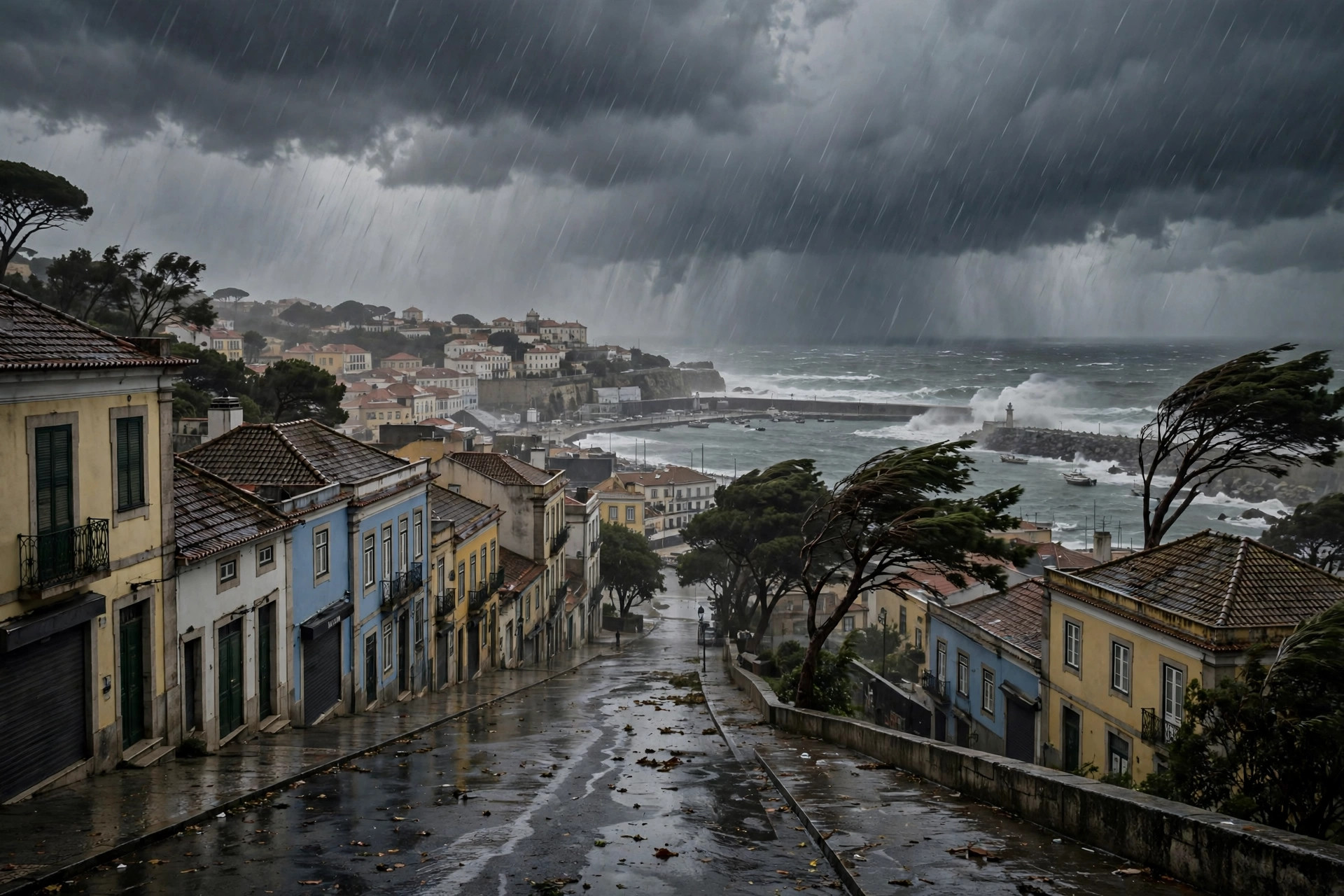
Storm Charles Portugal brought the country to a standstill on Wednesday 11 November 2026, as the Atlantic storm made landfall on the mainland with gusts above 120 km/h and forced the closure of all of Portugal's roughly 8,000 schools. It was the first time in living memory that every school in the country had shut for a storm, according to the Associated Press, and the shutdown reached far beyond classrooms. Non-essential public services closed, more than 200 flights were cancelled, and the government declared a state of alert across mainland Portugal. The storm arrived on ground already soaked by Storm Bruna, which had brought heavy rain since Sunday, and it struck Madeira first on Tuesday before turning toward the mainland and then Spain.
Storm Charles Portugal: Why All 8,000 Schools Closed
The decision to close every school in Portugal was taken by the government on Tuesday evening, before the worst of the weather arrived. Prime Minister Luís Montenegro chaired a crisis unit with eight ministers as the forecast hardened, and the government declared a state of alert for mainland Portugal. Schools at every level closed, along with non-essential public services, and people were told to stay at home unless travel was unavoidable. The Associated Press reported that it was the first time in living memory that Portugal's roughly 8,000 schools had cancelled classes nationwide over a storm forecast, a measure of how seriously the authorities took the warnings. The scale of the closure reflected two pressures at once: the strength of the wind forecast for Wednesday afternoon, and ground already saturated by days of rain. With rivers high and soils waterlogged, even rain that would normally be manageable carried a real risk of flash flooding. Closing schools removed millions of journeys from the roads at the exact hours the storm was expected to peak, and it kept children out of harm's way while emergency services dealt with fallen trees, blocked roads and flooding. The closure also sent a plain signal to the public. Portugal had been criticised in January, after Storm Kristin, for a slow official response, and the government moved early this time, choosing a blanket shutdown over a patchwork of local decisions that might have left some areas exposed.
Red Warnings, 120 km/h Gusts and Record Rain
Portugal's national weather service, IPMA, issued red wind warnings, its highest level, for multiple districts, with gusts forecast at 100 to 120 km/h and up to 140 km/h in the most exposed places. Red rain warnings were also in force across several districts as the storm drove heavy downpours onto the mainland. IPMA recorded gusts over 120 km/h as the storm came ashore, confirming that the forecast had been accurate. By mid-afternoon, only the Algarve remained on red alert, as the worst of the wind began to ease elsewhere. The red warning level is reserved for weather that poses a direct danger to life and property, and its use across so many districts at once is unusual. Wind at 120 km/h can tear roof tiles loose, bring down trees and power lines, and make driving dangerous, particularly for high-sided vehicles. Combined with intense rain on saturated ground, the gusts raised the risk of flash floods in towns and of landslides on steep slopes. The warnings were the reason behind the school closures, the suspension of non-essential public services, and the government's stay-at-home advice. They also explain why the country looked so quiet on Wednesday: with the warnings in force and the state of alert declared, streets in Lisbon and other cities were largely deserted as people waited for the storm to pass.
Madeira Hit First: 500 mm of Rain and 285 Rescue Calls
Before it reached the mainland, Storm Charles struck Madeira on Tuesday, and the island bore some of the storm's heaviest rain. A mountain station above Funchal recorded 19.8 inches of rain, about 500 mm, in 24 hours, an extraordinary total for a single day. Rescuers on the island answered 285 incidents, including 78 landslides, as the rain brought down slopes, flooded roads and trapped residents. In São Roque, a 74-year-old man was pulled alive from a flooded garage, one of the most dramatic rescues of the storm. Madeira's steep terrain makes it especially vulnerable to this kind of rainfall. Short, sharp valleys channel water downhill fast, and when half a metre of rain falls in a day, roads become rivers and hillsides give way. The 78 landslides recorded by rescuers show how widespread the damage was, and the 285 incidents in total underline how busy emergency crews were across the island. The island's experience was also a warning for the mainland. The same system that had dumped 500 mm on Madeira's mountains was heading for a mainland already wet from Storm Bruna, and the authorities used the island's ordeal to justify the scale of the mainland shutdown that followed.
Flights Cancelled and 538 Incidents as Storm Charles Portugal Made Landfall
Air travel was disrupted across the country as Storm Charles Portugal made landfall. Reuters reported more than 200 flight cancellations, while AP put the figure above 300, as airlines cancelled services in and out of Portuguese airports and passengers faced long delays. Civil Protection counted 538 weather-related incidents nationwide by midday on Wednesday, according to CNN Portugal, covering flooding, fallen trees, blocked roads and damage from the wind. Despite the scale of the disruption, no casualties were reported. The gap between the two flight figures reflects the speed at which cancellations mounted through the morning, as airlines reacted to worsening conditions and to the closure of airport operations in the worst-hit areas. The 538 incidents counted by midday show how widely the storm's effects were felt, from coastal towns facing rough seas to inland districts dealing with fallen trees and flooded roads. The absence of casualties, given the strength of the wind and the volume of rain, is the clearest sign that the early warnings and the shutdown worked as intended. People stayed home, schools were empty, and emergency services were able to reach incidents without competing with normal traffic.
Why Storm Charles Portugal Followed So Close Behind Storm Bruna
Storm Charles did not arrive out of nowhere. Storm Bruna had already brought heavy rain to Portugal since Sunday, soaking the ground and filling rivers before Charles arrived. The two storms in quick succession explain why the authorities treated Charles as a serious threat even before it made landfall: the ground could absorb little more water, so the rain Charles brought ran off fast, raising flood risk sharply. Readers can find the earlier storm's story in Storm Bruna's heavy rain in Portugal and in the account of Storm Bruna's impact on Madeira, where the island had already dealt with flooding and cancelled flights before Charles arrived. Charles was forecast to head into Spain after crossing Portugal, and Spain was already preparing for heavy rain and flooding of its own. Workers in Spain staged a general strike on Wednesday, the same day the storm arrived, adding to the disruption, as covered in Spain's general strike over the housing crisis. The back-to-back storms also fit a wider pattern of intense autumn weather in the region, and the season's storms are being watched in the context of a warming climate, as reported in the WMO's finding that the last 12 years are the warmest on record.
What Happens Next and What the Storm Leaves Behind
Storm Charles was forecast to move into Spain after crossing Portugal, carrying heavy rain and strong winds eastwards, and Portuguese authorities kept warnings in place until the system had cleared. The immediate task after the storm is clearing blocked roads, restoring power where lines came down, and checking slopes and riverbanks for damage. The longer question is what Portugal learns from a week in which two storms arrived in quick succession. In January, Storm Kristin drew criticism of the government's slow response, and in February a 70-year-old man died in Alentejo flooding after Storm Leonardo. The early, nationwide shutdown for Charles suggests the government has absorbed that criticism and now prefers to act before the weather peaks rather than after. Whether that approach becomes the standard for future storms will depend on how the damage is assessed in the coming days. For now, the numbers tell the story of a storm taken seriously: roughly 8,000 schools closed, more than 200 flights cancelled, 538 incidents by midday, and no lives lost. That is the outcome the warnings were designed to produce.