
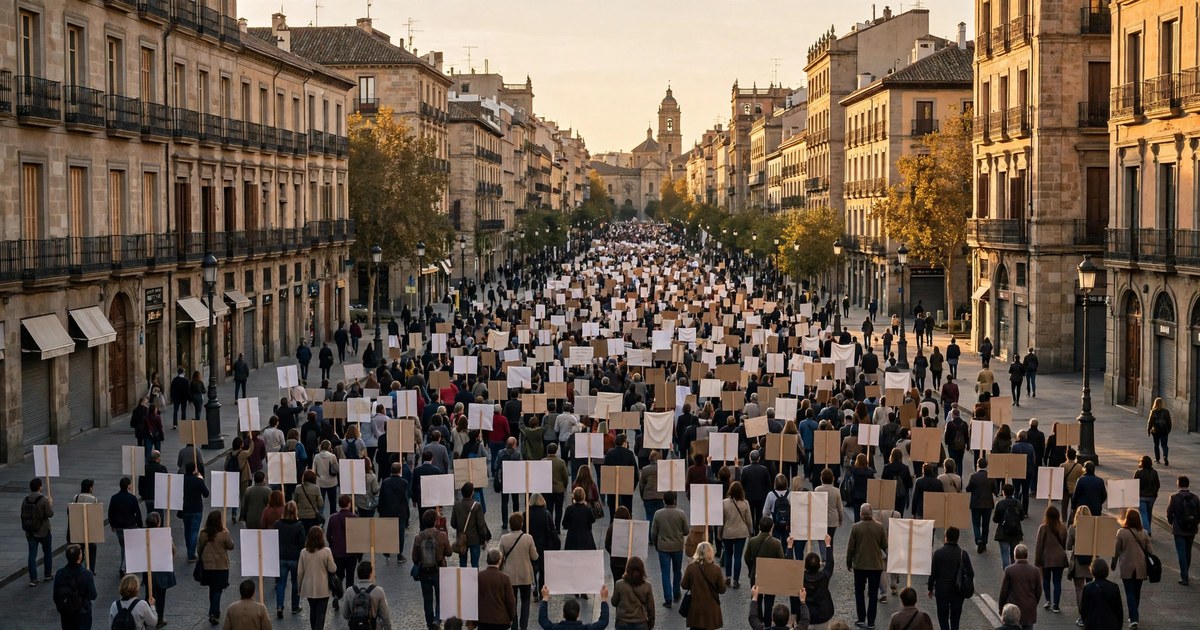
Spain came to a near-standstill on Wednesday 11 November 2026, as millions of workers joined a 24-hour general strike — the Spain general strike November 2026 — the first nationwide walkout in 14 years. Under the slogan “Salaries. Housing. Prices.”, the strike shut down businesses and public transport, disrupted schools and universities, and filled the streets of Madrid and Barcelona with tens of thousands of marchers. At its centre was not a pay dispute alone, but a housing crisis that has pushed rents beyond the reach of ordinary working households — and it landed 18 days before Spaniards vote in a snap general election on 29 November.
The walkout was called by Spain’s two largest unions, the General Union of Workers (UGT) and the Workers’ Commissions (CCOO), backed by smaller unions and tenants’ groups. It was the first general strike jointly called by the two big federations since 14 November 2012, during the austerity years of Mariano Rajoy’s government — and the first, according to the Associated Press, whose principal push came from unrest over housing rather than from a labour reform or a budget.
Spain General Strike November 2026: Why Housing, Wages and Prices Drove the Walkout
Start with the numbers behind the anger. Spain’s national statistics institute reported that its housing price index rose 12.2 percent in the second quarter of 2026 compared with a year earlier. Rents in the big cities have climbed faster still, and unions say housing costs are now swallowing wage gains as fast as workers earn them. UGT’s secretary general, Pepe Álvarez, put it bluntly: rising housing costs were absorbing the pay rises workers had won. CCOO framed the same problem from the other side — rent, mortgage payments and the savings needed for a deposit, taken together, have become the heaviest burden on a working household.
That is why the strike’s slogan puts salaries, housing and prices in one breath. The unions argue the three cannot be separated: a pay rise means little if the landlord takes it, and a rent cap means little if wages do not keep up with prices. Their case is that the housing market has become the place where the cost-of-living crisis is decided, and that after years of promises the government has not done enough to change it.
The political backdrop sharpened the message. Prime Minister Pedro Sánchez’s left-wing government had proposed emergency housing legislation, but both proposals were defeated by conservative groups in parliament. For the unions and the tenants’ groups, that defeat was the moment a protest became a strike.
Spain General Strike November 2026: What Workers Are Demanding
The unions went into 11 November with a specific list, not a vague protest. At its head is a demand for an across-the-board pay rise of between 4 and 7 percent, with mandatory inflation-review clauses — cláusulas de revisión salarial — that would automatically adjust wages when prices jump. Alongside it sits a demand for a new agreement on the minimum wage.
On housing, the demands are equally concrete: immediate rent caps in designated high-stress housing areas, known as zonas tensionadas; a crackdown on unlicensed tourist flats; a permanent, legally protected public housing reserve that can never be privatised or sold to investment funds; automatic lease renewals for vulnerable households; curbs on no-fault evictions; and limits on speculative rent rises. The unions also want stronger public services, better protection for workers’ health, and a bigger share of company profits for employees.
Not every union signed up. The civil service union CSIF and the unions USO and Fetico stayed out, and Spain’s main employers’ association, CEOE, disputed the case for the walkout. Business owners’ groups said afterwards that the strike had fallen flat. The unions said the opposite — CCOO’s secretary general, Unai Sordo, said the strike had exceeded the unions’ expectations in a country with 22 million registered workers.
What Shut Down on 11 November
The Spain general strike ran from midnight to midnight on Wednesday, and its effects were visible before dawn. About 5 percent of flights were cancelled at airports across Spain, according to the airport operator AENA. On the railways, minimum-service rules kept a skeleton service running: commuter trains were required to run at 75 percent of normal service during peak hours and 50 percent at other times, high-speed and long-distance trains at 73 percent, and medium-distance trains at an average of 65 percent. In Madrid, the Metro ran at 80 percent of its usual service during peak hours.
The unions reported heavy stoppages in industry, but their figures are their own estimates, not an independent count: they put the shutdown at 90 percent in the automotive and port sectors, 85 percent in meat processing, 82 percent in waste collection and 75 percent in energy. Schools and universities were reported closed or running with limited resources, and factories and workplaces across the country stopped or slowed. No official turnout figures had been released by the end of the day.
The marches were the most visible part of the day. Tens of thousands of workers and ordinary citizens marched in downtown Barcelona and Madrid, with gatherings in other cities, and demonstrators blocked part of Madrid’s Gran Vía. Police used pepper spray against protesters in Madrid, according to the Associated Press.
Spain’s rail network has had a difficult year, which made the transport disruption land harder: Spain’s transport minister resigned earlier in November after a train crash that killed 69 people, and the investigation into that crash pointed to a signalling failure.
The Maricarmen Eviction That Lit the Fuse
The strike did not start in a union office. It started with an eviction. Almost seven weeks before 11 November, 87-year-old Madrid resident Maricarmen Abascal was evicted from her home. Housing activists took up her case, staged a sit-in at the Puerta del Sol in central Madrid, and kept the pressure on as the government’s housing decrees were defeated in Congress. Her subsequent death intensified the outcry, and the tenants’ union, the Sindicato de Inquilinas, turned the mobilisation into a call for a general strike — winning the backing of the big unions within weeks.
That origin matters, because it explains why this strike looks different from the ones in 2012. The earlier general strikes were called by unions against government austerity. This one was driven first by tenants and housing activists, and only then adopted by the unions — a protest about where people live that became a protest about how people live.
A Strike 18 Days Before Spain’s Snap Election
The timing was no accident. Spain votes in a snap general election on 29 November 2026, for both chambers of parliament, and the Spain general strike fell 18 days before polling day, just as the election campaign was about to begin. Housing activists hope the show of force will push the next government — whichever side wins — towards stronger regulation to protect tenants. Sánchez’s government, meanwhile, is trying to mobilise its own voters ahead of the election, and the strike has put its housing record at the centre of the campaign whether it wanted it there or not.
The result is a strike with two audiences: the government of today, which is being pressed to act on rents and wages now, and the government of 30 November, which will inherit the demands whatever the result. The unions have made clear that the 11 November walkout is a warning, not a settlement.
Spain is not the only European country where workers have taken to the streets this autumn: France held a nationwide strike in November 2026, with hundreds of thousands marching for higher wages.
Why It Matters and What Happens Next
Three things will decide whether 11 November mattered. The first is the election. If housing stays at the centre of the campaign for the next 18 days, the parties will be forced to offer concrete plans — rent caps, public housing numbers, minimum wage figures — rather than slogans, and the result on 29 November will show whether voters rewarded or punished the strike. The second is the government’s response in the meantime: whether Sánchez’s administration offers new measures on rents or wages before polling day, or waits for the result.
The third is what the unions do next. A one-day general strike is a demonstration of strength, not a solution, and the demands on the table — a 4 to 7 percent pay rise, rent caps in stressed areas, a permanent public housing stock — will not be met by marching alone. If the election produces a government willing to negotiate, the strike will be remembered as the day housing became Spain’s central political issue. If it does not, the unions will have to decide whether to escalate — and Spain will find out whether 11 November was a one-off, or the start of a longer fight.
For now, the facts are these: for one day, the eurozone’s fourth-largest economy stopped to argue about the price of a home. The marchers have gone home, the trains are running again, and the question they left behind — who can afford to live in Spain — is now the question of the election.
Sources: Associated Press; Reuters; Europa Press; AENA; Spain’s National Statistics Institute; CCOO; UGT.