
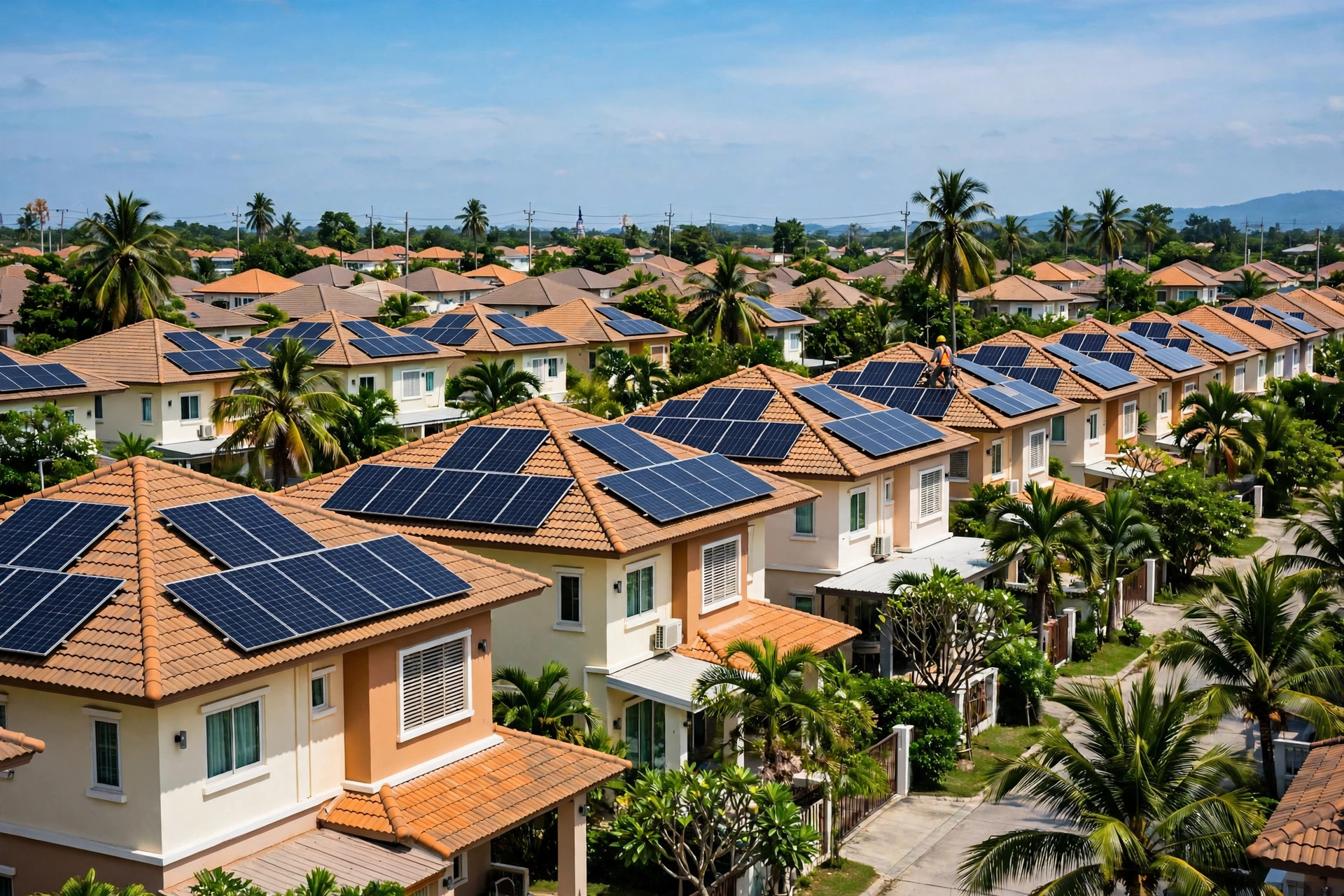
A Thailand rooftop solar subsidy worth 50 billion baht, or about 1.48 billion US dollars, was approved by Thailand's cabinet on Tuesday 27 October 2026, officials said, in one of the largest household energy schemes the country has attempted. The plan, part of the government's energy transition policy, aims to bring solar panels to one million homes over the next year, shielding households from soaring energy prices driven by the war in the Middle East and reducing reliance on imported fuel.
Each eligible household will receive a subsidy of 50,000 baht towards installation costs, Prime Minister Anutin Charnvirakul said on Tuesday. Registration runs from 27 October 2026 to 31 January 2027, or until the programme's funding is fully allocated. The government estimates the scheme could cut household electricity costs by more than 24.5 billion baht a year, a figure that, if achieved, would make it one of the most consequential energy policies in recent Thai history.
How the Thailand Rooftop Solar Subsidy 2026 Will Work
Households will sign up through the websites of the Metropolitan Electricity Authority and the Provincial Electricity Authority, which run the programme under a cabinet resolution. The grant covers equipment and installation for residential solar systems of 5 kilowatts peak to 10 kilowatts peak per meter, and can fund a new array or an addition to an existing one, which must include at least panels and an inverter. Applicants must be Thai citizens on the residential tariff, named on the meter, and can claim once.
State financial institutions will offer low-interest loans so participating households do not need to pay the full installation cost upfront. Households will use the electricity they generate and sell surplus power back to the grid. Work must be done by the electricity authorities or a vendor registered with them, tax invoices must be dated from 27 October onward, and systems must be grid-connected by 30 September 2027. A household that takes the grant cannot also claim the 200,000 baht income-tax exemption for home solar under Royal Decree No. 805.
The subsidies will be funded from the energy transition portion of an emergency decree authorising the Finance Ministry to borrow 400 billion baht. The cabinet approved the decree on 5 May 2026, and the Constitutional Court ruled it constitutional on 9 July. The solar programme therefore sits within a much larger borrowing plan, and its success will be judged alongside the other uses of that money.
Why the Thailand Rooftop Solar Subsidy 2026 Is Happening Now
Thailand's heavy dependence on imported fuel has left household bills exposed to swings in global markets, and the Iran war has pushed energy prices sharply higher. The energy minister said last month that the programme was designed to shield citizens from those soaring prices. By generating power at home, households reduce the amount of electricity they buy from the grid, and by selling surplus power they can earn income: officials have estimated that a 5-kilowatt system could bring in about 1,000 baht a month by selling unused power back to the grid.
The scale is striking when compared with what came before. Full uptake of the new scheme means 50 billion baht in grants and 5 to 10 gigawatts of panels, against 103 megawatts under the earlier household scheme, according to calculations reported from the programme's launch. That is a jump of roughly fifty to one hundred times in installed household capacity, if every slot is used. Whether demand reaches that level will depend on how quickly households can arrange installation, loans and grid connection.
What Households Need to Know Before Applying
The practical details matter. Registration opened on 27 October 2026 and closes on 31 January 2027, or earlier if funding is allocated. Applicants need to be the person named on the electricity meter, on a residential tariff, and a Thai citizen. The system must be between 5 and 10 kilowatts peak, installed by an authorised provider, with invoices dated from 27 October onward, and connected to the grid by 30 September 2027.
Households should also weigh the trade-off with the tax exemption. The 200,000 baht income-tax exemption for home solar may be worth more to higher-rate taxpayers than the 50,000 baht grant, depending on individual circumstances. The programme rules prevent claiming both, so applicants should compare the two before committing. They should also check roof condition, shading, and the terms of the low-interest loan, and confirm the buy-back rate for surplus power, which under the Metropolitan Electricity Authority's arrangement has been 2.20 baht per unit over a ten-year term.
What Happens Next for Thailand's Solar Programme
The first test is registration: how many of the one million slots are taken, and how quickly. The second is delivery: whether installers, the electricity authorities and lenders can process applications, installations and grid connections at the pace the one-year timetable requires. The third is the effect on bills and on the grid: whether household generation reduces peak demand, cuts imports, and delivers the estimated 24.5 billion baht a year in savings.
If the programme delivers, it will change Thailand's energy mix from the bottom up, household by household, rather than through a small number of large power plants. If it stalls, the reasons will likely be practical: installer capacity, loan processing, or grid-connection delays, rather than lack of interest. Either way, the coming months will show whether a subsidy of 50,000 baht per home is enough to turn a million Thai rooftops into power stations.
Thailand's Energy Imports and the Case for Home Solar
Thailand imports a large share of the energy it consumes, including natural gas and oil, which leaves household bills exposed to global price swings and to disruptions far from Thai shores. When the price of liquefied natural gas rises, or when a conflict disrupts shipping and supply, the cost flows through to electricity tariffs and to the price of fuel at the pump. Successive Thai governments have tried to reduce that exposure by diversifying supply, building gas storage and interconnections, and promoting renewables, but household demand has continued to grow with incomes, air-conditioning use and electric vehicles. Rooftop solar attacks the problem from the demand side: every kilowatt-hour generated on a roof is a kilowatt-hour that does not need to be imported, transmitted over long distances, or bought at a volatile spot price. The challenge is that solar generation peaks at midday, while household demand peaks in the evening, which is why grid connection, surplus buy-back arrangements and, eventually, household batteries matter as much as the panels themselves. The subsidy addresses the upfront cost, which is the largest barrier for most families, but the long-term success of the programme will depend on whether the grid and the market rules keep pace with a million new small generators.
Related reading: Japan energy security bills, Germany winter gas storage, Australia east coast storms.