
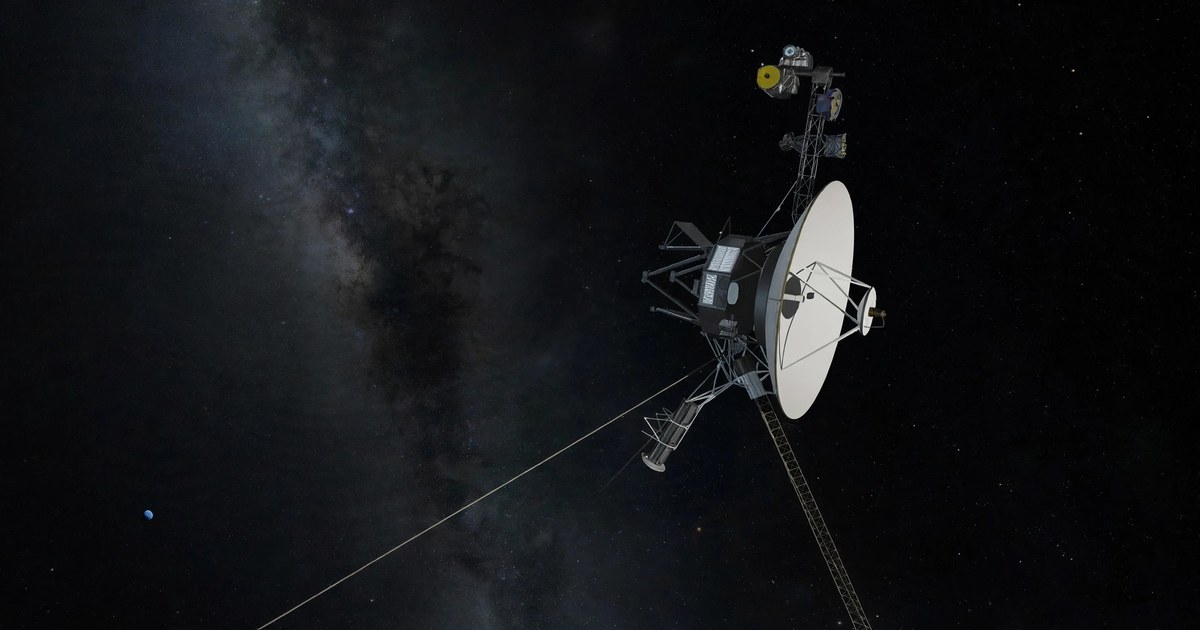
The Voyager 1 one light-day milestone is now real. NASA's farthest-travelling spacecraft crossed the mark on Wednesday, 18 November 2026, at 10:16:07 UTC, becoming the first human-made object ever to sit a full day's worth of light travel away from Earth. The distance is 25.9 billion kilometres — 16.094 billion miles, or 173.14 astronomical units — and it changes something practical about the mission. A radio signal sent from Earth now takes 24 hours to reach Voyager 1, and any reply takes another 24 hours to come back. Talking to the probe has become a two-day round trip.
What One Light-Day Means for Voyager 1
A light-day is a distance, not a time: it is how far light travels in 24 hours. Light moves at 299,792.458 kilometres per second, so a light-day works out to 25,902,068,356 kilometres, or 16,094,799,096 miles, according to NASA. Voyager 1 reached exactly that separation from Earth at 10:16:07 UTC on 18 November 2026 — 5:16:07 a.m. Eastern time, or 2:16:07 a.m. Pacific — based on the mission ephemeris from NASA's Jet Propulsion Laboratory. The German Aerospace Center, DLR, put the same moment at 11:16 CET, and NASA confirmed the date to IFLScience ahead of the crossing.
The crossing itself changes nothing on board. As one report on the milestone put it, it is a mile marker, not an event: the spacecraft feels no jolt and its instruments notice no difference. What it does change is the geometry of every conversation with Earth. At this distance, the Deep Space Network's antennas must aim at a point a full day away in light-travel terms, and every instruction the mission team sends is already a day old by the time the probe receives it.
The crossing is also permanent. Earth's distance from Voyager 1 fluctuates through the year as our planet orbits the Sun, sometimes growing and sometimes shrinking. But Voyager 1 is travelling outward so relentlessly — about 17 kilometres every second — that even when Earth starts moving back towards it, the spacecraft stays more than a light-day away, as ScienceAlert reported. In the seconds it takes to read a paragraph, the probe covers roughly the distance from Germany to New York, according to DLR.
Voyager 1 Distance From Earth: 25.9 Billion Km and Counting
Put the number in context and it is hard to picture. At 25.9 billion kilometres, Voyager 1 is more than 5.7 times as far from the Sun as Neptune, the most distant planet, according to mission figures compiled by CRV Science. It is travelling at roughly 38,000 miles per hour — about 17 kilometres per second — and it has been doing so, with only the occasional course correction, for 49 years.
The distance is still growing by about 1.5 million kilometres a day. That is why the light-day milestone arrived when it did: the probe was already within a whisker of the mark in early November, when a one-way signal took just under 24 hours. The final minutes ticked over on the morning of 18 November, and from now on the one-way light time only grows.
For scale, the Moon sits about 1.3 light-seconds away. The Sun is about 8.3 light-minutes away. Voyager 1 has now pushed the farthest edge of human reach to a full light-day — 24 light-hours — and no other spacecraft is anywhere near it. Its twin, Voyager 2, is also in interstellar space but has not reached the one light-day mark.
How Voyager 1 Talks to Earth Across a Light-Day
Voyager 1 communicates through a two-way radio system: its high-gain dish beams data to NASA's Deep Space Network antennas on Earth, and the same antennas send commands back up. With the probe now a light-day away, a command transmitted from mission control needs a full 24 hours to arrive, and telemetry confirming it arrived needs another full day to return. A single instruction and its confirmation therefore take about 48 hours — two days of signal travel alone, before any onboard processing or scheduling is counted.
That delay shapes how the mission is run. Nothing about Voyager 1 can be driven in real time. Commands are planned days ahead, and when something goes wrong the spacecraft must look after itself until the ground team can even learn about it. That is exactly what happened in October 2026: NASA reported on 29 October that Voyager 1's signal had gone missing during scheduled contact attempts on 18 and 19 October, then returned on 20 October. A set of thrusters had gone offline while backup thrusters switched on — the kind of protective behaviour the spacecraft is built to perform on its own.
The probe is also running on fading power. Forbes noted engineers are working to overcome power shortages in deep space as the mission continues, and NASA's instrument status, updated in April 2026, listed only two science instruments still active: the magnetometer and the plasma wave subsystem. The rest have been switched off over the years as the plutonium power source decays. Every watt is now rationed, and the mission team expects instruments to be switched off one by one in the years ahead as power keeps falling.
Voyager 1's Journey Since 1977: Jupiter, the Heliopause and Beyond
Voyager 1 launched on 5 September 1977 aboard a Titan IIIE-Centaur rocket from Cape Canaveral in Florida. Its twin, Voyager 2, had actually launched first, on 20 August 1977, but Voyager 1 took a faster trajectory and overtook it. The pair were built to tour the outer planets, and Voyager 1 flew past Jupiter in 1979 and Saturn in 1980, sending back the first close-up images of those worlds and their moons.
On 17 February 1998, Voyager 1 passed Pioneer 10 to become the most distant human-made object from Earth — a title it has held ever since. Then, on 25 August 2012, at a distance of about 18.2 billion kilometres from the Sun, it crossed the heliopause, the boundary where the Sun's solar wind gives way to the thin gas between the stars. It became the first human-made object to enter interstellar space. Its cameras also sent back the Solar System family portrait, the set of images that includes Earth as a tiny pale dot in a beam of sunlight.
NASA marked the light-day milestone with a public event the evening before it happened. After sunset on Tuesday, 17 November, the agency asked people around the world to point a torch at the sky and flash the probe's call sign — V-G-R — in Morse code, under the name "Shine Bright for Voyager". From the UK, the probe sits about 24 degrees up in the west-south-west after dark, just below the star Rasalgethi, according to Watch the Stars.
Where Is Voyager 1 Going Next?
Voyager 1 is heading towards a faint star called Gliese 445 in Ursa Minor, the Little Bear — also catalogued as AC +79 3888. If it keeps its course, it will pass within about 1.7 light-years of that star in roughly 40,000 years, according to NASA. Gliese 445 is itself moving towards our Sun, so by the time Voyager 1 draws level with it, the star will be only about 3.45 light-years from the Sun.
In our sky, the probe currently sits in Ophiuchus, close to the border with Hercules. It carries the Golden Record, a gold-plated disc of sounds and images from Earth, but at its present speed the next star is tens of thousands of years away. The realistic future is quieter: a slow dimming as power falls, instruments switching off, and eventually a signal too faint for the Deep Space Network to hear.
Exploration elsewhere is moving faster. Japan is preparing its MMX mission to bring back samples from the moons of Mars — a round trip measured in years, not decades — which our guide to Japan's MMX Mars moons mission covers in detail. And closer to home, SpaceX recently caught a returning Starship booster with its Mechazilla arms, as covered in our report on the Starship catch. But no mission now flying will catch Voyager 1. The probe's lead is measured in billions of kilometres and it grows every day.
Why the Voyager 1 One Light-Day Milestone Matters
The milestone matters for three reasons, and none of them is the distance itself. First, it is a hard engineering fact: a machine built in the 1970s, running on a decaying power supply, is still returning science data from interstellar space 49 years after launch. Every spacecraft built since has been measured, quietly, against that record — and none has matched it.
Second, it changes the operating reality of the mission. The 48-hour command loop means Voyager 1 is now, for practical purposes, on its own. The October signal loss showed why that autonomy matters: the spacecraft detected a thruster fault, switched to backups and waited, and contact was restored without anyone on Earth touching it in real time. Future deep-space missions — the ones that will fly farther and wait longer — will be designed around exactly that kind of self-reliance.
Third, it is a marker of how far a human artefact has ever travelled. The light-day is an arbitrary line, but crossing it makes the scale concrete in a way raw kilometres do not: there is now an object built by human hands that light itself needs a full day to reach. It will keep going. The signal will take 25 hours, then 26, and the round trip will stretch past two days. The probe will outlive its power supply and fall silent, but the distance it reached — one light-day, on 18 November 2026 — stays in the record.
Sources: NASA Jet Propulsion Laboratory (Voyager mission pages and ephemeris); USA Today; ScienceAlert; IFLScience; DLR German Aerospace Center; Watch the Stars; CRV Science; Forbes.