
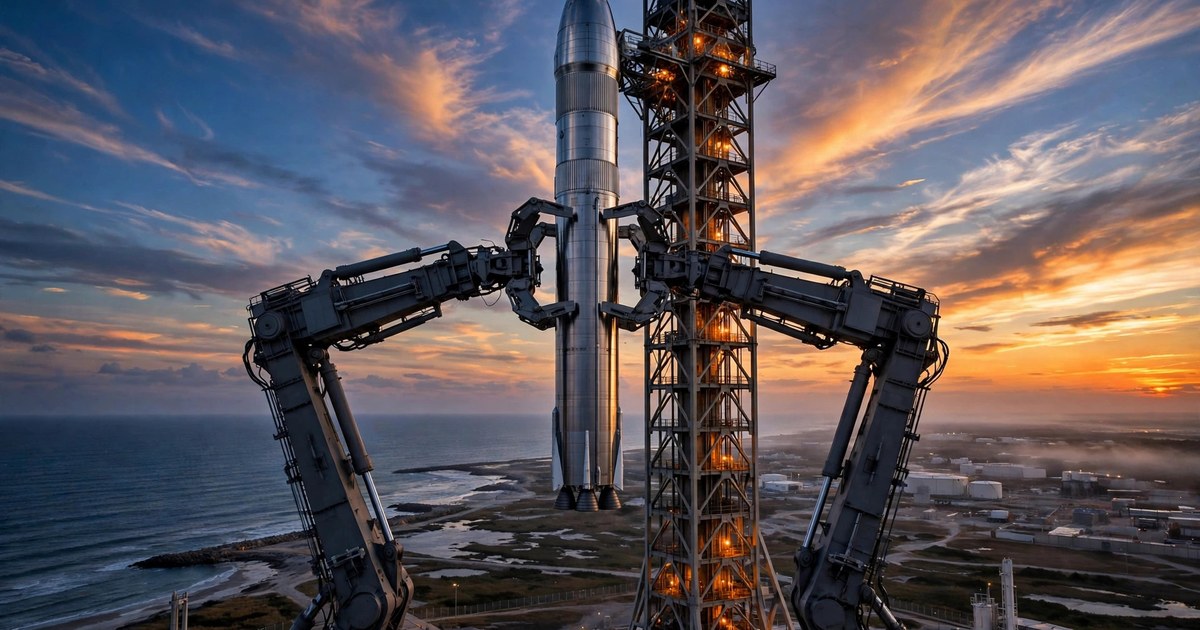
The SpaceX Starship catch on 14 November 2026 did something no rocket has ever done before. After nearly a full day in orbit, the upper stage of the world's most powerful rocket flew back to its launch site in Texas and was plucked out of the air by the giant mechanical arms of its launch tower. SpaceX summed it up in four words on X: "Mechazilla catches Starship!"
It was the payoff of a gamble SpaceX has been building toward for years: a rocket with no landing legs, no wings and no parachutes, designed to be caught like a ball in a glove. The catch worked on the first attempt. The booster that launched it did not come back, so Flight 15 ended one-for-two — but the half that mattered most, the ship itself, is now hanging in the tower at Starbase, intact.
What Happened in the SpaceX Starship Catch
Flight 15, the fifteenth integrated test flight of Starship, lifted off from Starbase in South Texas at 5:47 p.m. EST on Friday, 13 November 2026. The 33 Raptor engines of the Super Heavy booster pushed the stack toward orbit before the two stages separated, and the upper stage — Ship 42 — continued into orbit. It was the fourth launch of the redesigned Starship V3, and only the second time a Starship had reached orbit at all, after Flight 14 in September.
Ship 42 spent about 22 and a half hours in space, completing 14 orbits of Earth. During the flight it deployed 26 Starlink V3 internet satellites, and SpaceX confirmed contact with all 26 shortly after deployment. The mission was the longest Starship flight yet, and the satellite delivery showed the vehicle moving from pure testing toward doing a job in orbit. SpaceX has been scaling up its satellite business in parallel, and the Starlink network keeps growing as more satellites reach orbit; for background on how Starlink fits into the company's plans, see our report on Starlink's restoration in Ukraine after a 10-day speed cap.
The return began on Saturday afternoon with a deorbit burn of about ten seconds from a single Raptor engine, just enough to drop the ship out of orbit and onto a path back through the atmosphere. Ship 42 fell back at roughly 17,000 miles per hour, its black heat-shield tiles facing down as it used its whole body as an air brake. Then, at about 4:20 p.m. ET on 14 November, it flipped upright over Boca Chica, fired three of its six Raptor engines for the landing burn, and slid down between the tower's waiting arms at Launch Pad 2. The arms closed around it, small fittings near the top of the ship took the weight, and the engines shut down — leaving the 171-foot spacecraft hanging several hundred feet above the ground.
How the SpaceX Starship Catch Worked
The tower that caught it is about 146 metres tall, and its two arms — nicknamed "chopsticks" — ride on rails, swing inward and close like oversized tongs. The trick is that the arms never squeeze the hull. The ship carries reinforced catch pins, and those pins come to rest on rails on the arms, which take the weight and absorb the shock. The catch happens in a window measured in fractions of a second: arrive too fast, or at the wrong angle, and the tower cannot save the vehicle.
Catching the ship is a much harder problem than catching the booster, and SpaceX had already shown it could do the easier half. The Super Heavy booster separates a few minutes after liftoff, turns around and is back at the tower within minutes — SpaceX has caught it three times, the first on Flight 5 in October 2024. The ship has to finish its orbital flight first, survive re-entry at orbital speed, and only then line up with a tower in Texas. It also has to do all of this without the things every other returning spacecraft relies on. Ship 42 has no wings like the Space Shuttle, no landing legs and no parachutes, because SpaceX wants the same vehicle to land on the Moon and Mars, where there are no runways and, on the Moon, no air at all.
Instead it falls belly first, like a skydiver, steering with four flaps — two near the nose, two at the base — that work like a skydiver's arms and legs. At the last moment a short engine burn swings it vertical and slows it down, and it descends past the top of the tower into the arms. On 14 November, every part of that sequence worked on the first try.
Why the Super Heavy Booster Missed Its Catch
The double catch SpaceX wanted did not happen. Super Heavy Booster 22 was supposed to return to the tower about six and a half minutes after liftoff on 13 November. Instead it diverted toward the Gulf of Mexico and splashed down there, ending in a fiery descent that was shared widely on social media.
SpaceX said preliminary indications pointed to a low-fuel-mass warning that ended the boostback burn early, leaving the booster unable to get into position for a tower catch. Its guidance system determined it was not correctly placed and made an automated diversion to the water. Elon Musk later said on X that "slight underperformance of engines on this flight is the reason" for the diversion. SpaceX confirmed the flight termination system was triggered as the booster came down over the water, and said the underlying cause remained under investigation.
So Flight 15 ends as a split result: a historic first for the ship, a lost booster. That is not a failure of the idea — the booster catch has already been demonstrated three times — but it is a reminder that the system still has to prove it can bring both stages home on the same flight. Nobody has ever done that, and it remains the next milestone.
Why the SpaceX Starship Catch Matters for the Moon and Mars
The catch matters because reusability is the whole point of Starship. A rocket that is thrown away after one flight can never be cheap, no matter how big it is. SpaceX's plan is to catch both stages, inspect them, refuel them and fly them again quickly — the same way an airliner turns around between flights. Saturday proved the harder half of that plan is possible. What is still untested is the speed: SpaceX must still show it can turn both stages around fast enough for rapid reuse to be real rather than theoretical.
The stakes go beyond cheaper satellite launches. Starship is the vehicle NASA has hired as the lunar lander for its Artemis astronauts — the Starship HLS version will carry crews down to the Moon's surface, and it will land on legs, since no tower waits there. The same design is meant to reach Mars one day, where the thin air and lack of runways rule out wings and parachutes as a landing method. Every successful catch on Earth is a step toward that, because it proves the vehicle can be flown, recovered and flown again instead of built from scratch each time. Mars exploration is moving on other fronts too, including Japan's MMX mission to bring back a sample from the Martian moon Phobos.
There is also a simpler reason the flight drew so much attention: it worked. After years of explosions, lost ships and aborted catches, a 171-foot spacecraft came home from orbit and was caught in mid-air by a tower. The scale of SpaceX's ambitions keeps growing — the company is simultaneously planning $74 billion of AI campuses and raising tens of billions in new financing — but Flight 15 was a reminder that the rocket itself is still the centre of the story.
What Happens Next for Starship
SpaceX engineers will now inspect Ship 42 in the tower at Starbase, checking the heat shield, the flaps and the catch fittings for damage from re-entry and the catch itself. The data from the flight — the deorbit burn, the re-entry, the landing burn — will feed into the next test. The booster investigation will run in parallel, and the fix for whatever ended the boostback burn early will have to be proven before the next flight attempts another double catch.
No date has been announced for Flight 16. When it flies, the goal will be the one Flight 15 missed: both stages back at Starbase, both caught by the tower, on the same mission. Until that happens, Saturday's catch stands as the high point of the programme so far — the first time an orbital spacecraft has ever been caught out of the sky.
SpaceX Starship Catch: The Flight 15 Numbers
The flight in brief: launch at 5:47 p.m. EST on 13 November 2026 from Starbase, Texas; 33 Raptor engines on the Super Heavy booster; Ship 42 in orbit for about 22.5 hours and 14 orbits; 26 Starlink V3 satellites deployed, with contact established with all 26; a roughly ten-second deorbit burn from one Raptor; re-entry at about 17,000 miles per hour; and the catch at about 4:20 p.m. ET on 14 November 2026, using three of the ship's six Raptor engines for the final landing burn. The Super Heavy booster was lost in the Gulf of Mexico. The ship is 171 feet tall, and the full stack stands about 407 feet tall.
Sources: USA Today; Scientific American; SpaceX; CNBC; EarthSky.