
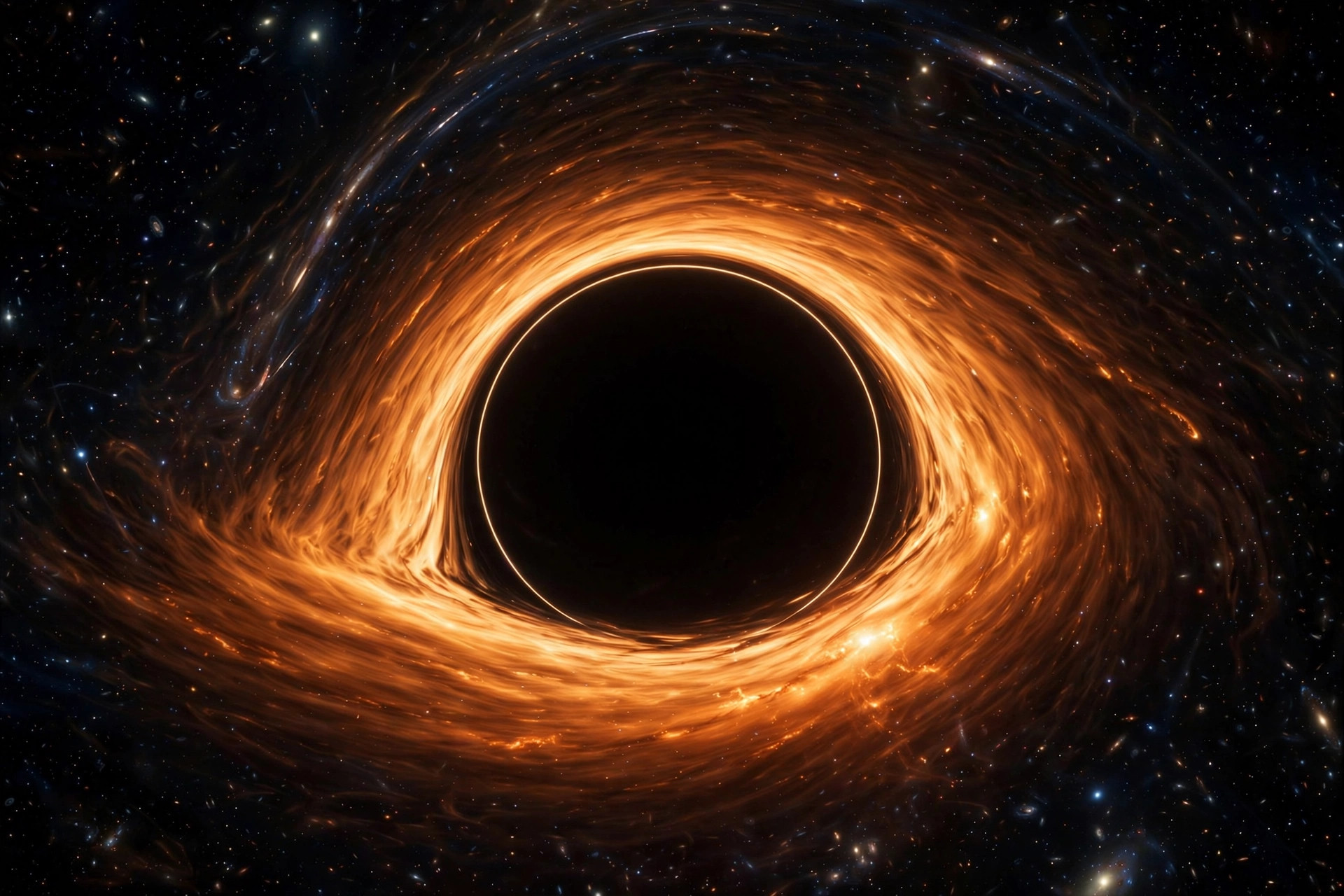
What is a black hole? It is a place where gravity has won completely. Squeeze enough mass into a small enough space, and gravity becomes so strong that nothing — not even light, the fastest thing in the universe — can escape. That is the whole idea, and everything strange about black holes follows from it.
The nearest known black hole, Gaia BH1, sits about 1,500 light-years from Earth. That sounds close on a cosmic map, and it is the closest one we know of — yet it is far too distant to ever reach us, and far too small to threaten us. This guide explains what a black hole actually is, where the point of no return lies, how these objects are born, what would happen if you fell into one, and how astronomers managed to photograph something that swallows light.
What Is a Black Hole? The Short Answer
A black hole is not a hole. It is a huge amount of matter packed into a tiny space. NASA puts it plainly: they are huge concentrations of matter packed into very tiny spaces, and the gravity just beneath the surface — the event horizon — is strong enough that nothing, not even light, can escape.
The idea goes back to Einstein's general theory of relativity, published in 1915, which describes gravity as the curvature of spacetime. Within months, the German astronomer Karl Schwarzschild worked out the first mathematical solution describing such an object. For decades, most physicists treated it as a mathematical curiosity. The term "black hole" itself only arrived in 1967, when the American physicist John Wheeler coined it.
Two common pictures of black holes are wrong. They are not wormholes or portals to other universes, and they are not cosmic vacuum cleaners. As NASA notes, they don't suck in other matter — from far enough away, their gravity behaves exactly like the gravity of any other object of the same mass. What makes them special is density: the same mass squeezed into a far smaller volume.
The Event Horizon: The Point of No Return
The event horizon is the boundary around one past which escape becomes impossible. It is not a surface you could stand on. Inside it, the speed needed to escape exceeds the speed of light, so not even light gets out. The size of the horizon — the Schwarzschild radius, named after Karl Schwarzschild — grows with its mass. For one ten times the mass of the Sun, the radius is only about 30 kilometres: about the width of a large city, holding ten Suns' worth of mass.
At the centre, general relativity predicts a singularity: a point of zero volume and infinite density where the mass is concentrated. That prediction is also a warning sign. An infinite density is where the mathematics stops making sense, which physicists take to mean that general relativity itself is incomplete at the centre of a black hole — not that we know what is actually there. Nobody has ever observed the inside of one, and by definition, no information can come back out to tell us.
Crossing the horizon itself is stranger than it sounds. General relativity says that for the falling object, crossing produces no locally detectable change — you would not feel a jolt or pass through a wall. But to someone watching from far away, your fall would appear to slow down more and more until you seemed frozen at the horizon. Both descriptions are correct; they are two views of the same event, seen from different places.
How They Form: Stellar-Mass vs Supermassive
Most are born when massive stars die. A star spends its life balancing the inward pull of its own gravity against the outward push of nuclear fusion in its core. When a star born with roughly 8 to 10 times the mass of the Sun runs out of fuel, that balance fails. The core collapses in on itself, the outer layers are blown away in a supernova explosion, and what is left behind is a black hole. The collapsed core is more than about three times the mass of the Sun; smaller stars end their lives more quietly, as white dwarfs or neutron stars. The Sun is an ordinary example of a star in balance — and its light is also what powers photosynthesis on Earth, the process plants use to turn sunlight, water and carbon dioxide into food and oxygen.
The first one anyone identified this way was Cygnus X-1, a binary system in the constellation Cygnus. Astronomers first detected its X-rays in 1964, and by 1971 they had shown the invisible companion was about 14.8 times the mass of the Sun, orbiting a blue supergiant star every 5.6 days. Stephen Hawking was so unsure that in 1974 he bet the physicist Kip Thorne the source was not one — and conceded the bet in 1990.
Supermassive ones are a different puzzle. These monsters weigh millions or billions of times more than the Sun and sit at the centres of most large galaxies, including our own. Astronomers are still not sure how they grow so large. They may have started as smaller black holes that merged over billions of years, or formed when huge clouds of gas collapsed directly, skipping the star stage entirely. A third size class — intermediate ones, between about 1,000 and 100,000 solar masses — may bridge the gap, but the evidence for them is still debated.
There is also a fourth, stranger kind. In the first moments after the Big Bang, rapidly expanding space may have squeezed some regions into miniature ones less massive than the Sun. These primordial ones, if they exist, would slowly evaporate away through Hawking radiation — a trickle of particles predicted by Stephen Hawking. Even so, evaporation takes far longer than the age of the universe for any black hole we have actually observed; stellar black holes gain mass from the cosmic microwave background faster than Hawking radiation can carry it away.
What Happens If You Fall Into a Black Hole?
This is the question everyone asks, and physics gives two answers — one from Einstein's theory, and one from quantum theory, and they disagree.
The classical picture is spaghettification. As you fall feet-first, the gravity pulling on your feet is stronger than the gravity pulling on your head, because your feet are closer to the black hole. The difference stretches you lengthways and squeezes you sideways. NASA describes it exactly that way: matter gets squeezed horizontally and stretched vertically, resembling a noodle. Neil deGrasse Tyson put it more vividly: you get extruded through the fabric of space like toothpaste through a tube. Either way, the classical theory says you would be torn apart before you reached the centre.
But a 2012 study published in the journal Nature proposed something stranger. Quantum effects, the authors argued, could turn the event horizon itself into a wall of fire that would burn you instantly — before spaghettification even began. Physicists still argue about this "firewall" idea, and there is no observation that can settle it: nobody can send a probe past the horizon and report back. Treat the firewall as a live debate, not a settled fact.
Time behaves just as oddly. As you fall, your own clock keeps ticking normally — you feel nothing special as you cross the horizon. But to a distant observer watching you, your fall appears to slow down more and more, until you seem frozen at the edge, never quite crossing it. This is gravitational time dilation, and it follows directly from the same 1939 calculation by Oppenheimer and Snyder that first described a star collapsing into a black hole: viewed from afar, the collapse seems to slow down further and further until the star appears frozen in time.
The First Photographs: M87* and Sagittarius A*
For most of their history, they were invisible by definition — they emit no light, so no telescope could photograph one. Astronomers found them indirectly: by the X-rays from gas heated as it spirals in, by stars orbiting an unseen mass, by the bending of light from objects behind them, and since 2015, by the gravitational waves released when two of them merge.
Then, in 2019, the Event Horizon Telescope — a planet-sized network of eight radio telescopes working together — released the first image of one: the supermassive black hole at the centre of the galaxy M87, 55 million light-years from Earth. The image showed a glowing ring of hot gas around a dark shadow. It weighs about 6.5 billion times as much as the Sun, yet the shadow itself is only about 38 billion kilometres across.
In May 2022, the same collaboration released the first image of the black hole at the centre of our own galaxy, Sagittarius A*. It weighs about 4 million times as much as the Sun and lies roughly 26,000 light-years away. The two photographs look similar — a dark centre ringed by light — but the objects could hardly be more different in scale: M87* is more than a thousand times heavier than Sagittarius A*. The work behind both images traces back to decades of tracking stars around our galaxy's centre, work that earned Andrea Ghez and Reinhard Genzel the 2020 Nobel Prize in Physics.
Turning the telescopes' raw data into those images took two years of work after the observations — the network produces so much data that it cannot even be sent over the internet. Finding them has always been a matter of reading indirect clues, from the orbits of stars to the bending of light. It is the same style of reasoning — drawing conclusions from patterns in data, rather than from direct sight — that sits behind modern AI systems, which learn by finding patterns in huge amounts of data instead of following hand-written rules.
What Is a Black Hole in Numbers?
| Black hole | Figure | Source |
|---|---|---|
| Nearest known — Gaia BH1 | About 1,500 light-years away | NASA |
| Biggest known — TON 618 | 66 billion times the Sun's mass | NASA |
| Lightest known — unnamed, paired with a star | 3.8 times the Sun's mass | NASA |
| Our galaxy's centre — Sagittarius A* | About 4 million solar masses; about 26,000 light-years away | NASA / Space.com |
| First photographed — M87* | 6.5 billion solar masses; 38 billion km across; image released 2019 | Britannica / Space.com |
| Fastest spinner — GRS 1915+105 | Over 1,000 rotations per second | NASA |
| Milky Way total | Over 100 million black holes | Space.com |
Can a Black Hole Swallow Earth?
No — and the reason is simple arithmetic about distance and gravity.
The nearest known black hole, Gaia BH1, is about 1,500 light-years away. Light itself takes 1,500 years to cover that distance; nothing that could harm us is coming from there. And they do not reach out and grab things. Their gravity at a distance is no stronger than the gravity of any other object of the same mass. If the Sun were suddenly replaced by a black hole of the same mass, Earth would keep orbiting exactly as it does now — it would just get very cold and dark.
Earth's real dangers are closer to home and far less exotic. The threat actually reshaping the planet right now is not a black hole but climate change — the long-term shift in Earth's climate driven by greenhouse-gas emissions. That is a danger we can measure, and one we can still limit.
Why They Matter
Black holes matter because they are where our best theory of gravity meets its limits — and where new physics must be hiding. Every photograph, every gravitational-wave detection, and every star orbit tracked around Sagittarius A* is a test of general relativity in conditions no laboratory can reproduce. So far, Einstein's theory has passed every test. The singularity at the centre, where the theory predicts infinite density, is the one place it visibly fails — and that failure is itself a clue, pointing toward a deeper theory that unites gravity with quantum mechanics.
They also matter for a simpler reason: they are the most extreme objects we know, and they anchor the galaxies we live in. Most Milky Way-sized galaxies have a supermassive one at their centre, and ours is no exception. The Milky Way may hold anywhere from 10 million to a billion stellar black holes, with the vast majority never directly seen.
The next steps are already underway. Astronomers expect to photograph more of them in the coming years, building a collection of images rather than just two. Each new image, each new merger detected, and each new orbit measured narrows the gap between what Einstein's theory predicts and what the universe actually does. A century after black holes were first written down as mathematics, they have become something we can see — and the seeing has only just begun.