
What is launching, and when
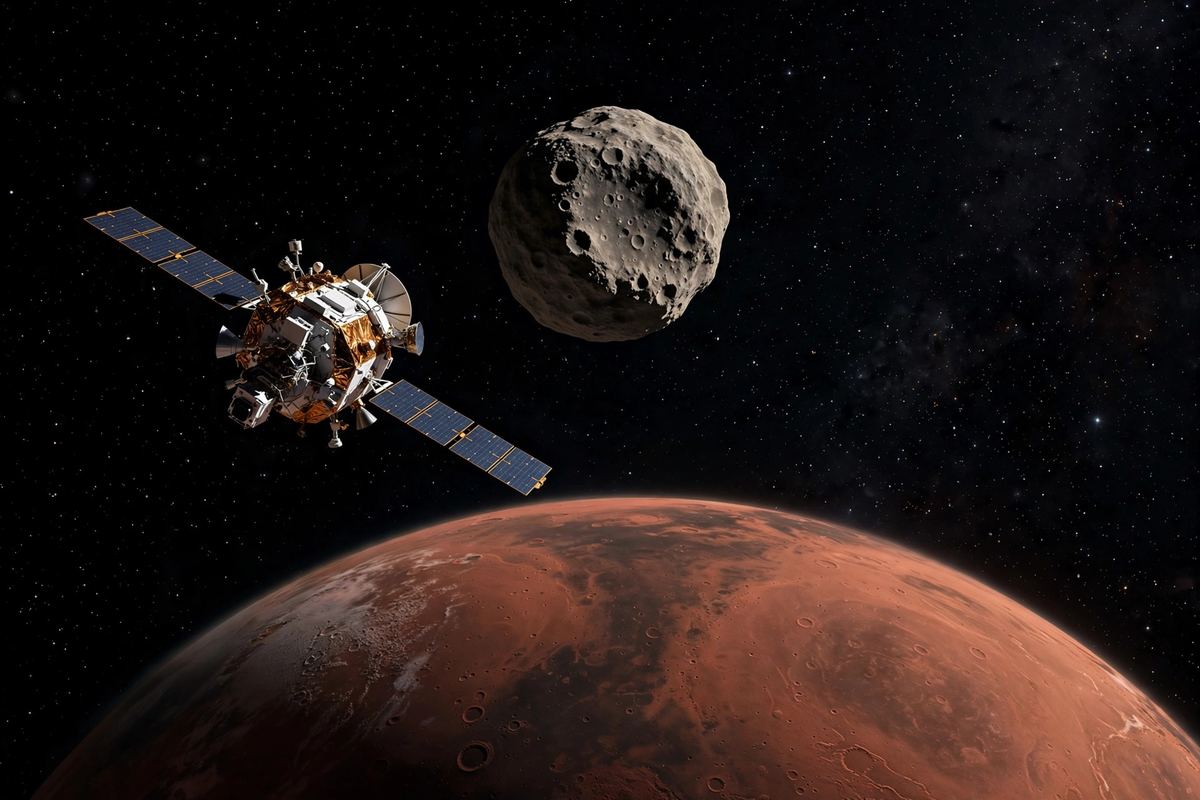
A spacecraft is about to set out on one of the most ambitious sample-return missions ever attempted. Japan's Martian Moons eXploration (MMX) mission, led by the Japan Aerospace Exploration Agency (JAXA), is scheduled to launch on Monday, October 19, from JAXA's Tanegashima Space Center in Japan. NASA, which is supporting the mission, held a briefing on October 15 to explain what MMX will do and why it matters. The mission's goal is to visit Mars, study its two small moons, Phobos and Deimos, land on Phobos, collect a sample of its surface, and bring that sample back to Earth. If it succeeds, it will be the first time material from a Martian moon has been returned to laboratories on Earth.
Update — launch success: the mission launched successfully. JAXA's H3 rocket lifted off from Tanegashima at 4:41 a.m. Japan time on 20 October 2026 (19:41 UTC on 19 October), and the MMX spacecraft separated about 71 minutes later on course for Mars, with JAXA confirming the rocket flew as planned. The spacecraft is now on its roughly ten-month cruise, with arrival at Mars planned for August 2027 and the Phobos sample due back on Earth in 2031.
The timeline is long by human standards and short by interplanetary ones. If the mission launches on schedule, the MMX spacecraft would arrive at Mars by August 2027, about ten months after launch. It would then spend more than a year surveying the moons from orbit before landing on Phobos in December 2028 and collecting a sample. The return journey would bring the sample capsule back to Earth by 2031, according to NASA. Five years from launch to sample delivery is a long time to wait, but it is the nature of planetary science: the distances are vast, the windows for launch and return are narrow, and the spacecraft must do its work with no possibility of repair.
The mission builds on Japan's remarkable record in sample return. JAXA's Hayabusa missions visited asteroids and brought back grains of material, demonstrating the precise navigation and sampling techniques that MMX will rely on. MMX is a step up in ambition: instead of a tiny asteroid, its target is a moon of another planet, and instead of a brief touchdown, it must operate in the Martian system for years. The mission is also a partnership: NASA is contributing instruments and expertise, and scientists from several countries are involved in planning the observations and analysing the eventual sample.
The mystery of Mars' moons
Mars has two moons, and both are strange. Phobos, whose name means "fear" in Greek, is the larger of the two, and it orbits Mars three times a day, closer to its planet than any other moon in the solar system is to its planet. Deimos, meaning "dread," is smaller and farther out, and it is drifting ever outward, so slowly that it will eventually leave Mars' orbit entirely. Phobos is moving in the opposite direction: Mars' gravity is drawing it about 6 feet closer every century, and within about 50 million years it is expected to either crash into Mars or break up into a planetary ring like Saturn's. The moons are small, dark, cratered and irregular, more like asteroids than like Earth's Moon.
That resemblance is the heart of the mystery. Scientists suspect that the moons could be one of two things. They could be the remnants of something that crashed into Mars early in its history, throwing debris into orbit that coalesced into moons. Or they could be asteroids that wandered too close to Mars and were captured by its gravity. The two stories imply very different histories for Mars and for the inner solar system. If the moons are impact debris, they are made of Martian material, and their composition should resemble Mars' crust. If they are captured asteroids, they are made of primitive material from the outer solar system, and they could contain water and organic compounds that were delivered to the inner planets billions of years ago.
MMX is designed to settle that question. The spacecraft will survey both moons, including studying the elemental composition of Phobos' surface, to determine their origin and evolution. But remote sensing can only go so far: the decisive evidence will be the sample. By bringing a piece of Phobos back to Earth, scientists can analyse it with instruments far too large and sensitive to fly on a spacecraft, and they can compare its chemistry, isotopes and minerals with those of Mars, asteroids and meteorites. A single handful of Phobos dust could rewrite the history of the Martian system. For readers who want the background on how the solar system works, the guide to Earth's continents is a reminder of how much planetary science begins at home.
How the mission will work
The MMX spacecraft is a sophisticated machine. It will enter orbit around Mars, then make close flybys of both moons, mapping their surfaces in detail and measuring their composition with spectrometers. The landing on Phobos is the most delicate phase: Phobos has very weak gravity, so the spacecraft must approach slowly, touch down gently, and collect a sample without bouncing off or kicking up debris that could damage it. The sampling mechanism is designed to gather material from the surface and from slightly below it, because the subsurface may be less altered by space weathering. The sample will be sealed in a capsule, and the spacecraft will leave Mars orbit for the long journey home.
The return is as challenging as the arrival. The capsule must survive re-entry into Earth's atmosphere at interplanetary speed, protected by a heat shield, and land in a designated recovery zone. Japan's earlier Hayabusa missions proved the concept, but MMX's capsule will carry material from a different world, and the recovery team will treat it with the same care as a sample from Mars itself, because of the possibility, however remote, that it could contain Martian material. Planetary protection protocols require that the sample be handled in a clean facility to prevent contamination in either direction: Earth microbes must not contaminate the sample, and any Martian material must not escape into Earth's environment.
The science does not stop with the sample. MMX will also study the Martian atmosphere and the space environment around Mars, contributing to our understanding of how the planet lost most of its atmosphere and water. That knowledge feeds into the broader question of whether Mars was ever habitable, and whether it could be again. The mission's observations of Deimos, which it will not land on, will still provide the best data ever collected on that small, mysterious moon. The 2026 Nobel Prizes included work that shows how fundamental science, pursued patiently over years, eventually transforms what we know.
Why it matters
MMX matters for three reasons. The first is pure science: it will answer a question that has puzzled astronomers since Phobos and Deimos were discovered in 1877. The second is practical: understanding Phobos and Deimos helps plan future human missions to Mars, because the moons could serve as staging posts, sources of water or even hazards to navigation. A moon that is spiralling toward its planet is a reminder that the Martian system is dynamic, not static. The third is inspirational: a mission that lands on a moon of another planet and brings a piece of it home is a demonstration of what careful engineering and patient science can achieve, and it will inspire a generation of students in Japan and around the world to study science and engineering.
The mission also matters because it shows how space exploration is becoming a genuinely international enterprise. JAXA leads MMX, NASA supports it, and scientists from Europe and elsewhere are involved. The sample, when it returns in 2031, will be shared with laboratories around the world, just as Apollo's lunar samples were. That model of cooperation is the opposite of the space race: it treats the exploration of the solar system as a common human project. At a time when geopolitics often seems to be pulling countries apart, a spacecraft built by one nation, supported by another, and studying a world that belongs to no one is a quiet reminder of what cooperation can do. The role of artificial intelligence in modern spacecraft navigation is one of the technologies making such missions possible.
What happens next
The launch milestone has passed: MMX lifted off on 19–20 October and is now cruising toward Mars. The arrival in August 2027 will be the next major event, followed by the survey phase and the landing, with the sample return in 2031 as the payoff. If the launch succeeds, the spacecraft will begin its cruise to Mars, with a series of checkouts and course corrections along the way. The arrival in August 2027 will be the next major event, followed by the survey phase and the landing in December 2028. The sample return in 2031 is the payoff, but the mission will produce science throughout its journey. For anyone who has ever looked up at the night sky and wondered about the red planet, MMX is a reason to keep watching: a small, dark moon is about to give up its secrets.