
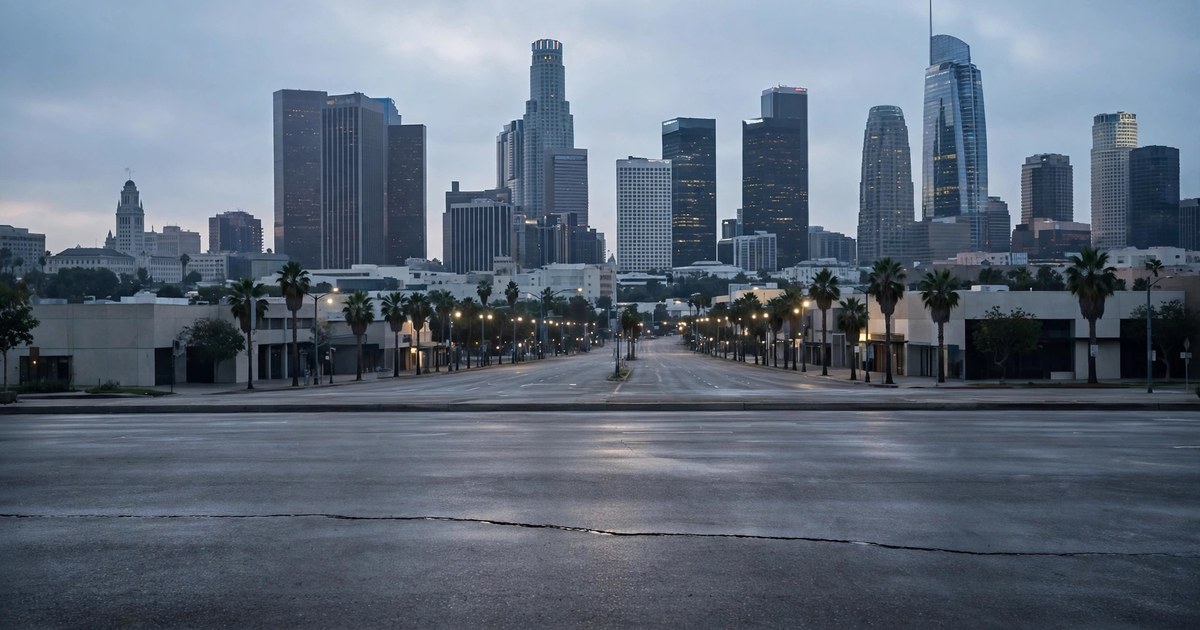
The Los Angeles earthquake woke much of the city in the middle of the night, after a magnitude 4.4 tremor struck just east of downtown Los Angeles at 3:25 a.m. on Friday, 20 November 2026. The United States Geological Survey (USGS) put the epicentre about 1 kilometre north-northwest of Commerce, roughly 5 miles east-southeast of downtown Los Angeles, at a depth of about 17 kilometres. Within minutes, thousands of people across the Los Angeles basin were reporting the shaking, and by early morning the USGS had logged more than 7,500 "felt" reports from residents. It was the second earthquake to hit California that night: a stronger magnitude 5.1 quake had shaken Monterey County hours earlier.
What happened in the Los Angeles earthquake
The quake struck at 3:25 a.m. Pacific time, when most of Los Angeles was asleep. The USGS lists the event (ci41364111) at magnitude 4.4, with its epicentre 1 kilometre north-northwest of Commerce, a city in south-east Los Angeles County, and a depth of 17.1 kilometres, or about 10.6 miles. Weather.com, which first reported the shaking, described it as a preliminary 4.4 magnitude tremor and called the story developing. Early figures moved in the first minutes after the event, with some outlets reporting 4.2, as seismologists refined the measurement — a normal pattern for a quake of this size, and one reason the USGS figure is the one to trust.
Social media filled up within minutes with posts from people who had been jolted awake, according to weather.com, and the shaking was reported across the greater Los Angeles area. As of the first hour, no reports of major damage had surfaced, and the picture was still developing, with officials yet to complete their checks. That is typical for a quake of this size: strong enough to wake a city, usually not strong enough to damage modern buildings.
How strong was the Los Angeles earthquake — and how widely was it felt?
A magnitude 4.4 earthquake is classed as moderate. It is felt widely near the epicentre, can rattle dishes and windows, and can knock small objects off shelves, but it rarely causes major structural damage. The strongest shaking reported to the USGS reached intensity 4.1 on the felt scale, which corresponds to light-to-moderate shaking — noticeable indoors, with hanging objects swinging and parked cars rocking slightly.
What made the Los Angeles earthquake stand out was not its power but its address. The epicentre sat almost underneath one of the most densely populated parts of the United States, about 5 miles from downtown Los Angeles, so millions of people were within a few dozen kilometres of it. The USGS "Did You Feel It?" system had collected 7,557 felt reports by the morning, a number that kept climbing as more people woke up and logged what they had felt. A quake of the same size in a remote desert would barely register; under Los Angeles, it becomes a city-wide alarm clock.
California's second earthquake of the night: the 5.1 near Pinnacles
Hours before Los Angeles shook, California had already had a bigger quake. A magnitude 5.1 earthquake struck near Soledad in Monterey County at 10:49 p.m. Pacific time on Thursday, 19 November, according to Reuters, citing the USGS. Its epicentre was about 20 kilometres from Soledad and about 40 kilometres from Salinas, at a depth of 6.7 kilometres. The USGS first estimated the quake at magnitude 5.4 and later revised it down to 5.1.
The two quakes were separate events in different parts of the state, hours apart, and neither the USGS nor any outlet had linked them by the morning. But together they made for an unusually shaky night in California — and they explain why "earthquake" was trending across search engines before dawn. November has been a busy month for earthquakes worldwide: a magnitude 5.7 quake near Hamamatsu in Japan injured at least 22 people, a magnitude 5.1 quake struck south of Moíres in Crete, and a magnitude 5.7 quake rattled Romania.
Why Los Angeles shakes: the faults beneath the city
Los Angeles sits above a web of active faults, and quakes in the magnitude 4 range are a regular feature of life there. The basin has been restless in recent months: in September, USGS data logged about 90 small quakes, magnitudes 1.0 to 2.7, clustered around Lennox and Westmont in South Los Angeles along the Newport-Inglewood Fault Zone, and in May 2026 a magnitude 5.5 quake struck 79 kilometres west-southwest of Los Angeles at a depth of 35 kilometres.
No single fault had been publicly blamed for Friday's quake in the first hours after it struck, and that is normal: pinpointing the fault takes time, and several faults run through the area east of downtown. What matters for residents is the pattern, not the name. The Los Angeles basin is crossed by faults that can produce damaging quakes, and every moderate shake is a reminder that the next one could be bigger. That is why seismologists treat a 4.4 under a city of millions as more than a curiosity, even when it causes no damage.
Los Angeles earthquake aftershocks: what to expect next
Smaller aftershocks are common after a magnitude 4.4 earthquake and can follow over hours and days, most of them smaller than the main shock. A few may be felt, especially close to the epicentre, and the sequence usually fades over days to weeks. The USGS updates its event page as new aftershocks are recorded, and that page, along with local emergency channels, is the best place to check for the latest figures rather than social media, where early magnitudes often linger long after they have been revised.
Anyone who felt the Los Angeles earthquake can help seismologists by filing a "Did You Feel It?" report with the USGS. The thousands of reports already filed are what let scientists map how far the shaking travelled and how strongly different neighbourhoods felt it.
What to do after an earthquake in Los Angeles
If shaking starts again, the standard advice is Drop, Cover, and Hold On: get under a sturdy table, cover your head and neck, and hold on until the shaking stops. Stay away from windows and heavy objects that could fall. Once the shaking stops, check yourself and those around you for injuries, then check your home for damage, paying attention to gas smells, water leaks and cracks in walls. Do not use lifts until they have been checked, and keep phone lines free for emergencies, using text messages rather than calls where possible.
It is also worth using the moment to check your own readiness. Keep a torch and sturdy shoes by the bed, keep a small emergency kit with water and medicines, and know how to turn off your gas and water. Los Angeles runs earthquake drills for a reason, and a 3:25 a.m. wake-up call is the cheapest possible reminder to take them seriously.
Why it matters and what happens next
The Los Angeles earthquake caused no confirmed major damage in its first hour, but its significance is not measured in damage. A magnitude 4.4 quake directly under the second-largest city in the United States, at a depth of 17 kilometres, is a live test of everything the city has built for the next big one: its building codes, its early-warning system, and its residents' reflexes. Through the morning, officials will survey bridges, buildings and infrastructure around Commerce and downtown, the USGS will refine its magnitude and depth figures, and the aftershock count will grow.
For the millions who were woken at 3:25 a.m., the quake is also a prompt. The next earthquake in Los Angeles will not send a warning, and it will not wait for office hours. Checking the USGS page, filing a felt report and refreshing a household emergency kit take minutes, and a quiet Friday morning is the best time to do them. Sources: United States Geological Survey (USGS) Earthquake Hazards Program; weather.com; Reuters.