
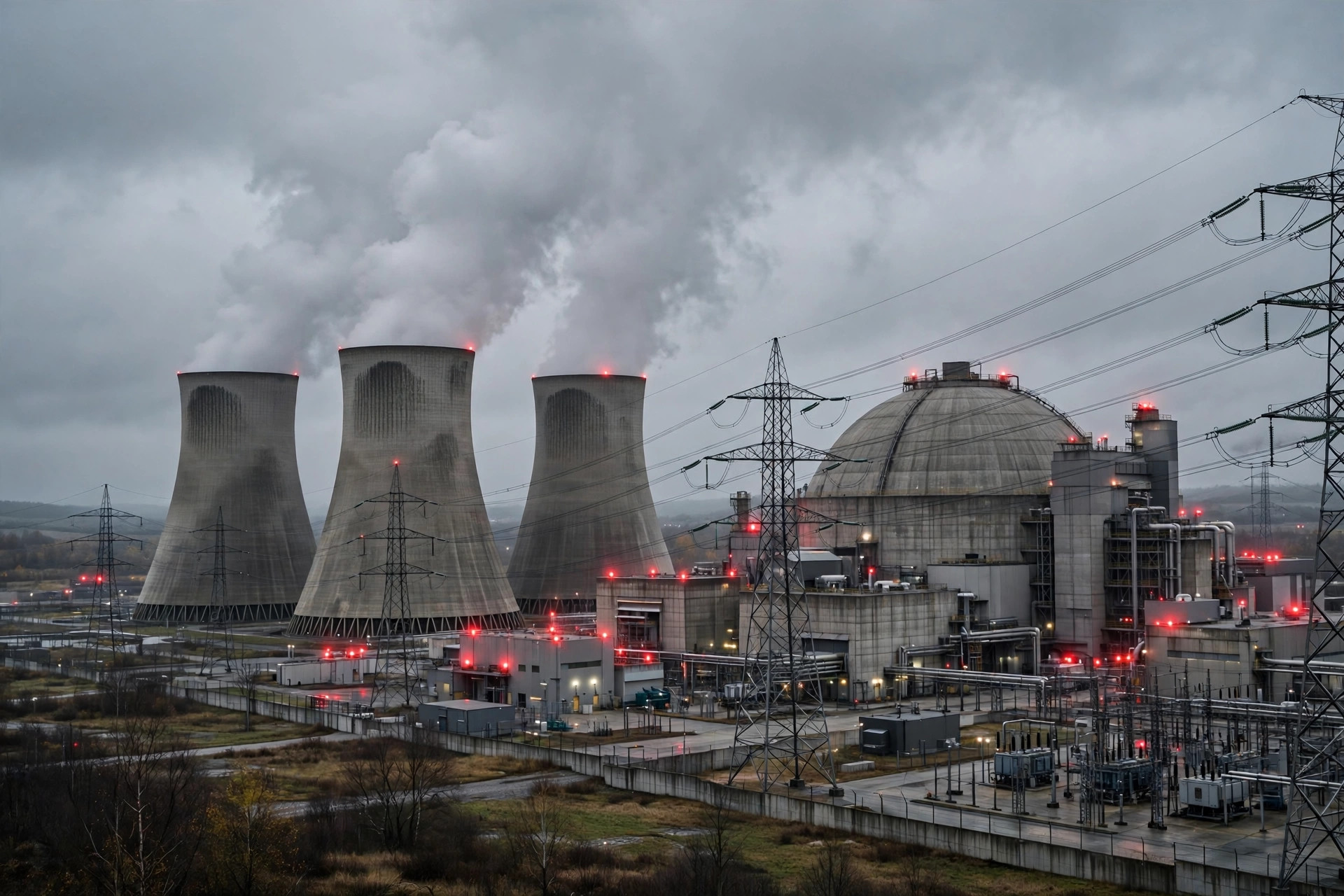
Early on Sunday 8 November 2026, the Zaporizhzhia nuclear plant lost its connection to the outside electricity grid, leaving Europe's largest nuclear facility to run on emergency diesel generators. The Zaporizhzhia nuclear plant November 2026 power cut was the 27th time the plant had lost all offsite power since the conflict began, according to the International Atomic Energy Agency (IAEA), and it ended the same day when the plant's only remaining power line was switched back on.
Ukraine's nuclear operator, Energoatom, said the 330 kV Ferosplavna-1 line was switched back on at 17:41 on 8 November, reconnecting the plant to Ukraine's grid. The IAEA said the cause of the disconnection and the place where it happened were not yet known. The plant's Russian-installed management said automatic protection systems had disconnected the line and that radiation levels remained normal.
What happened at the Zaporizhzhia nuclear plant November 2026
The Ferosplavna-1 line was the plant's only remaining offsite power line. When it disconnected early on Sunday, the plant lost its external electricity supply in full and switched to emergency diesel generators to keep reactor cooling and essential safety systems running, the IAEA said. A nuclear plant's reactors need cooling even when they are shut down, because the fuel inside them keeps producing heat, and the safety systems that move water, monitor the reactors and control the plant all run on electricity.
The plant had already been running on a single line. Its main power line, the Dniprovska line, has been unavailable since at least 23 October, the IAEA said, which left Ferosplavna-1 as the only link between the plant and the grid. That single point of failure is what turned a line disconnection into a complete loss of offsite power.
Power returned the same day. Energoatom said the Ferosplavna-1 line was switched back on at 17:41 on 8 November, and the plant was reconnected to Ukraine's grid, according to a report by Ukrinform. The gap between the early-morning loss and the evening restoration was measured in hours, not days, and the diesel generators covered the plant's safety needs in between.
Background: Europe's largest nuclear plant under occupation
The Zaporizhzhia plant is Europe's largest nuclear facility. It has six VVER-1000 reactors with a combined capacity of 6,000 MW. All six reactors are shut down as a precaution, but a shut-down reactor still needs power for cooling and for safety systems, which is why a loss of offsite power is treated as a serious event even when nothing is generating electricity.
The plant has been under Russian control since the early weeks of the 2022 invasion of Ukraine. It sits on the front line of the war, and its power lines cross contested ground, which is why they have been cut so often. The IAEA has kept inspectors at the site and reports on its condition, and its director general, Rafael Grossi, has repeatedly called the situation fragile.
The danger around the plant is not only to its wires. On 3 November, a drone strike killed two people in a car, including a plant employee, Reuters reported. That death was the third plant employee killed in two weeks and the 13th since April, according to Reuters. The figure shows that the people who keep the plant running are themselves at risk, on top of the risk to the plant's power supply.
Why the Zaporizhzhia nuclear plant November 2026 outage matters
A single loss of offsite power is manageable. A nuclear plant is built with diesel generators for exactly this case, and the generators at Zaporizhzhia did their job on 8 November. The problem is repetition and time. Each loss tests backup equipment that was designed for rare emergencies, and each one burns diesel that has to be brought in and stored on site.
The IAEA said fuel reserves at the plant were enough to run a limited number of emergency diesel generators for about two weeks. Two weeks is a real limit, not a comfort margin, and it is one reason Grossi stressed the need to restore grid electricity and to increase diesel reserves at the plant. A longer outage, or a second fault while the grid was down, would have put that limit to the test.
The 27th loss also matters because it shows how thin the plant's margin has become. With the Dniprovska line out since at least 23 October, the plant depended on one line, and when that line went down there was nothing left between the reactors and their diesel generators. The restoration on 8 November fixed the immediate problem, but it did not fix the single-line dependence.
Key facts about the Zaporizhzhia power loss
- Early on Sunday 8 November 2026, the Zaporizhzhia plant lost its external electricity supply after the 330 kV Ferosplavna-1 line disconnected, the IAEA said.
- Ferosplavna-1 was the plant's only remaining offsite power line; the main Dniprovska line has been unavailable since at least 23 October.
- The plant switched to emergency diesel generators for reactor cooling and essential safety systems.
- It was the 27th complete loss of offsite power at the plant since the conflict began, according to the IAEA.
- The IAEA said the cause and location of the disconnection were not yet known.
- Energoatom said the Ferosplavna-1 line was switched back on at 17:41 on 8 November, reconnecting the plant to Ukraine's grid.
- The IAEA said fuel reserves were enough to run a limited number of emergency diesel generators for about two weeks.
- The plant has six VVER-1000 reactors totalling 6,000 MW, all shut down as a precaution, and has been under Russian control since the early weeks of the 2022 invasion.
- Russian-installed plant management said automatic protection systems disconnected the line and radiation levels remained normal.
- On 3 November, a drone strike killed two people in a car, including a plant employee, Reuters reported, the third plant employee killed in two weeks and the 13th since April.
What happens next at Zaporizhzhia
The first question is why the Ferosplavna-1 line disconnected. The IAEA said the cause and location were not yet known, and its inspectors at the site are the most likely source of an answer. Until the cause is known, the same fault could recur, and the plant will keep running on a single line while the Dniprovska line stays out.
The second question is the Dniprovska line itself. It has been unavailable since at least 23 October, and its repair would give the plant a second connection and a real margin again. Grossi's call to restore grid electricity and increase diesel reserves points in the same direction: the plant needs both a working grid link and enough fuel to cover a longer outage.
Readers following the wider war can also read our coverage of Russia's missile attack on Kyiv and Iran lifting its missile range limit for the context around the fighting that keeps putting the plant's power lines at risk.
Sources
Reuters via SRN News; International Atomic Energy Agency (IAEA); Energoatom via Ukrinform. November 2026.