
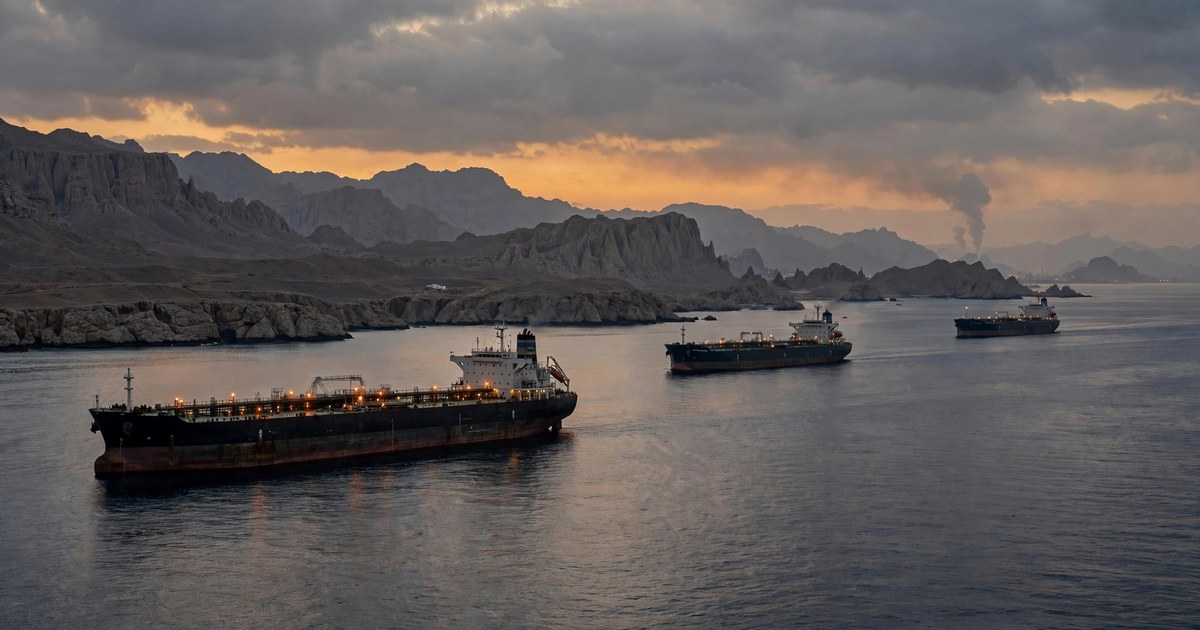
Three tankers hit mines in the Strait of Hormuz on Saturday, 14 November 2026, and caught fire, Iran's navy and the Revolutionary Guards said — the latest strike on shipping in the waterway at the centre of the war between the United States and Iran. The claim, carried by Iranian state media and reported by Reuters, has not been independently confirmed, and the United States military has dismissed it as false. No vessel has been named, no flag or cargo has been disclosed, and no casualty figure has been given. What is not in doubt is the setting: the strait is the narrow channel through which a large share of the world's seaborne oil must pass, and shipping through it has already fallen by about two-thirds since the war began in February.
What Happened: Three Tankers Hit Mines in the Strait of Hormuz on 14 November
According to the Iranian accounts, the incidents came in two parts. One tanker hit a naval mine in the eastern Strait of Hormuz on Saturday morning and was left burning and unable to move, Iran's conventional navy said. Two more struck mines later in the day in the south of the strait, exploding and bursting into flames, according to the Revolutionary Guards navy. One of the two was a supertanker, and the Guards said its flames lit up the shore at night. The Guards said both evening tankers had switched off their navigation and automatic identification systems and were trying to cross on a route Tehran had not authorised. Two other tankers approaching the strait turned back after warnings from the Guards' maritime traffic control centre. Iran's navy warned that any vessel entering the restricted zone east of the strait would meet the same fate.
The sequence matters because it is not the first of its kind. Less than a day earlier, on Friday 13 November, Iran said a tanker carrying liquefied natural gas struck a mine and exploded in the same waterway. A week before that, on the night of 7–8 November, the Revolutionary Guards said two tankers hit mines and caught fire in the strait. Saturday's report extends a campaign that has now produced a new incident almost every week.
What Iran Claims — and What Is Not Confirmed
The first thing to be clear about is that almost everything in this story comes from one side. The incidents were reported by Iranian state television and the IRNA news agency, citing statements from the Revolutionary Guards navy and the Iranian Armed Forces navy. Reuters, which carried the report, said it could not immediately verify it. The UK Maritime Trade Operations centre, which monitors shipping in the region, had not confirmed the incidents at the time of publication. No owner, operator or flag state has confirmed the Iranian account, and no independent source has identified the vessels, confirmed casualties, or established who laid any mines, or where they were placed.
Even the tally is disputed. While Reuters reported three tankers on Saturday, Al Jazeera counted five tankers hit around Hormuz in 24 hours, and Iranian statements have given different totals. The United States military has gone further than withholding confirmation. US Central Command dismissed Tehran's claims as "false" and "another example of their lies and efforts to intimidate", and says its forces have cleared the main shipping routes through the strait of mines. CENTCOM's commander, Admiral Brad Cooper, said on 30 October that Iranian naval forces had effectively vanished from the strait after months of American strikes. Tehran answers that the American claims are themselves untrue: Revolutionary Guards spokesman Brigadier General Hossein Mohebbi said on 9 November that claims of US control over the strait and of mine clearance were "sheer lies", and that the strait was "completely closed". The two sides cannot both be right, and at the time of writing neither claim can be checked independently.
What can be checked is the framework Tehran says it is enforcing. Under regulations issued on 26 October, every vessel passing through the strait must obtain permission and follow the coordination of the Revolutionary Guards' Maritime Traffic Control Center — the rule Iran says the three tankers broke. That is the legal basis, in Tehran's telling, for treating unauthorised transits as targets rather than accidents.
Why the Strait of Hormuz Matters for Oil
The Strait of Hormuz links the Persian Gulf with the Gulf of Oman and is the only sea route out for the oil of Saudi Arabia, Iraq, Kuwait, the United Arab Emirates, Qatar and Iran itself. At its narrowest it is about 21 miles wide, and roughly a fifth of the world's seaborne oil — and a fifth of its traded liquefied natural gas — passes through it. That is why a mine claim in the strait moves oil prices even before anyone knows whether it is true.
The human and commercial cost of the campaign at sea is already measurable. The United Nations told the Security Council on 14 November that at least 25 seafarers have been killed in and around the strait since the war between the United States, Israel and Iran began in late February 2026. Figures from the International Maritime Organization shared with the Council counted 134 confirmed incidents involving vessels in and around the strait since February, 35 of them in October — the busiest month — and ten more so far in November. Shipping through the strait is about 65 per cent below pre-war levels, according to the UK Maritime Trade Operations centre, falling from 130 to 140 passages a day to around 36.
What Three Tankers Hitting Mines in the Strait of Hormuz Means for Oil Prices
For now, the oil market is taking the latest incidents in its stride — largely because it has not yet had the chance to react. Brent crude settled at $95.84 a barrel on Friday, up two cents on the day, and West Texas Intermediate settled at $88.56. Brent is up from about $72 before the war began in late February, but it has fallen for two straight weeks, and on Thursday the International Energy Agency said the world oil market had flipped into surplus for the first time since the war began, with supply running about 1.7 million barrels a day ahead of demand in the fourth quarter. Markets do not trade on Saturday, so the weekend's news has not yet been priced in.
Traders going into Sunday evening's reopen face two facts pulling in opposite directions: a surplus that points to lower prices, and a mine campaign that points to higher ones. The last time the two collided, on 12 November, Brent jumped $3.06 in a day after the Houthis claimed attacks on three Saudi energy sites and Iran said four tankers had been hit in the strait. Whether Saturday's claims produce the same jump depends on what Monday brings: independent confirmation, the names of the vessels, and whether any ship is confirmed sunk. If the mine campaign moves from claims to confirmed sinkings, the premium on Gulf oil rises fast; if the claims stay unconfirmed, the surplus reasserts itself.
A Pattern, Not a One-Off: The Tanker Attacks So Far
Saturday's incident is the fourth of its kind in just over two weeks, and the pattern is now familiar. On 29 October, Iran said four tankers caught fire after hitting mines. On the night of 7–8 November, the Revolutionary Guards said two tankers hit mines and caught fire. On Friday 13 November, Iran said a tanker carrying liquefied natural gas struck a mine and exploded. In each case the claim came only from Iranian military authorities, and in each case independent confirmation did not follow. The Jerusalem Post, publishing the Reuters account of the latest incidents, noted that Iran has claimed a string of mine strikes on tankers in recent weeks and that none of those claims has been independently verified.
The wider count kept by the International Maritime Organization tells the same story in numbers: 37 vessels were attacked in the Strait of Hormuz and surrounding waters in October, the highest monthly total since the war began, and ten more have been attacked in November so far. Mines change the arithmetic of the war at sea in a way missiles do not. A missile attack stops when the firing stops; a mine stays in the water after the fighting ends and has to be found and cleared before shipping can safely resume.
Why It Matters and What to Watch Next
What matters about Saturday is not only the three tankers — it is what the incident says about the state of the war at sea. Nine months in, neither side can prove its version of events in the strait: Iran cannot produce the names of the ships it says were hit, and the United States cannot produce independent proof that the lanes are clear. In that vacuum, the risk premium on every barrel that passes through Hormuz stays high, insurers keep raising rates, and shipowners keep choosing longer, costlier routes around the region.
Three things will settle the argument, and they are worth watching this week. First, whether the UK Maritime Trade Operations centre or the US-led Joint Maritime Information Center confirms any incident from Saturday — their silence so far is itself a signal. Second, whether Iran names the vessels, their flags or their cargoes; a claim with a name can be checked, and a claim without one cannot. And third, how Brent crude opens on Monday: a sharp rise would mean traders believe the mine campaign is escalating from claims to sinkings, while a flat open would mean the market still treats these reports as noise. Until one of those three moves, the honest summary of Saturday is the narrow one: Iran says three tankers hit mines in the Strait of Hormuz, the United States says the claim is false, and nobody outside those two governments can yet say who is right.
Sources: Reuters; IRNA; Iranian state television (IRIB); Al Jazeera; TBS News; The Curtain; US Central Command; International Maritime Organization; International Energy Agency; UK Maritime Trade Operations.