
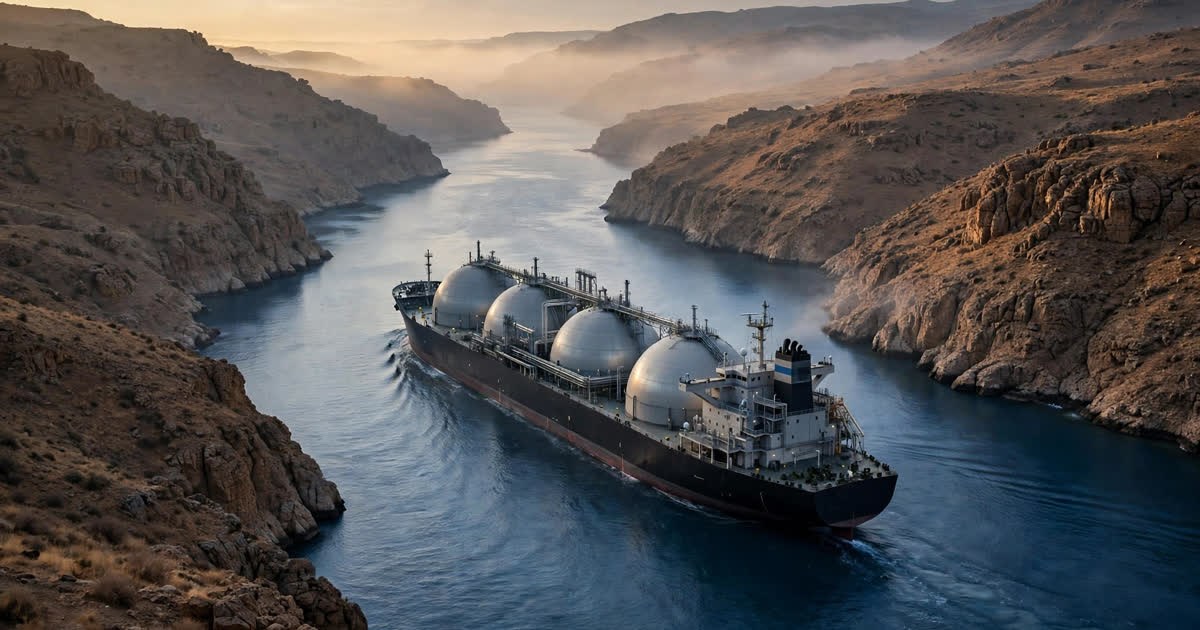
An LNG tanker — a vessel carrying liquefied natural gas — struck a naval mine and exploded in the Strait of Hormuz on Friday, 13 November 2026, Iran's Revolutionary Guards navy said, in the latest attack on commercial shipping through the world's most important oil waterway. The vessel was using what Tehran called an "unauthorised and dangerous route", according to Iranian state media cited by Reuters. No details about the tanker were released — not its name, its flag, or whether anyone on board was hurt — and Reuters said it could not independently verify the Iranian account. The incident was widely covered in world news on Friday, and it is a different kind of target from the crude oil tankers that have borne the brunt of the campaign so far: a gas carrier, not an oil tanker. The numbers behind it are stark: at least 10 ships were hit in the first 10 days of November, after 37 attacks in October, the highest monthly tally since the conflict began in late February, according to data from the Washington Institute for Near East Policy.
What Happened to the LNG Tanker in the Strait of Hormuz?
What is known so far comes almost entirely from Iran. The Revolutionary Guards navy said the LNG tanker hit a mine and suffered an explosion while trying to cross the strait on a route Iran had not authorised. Iranian media added on Thursday that four oil tankers had been hit by explosions in the same waterway, and that those vessels had ignored warnings and entered areas Iran considers restricted. Reuters, which first reported the Guards' statement, said no details on the tanker were immediately available. That silence matters: without a name, a flag, or a casualty report, there is nothing for independent monitors to check the claim against. The British military's United Kingdom Maritime Trade Operations service had already logged attack reports in the strait on 10 and 11 November, including a tanker struck by an unknown projectile and an incident 14 nautical miles north-west of Ra's al Khaymah in the United Arab Emirates. Gas carriers were already in the firing line: on 1 November, the Marshall Islands-flagged Al Mayeda, carrying Qatari LNG to Pakistan, was hit by unidentified projectiles near the strait. Friday's explosion fits that pattern, but it also raises it — a mine under a vessel carrying pressurised, flammable gas is a different order of risk from another hole in an oil tanker's hull.
A Campaign, Not a One-Off: 37 Attacks in October
The numbers behind Friday's explosion show a campaign that has been accelerating for weeks. The Washington Institute for Near East Policy counts 37 vessels attacked in October, the highest monthly total since the conflict began in late February, and at least 10 more hit in the first 10 days of November, Reuters reported. Oilprice, the energy trade publication, noted that attacks on vessels carrying energy products have intensified over the past month, with Iran reporting incidents nearly every day. Tankers were hit by mines in the strait earlier in November, and Thursday's four oil tankers came a day before Friday's LNG carrier. Iran's message has been consistent: vessels that ignore its warnings and use routes it has not approved are on their own. Its parliament speaker and top negotiator, Mohammad Bagher Ghalibaf, told Al Jazeera this week that navigation through the strait "would not return to pre-war conditions, ever".
Why This LNG Tanker Attack in the Strait of Hormuz Matters
The strait is about 21 miles wide at its narrowest point, and there is no sea route around it. Before the crisis, about 19.9 million barrels of oil a day moved through it, along with roughly 20% of the world's traded liquefied natural gas, according to the International Energy Agency. That is why a mine under one gas carrier in the Strait of Hormuz moves markets: it is not one ship, it is the lane itself. Kpler ship-tracking data showed LNG exports through the strait reached 31 tankers in October, the highest total since February, against 23 in September, Oilprice reported — trade was recovering, and Friday's explosion threatens that recovery. Qatar's LNG cargoes through the strait have fallen about 96% since the conflict began, with only around 18 cargoes getting through against 509 in the same period a year earlier, according to gCaptain, citing Reuters data. Some oil can go around the strait by pipeline — the IEA puts usable Saudi and UAE bypass capacity at 3.5 to 5.5 million barrels a day — but Iraq's, Kuwait's, Qatar's and Bahrain's exports, and all Qatari and UAE LNG, have no bypass at all. Brent crude traded at about $95.40 a barrel on Friday, according to Trading Economics, as the renewed attacks offset recent hopes of de-escalation. And the cost of moving oil while the strait is contested has soared: Reuters reported on 9 November that shipping costs during the disruption were running at about $30 a barrel, against roughly $5 before the war. Oil prices had already jumped $3 as Gulf tensions escalated.
What "Unauthorised Route" Means — and What Iran Has Said
The phrase Iran keeps using — an "unauthorised and dangerous route" — is doing a lot of work. Since the conflict began in late February, Iran has treated parts of the strait as restricted and warned ships away from them; vessels that crossed anyway have been hit. Friday's LNG tanker, like Thursday's four oil tankers, was described by Iranian media as having ignored those warnings. Tehran's account is that it is policing its own waters. The rest of the world reads the same events as a campaign to make the strait unusable, and Ghalibaf's remark to Al Jazeera that navigation "would not return to pre-war conditions, ever" is the bluntest version of that message. The two readings cannot both be right, and the gap between them is the story. What is not in dispute is the effect: commercial traffic through the strait has collapsed. IMF PortWatch satellite tracking recorded an average of 1.0 tankers a day in the week to 8 November, 98% below the average of 40.4 a day before the crisis.
What Happens Next
Three things will show how serious Friday's explosion is. First, whether the vessel is identified and what its flag state and owners say — an unnamed tanker is a claim, and a named one is a fact that can be checked. Second, whether the pace holds: 10 ships in the first 10 days of November, and now a gas carrier, suggests the campaign is not slowing. Third, whether the United States answers. Iran also claimed on Friday that it had destroyed a US early-warning radar in Bahrain, and the two claims landed together for a reason: Tehran is showing it can reach both the ships and the systems that watch them. That claim is unverified. For now, the strait that carries a fifth of the world's oil and a fifth of its traded gas has a new kind of casualty: not just another oil tanker, but the gas trade itself. If the next ship hit is another gas carrier, the question will stop being whether the strait is dangerous and become whether it is usable at all.