
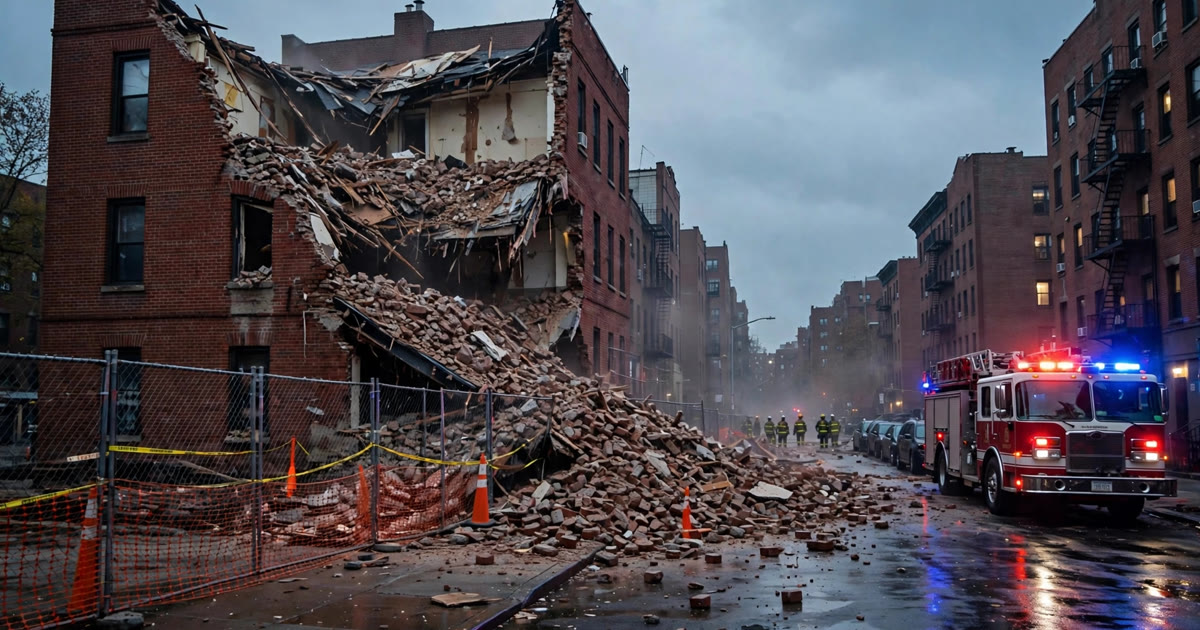
A three-storey building came down in Brooklyn on Wednesday afternoon, killing eight people and injuring 18. Firefighters ended the search on Thursday afternoon after finding no more victims. The Brooklyn building collapse happened at about 4 p.m. on 11 November 2026 in Flatbush, a residential neighbourhood in the centre of the borough, beside a construction site that had already been cited for working through a stop-work order. This is what is confirmed so far: the casualties, the rescue, and the paper trail next door — and what investigators still have to answer.
Brooklyn Building Collapse: What Happened in Flatbush
The first emergency call came in at 4:01 p.m. Eastern Time, and the New York City Fire Department sent crews to 2625 Bedford Avenue, between Newkirk and Flatbush Avenues, within minutes. The building that fell was a three-storey, mixed-use property: a shop at street level, with apartments above it. City records describe it as having four residential units and five units in total. The collapse tore down a wall of the building next door, according to Engineering News-Record, and the wreckage spilled into the construction site beside it.
Flatbush is a largely residential neighbourhood with a predominantly Black and Afro-Caribbean community, CNN reported, and the Brooklyn building collapse happened in the middle of an ordinary Wednesday afternoon, when the shops were open and people were at home. The fire department classified the incident as a major technical rescue — the category it uses when people are trapped under a collapsed structure and the search has to be done by hand, piece by piece.
The Rescue Effort and the Rising Casualty Count
Eight people were killed in the Brooklyn building collapse, Mayor Zohran Mamdani confirmed on Thursday, and 18 others were injured — 26 people were affected in total. The toll had risen through the day as rescuers pulled more people from the debris: early reports put the injured at four; by early evening the count stood at nine, then 10, then 12, before the Fire Department confirmed 19 patients in total on Wednesday night.
Four of the injured were in a critical condition and 12 were stable, Fire Department Commissioner Lillian Bonsignore said, and seven of the injured were children. Four firefighters were among the injured. At least two people were pulled alive from the rubble, and five of the injured were taken to Kings County Hospital. As of the latest updates on Wednesday night, officials said they did not know how many people might still be trapped, and firefighters were continuing to search the site.
The office of Brooklyn Borough President Antonio Reynoso confirmed the death to USA Today. New York City Emergency Management set up a Red Cross help centre for residents affected by the Brooklyn building collapse, CNN reported. The identities of the dead and injured had not been released by Wednesday night, and officials had not said how many people were inside the building when it fell. Rescues after collapses often run for days — a building collapse in Nairobi in October was still under way on its second day with seven people missing. Rescue operations after sudden disasters can run for days: a 5.7 earthquake near Hamamatsu in November injured at least 22 people.
Brooklyn Building Collapse: The Construction Site Next Door
The building stood at the edge of a lot at 2621 Bedford Avenue, where a one-storey building had been torn down to make way for a new development. In April, a demolition contractor working at that site was issued a violation for continuing demolition work despite a full stop-work order from the Department of Buildings, according to city records reviewed by CNN and PIX11. The contractor, N Tech Design of America, had demolished the one-storey building during the stop-work order, the records show.
The development planned for the site is far bigger than what stood there before. Engineering News-Record reported that the Department of Buildings issued earthwork and support-of-excavation permits on 9 September 2026 for a nine-storey-plus-cellar mixed-use building of 71,388 square feet with 64 residential units. The permits allow excavation to 14 feet below ground level, and list Townhouse Builders as the contractor. Department of Buildings investigators were at the scene on Wednesday evening, and the department said its commissioner was heading to the location to assess the damage.
None of that, on its own, explains why the building next door fell. City officials had not identified a cause by Wednesday evening, and had not said whether the excavation or the support-of-excavation work played any role, Engineering News-Record reported. That is the question the investigation into the Brooklyn building collapse now has to answer.
Could the Dig Next Door Have Brought the Building Down?
It is the question everyone in Flatbush is asking, and it is the one officials are not yet answering. Deep excavation beside an existing building can create structural risks if appropriate precautions are not taken, Glenn Corbett, an associate professor of fire science at John Jay College, told CBS New York. When a site is dug out to 14 feet below ground next to a three-storey building, the ground that supports that building's foundations is disturbed, and engineers use shoring and underpinning to hold it in place. If that support is missing, inadequate, or fails, the neighbouring structure can move — and a brick building with shallow foundations has little tolerance for movement.
That is general engineering, not a finding about this site. The Department of Buildings investigation will have to establish whether the excavation, the earlier demolition, the condition of the collapsed building itself, or some combination of the three was responsible. The April violation will be part of that inquiry: a contractor that worked through a stop-work order has already shown it will keep going when told to stop, and investigators will want to know what else was done without approval. Until the department reports, any claim that the construction caused the Brooklyn building collapse is speculation — and the outlets covering the story have been careful to say so.
What Happens Next for Residents and the Investigation
The rescue is over. Firefighters concluded their search on Thursday afternoon, 12 November, after determining there were no more victims, and the site was handed to the Department of Buildings and the police. The casualty figures are now final: eight dead and 18 injured. The Red Cross help centre will stay open for residents who cannot return to their homes, and the buildings on either side of the collapse will have to be checked before anyone is allowed back in.
Then comes the investigation into the Brooklyn building collapse. The Department of Buildings will examine the excavation and the support-of-excavation work, the demolition that was carried out under the stop-work order, and the condition of the building that fell. Its findings will decide whether the collapse was an accident, a failure of engineering, or a failure of enforcement — and whether anyone faces action. The planned nine-storey development on the neighbouring lot is now in doubt, and its permits will almost certainly be re-examined before any work resumes. Investigations after building disasters can take months and end in resignations — the inquiry into the Wang Fuk Court fire saw 168 people dead and a housing chief resign.
Why This Collapse Matters Beyond Flatbush
New York is a city that builds upward, and digging deep beside occupied older buildings is routine. The system that is supposed to keep that safe rests on three things: permits that set out how the work must be done, inspections that check it is done that way, and stop-work orders that halt it when it is not. In Flatbush, all three were in play before the building fell. A contractor was cited in April for working through a stop-work order. Excavation permits were issued in September. Two months later, the building next door came down.
That sequence is what makes the Brooklyn building collapse more than a local tragedy. If the investigation finds the excavation was done properly and the building failed for its own reasons, the lesson is about the condition of the city's older housing stock. If it finds the work was not done as permitted, or that the April violation was a warning that went unheeded, the lesson is about enforcement — and about what a stop-work order is worth when a contractor ignores it. Either way, the answer matters to every New Yorker who lives beside a building site, which is to say, to a very large number of them.
Sources: CNN; Engineering News-Record; USA Today; New York Post; New York Daily News via Firehouse; PIX11; New York City Department of Buildings; CBS New York.