
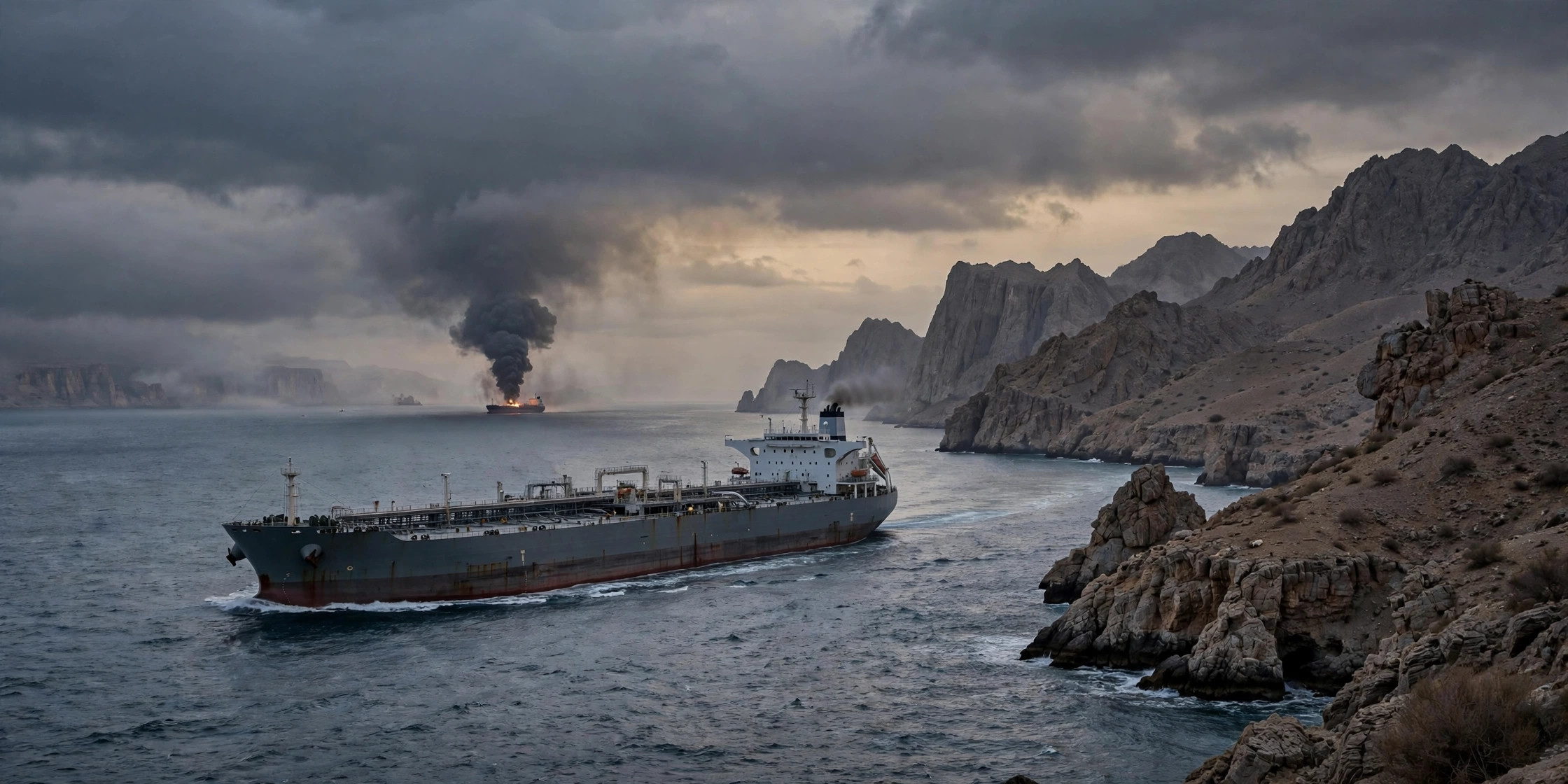
Four oil tankers are on fire in the Strait of Hormuz after striking sea mines, Iran's armed forces said on Thursday, 29 October 2026 — the latest escalation in a shipping crisis that has turned the world's most important oil chokepoint into a war zone. The Strait of Hormuz tankers on fire incident, trending per news coverage worldwide, pits Tehran's account of mined "unauthorised" routes against Washington's insistence that the main shipping lanes are clear — and leaves shipowners, insurers and oil markets guessing which version to trust.
According to Iran's Islamic Revolutionary Guard Corps (IRGC), three oil tankers exploded and caught fire within the previous 24 hours after hitting mines while trying to use what Tehran calls an unauthorised southern route through the strait. The IRGC said the vessels had switched off their radar and navigation systems and ignored warnings from its naval forces. Later on Thursday, Iran's army reported that a fourth tanker had caught fire east of the strait after striking a mine while operating in what it described as a restricted and dangerous area. That vessel was damaged and left unable to move, the army said.
Iran did not name any of the four tankers, identify the flags they were sailing under, or say exactly when the incidents occurred. No casualties have been reported from any of the incidents. The Associated Press said it could not independently verify the Iranian account, and no Western maritime authority has confirmed that mines caused any of the fires.
Strait of Hormuz Tankers on Fire: What Happened on 29 October
The IRGC statement, carried by Iranian state media on Thursday, was precise about the sequence it alleges. "Over the past 24 hours, three violating oil tankers exploded and caught fire after striking mines while attempting to pass through the unauthorised southern route of the Strait of Hormuz," the IRGC said. The three vessels, it claimed, had "switched off all their radar and navigation systems" and disregarded warnings from the IRGC navy before hitting the mines.
The fourth incident was reported separately by Iran's regular army, which said a tanker operating in a prohibited and dangerous area east of the strait struck a naval mine and caught fire. The army said the impact damaged the tanker and left it unable to continue sailing. Taken together, the two announcements make this one of the largest single-day tallies Tehran has announced since attacks on Gulf shipping accelerated this month.
The timing matters. The claims came a day after the United States military said it had cleared key shipping routes through the strait of mines. On Wednesday, 28 October, US Central Command (CENTCOM) stated that Iranian mine-strike reports were false and that the recognised transit lanes remained cleared. Admiral Brad Cooper, the CENTCOM commander, had visited the strait on 25 October and said its primary transit routes were free and clear of Iranian mines, adding that US forces had helped Gulf producers export more than 1.5 billion barrels of crude oil since the summer.
What UKMTO Confirmed — and What It Did Not
Britain's maritime agency, the United Kingdom Maritime Trade Operations (UKMTO) centre, reported several incidents in the same waters on Thursday — but its account does not line up neatly with Iran's. UKMTO said it had received a report of a vessel on fire about 25 nautical miles (46 kilometres) north-east of Khasab, Oman, in the Strait of Hormuz. It gave no cause for that fire and no information about the crew.
UKMTO also reported that a tanker was struck by an unidentified projectile while completing an outbound transit of the strait at around 1600 GMT on Thursday (8pm UAE time). No crew injuries were reported. In a separate incident, a traditional dhow caught fire and sank following a maritime security incident off Oman; its crew were evacuated safely. Maritime security reports said a small boat had attached two explosive devices to a tanker's hull near Oman, setting the engine room on fire.
Crucially, UKMTO did not say whether the vessel on fire near Khasab was among the four tankers Iran described, and it did not confirm mines as the cause of any fire. Until vessel names, flags or independent confirmation emerge, the exact scale of what happened in the strait on Thursday remains unclear — and the public record contains two separate threads: an Iranian claim of four tankers hit by mines, and a British monitor's report of a vessel on fire and a tanker hit by a projectile.
Why the Strait of Hormuz Tankers on Fire Claims Are Disputed
The dispute is about more than this one day. Iran considers ships using the southern corridor near the Omani coast unauthorised, and it insists commercial vessels use northern routes approved by its authorities. The United States, by contrast, has encouraged shipping operators to use the southern passage, where US warships escort traffic. Ships entering the Gulf now effectively choose between the two — and Tehran says the southern route is mined.
"The unauthorised route through the Strait of Hormuz is mined, and vessel owners and crews are responsible for transiting these routes," the IRGC said in its statement, telling operators they should not pay attention to what it called CENTCOM's "delusions on social media". IRGC spokesman Hossein Mohebi challenged Washington directly on X: "Prove your Hormuz mine-clearing claim with independent evidence, not statements!"
Iran also claimed on Thursday to have captured an American reconnaissance drone in the area. Iranian state television described it as a US MQM-170 drone seized through electronic warfare in the western Strait of Hormuz. US Central Command called that claim false. The competing claims underline how little of this confrontation can be verified independently: the strait is a war zone, and both sides are fighting a battle of narratives as well as a military one.
Why the Strait of Hormuz Matters for Global Oil
The Strait of Hormuz is the narrow waterway between Iran and Oman that connects the Persian Gulf to the Arabian Sea, and it normally carries about one-fifth of global oil consumption. Since the war that began on 28 February 2026, Iran has severely restricted traffic through the waterway, and Tehran later declared it closed to all traffic — although tankers have continued to move through with US military protection.
The shipping toll has climbed fast. Researcher Noam Raydan of the Washington Institute for Near East Policy counted 30 Iranian attacks on shipping since 1 October, the fastest pace since the conflict began. At least 24 seafarers have been killed in and around the strait since the fighting started. On 22 October, Iran claimed seven tankers were damaged in a single night — a claim covered in our earlier report on Iran's claim that seven oil tankers were struck in the Strait of Hormuz. On 13 October, the Singapore-flagged container ship GFS Pride sank after a strike as it left the strait. A supertanker carrying 2 million barrels of oil exploded after hitting a mine in the strait earlier in October, as reported in our article on the supertanker explosion in the Strait of Hormuz.
Shipping data cited in regional reporting puts daily commercial transits through the strait at fewer than 10 vessels, down from about 85 before the war. Marine insurers have raised war-risk premiums sharply across the Gulf, and some shipping companies are refusing the route altogether. The US has responded with a naval blockade of Iranian ports and by escorting tankers, while the US Navy has also destroyed Iranian vessels it says were threatening shipping, including the surveillance dhow sunk in the Gulf of Oman in our report on the US destruction of an Iranian surveillance dhow.
Oil Prices Jump as the Hormuz Shipping Crisis Deepens
Oil prices climbed in early trade on Friday, 30 October, on supply concerns. Brent crude futures rose 86 cents, or 0.75 percent, to 115.74 dollars a barrel, while US West Texas Intermediate crude rose 72 cents, or 0.71 percent, to 102.72 dollars a barrel. The gains came as the tanker fires coincided with a separate escalation: Yemen's Iran-aligned Houthis said on Thursday they had attacked several sites in Saudi Arabia, including its largest oil refinery at Ras Tanura, the Rabigh refinery and an Aramco facility at Abqaiq, while a Saudi-led coalition said it had intercepted a cruise missile launched towards the kingdom's western region.
"Continued kinetic action around the Strait of Hormuz amidst doubts of a viable diplomatic pathway are keeping oil prices elevated in expectation of an escalation of the conflict in coming weeks," Saul Kavonic, head of energy research at MST Marquee, told Reuters. The Houthi attacks on Saudi Arabia are part of the same regional confrontation — the group has stepped up strikes on the kingdom in recent weeks, as covered in our report on Iran and Houthi strikes on a tanker and Riyadh airport. Amid the security concerns, ExxonMobil and Chevron have cancelled plans for their executives to travel to the United Arab Emirates' biggest oil show next week.
For energy markets, the question is whether the strait stays passable at all. Gulf producers have relied on US escorts and the cleared northern lanes to keep exports moving — CENTCOM says 1.5 billion barrels have moved since the summer — but every new incident pushes insurance costs higher and narrows the margin for error. If shipowners conclude the southern route is mined and the northern route is subject to Iranian approval, the world's oil supply faces a bottleneck with no easy alternative.
What Happens Next in the Strait of Hormuz
Three things will decide what happens next. First, whether any independent evidence emerges about the four tankers — vessel names, flags, insurers or satellite imagery would settle whether Thursday's fires were caused by mines, limpet devices, projectiles or something else. Second, whether the United States produces the independent evidence of its mine-clearing operation that Iran's IRGC spokesman demanded, or whether the dispute stays a war of statements. Third, whether diplomacy gets a chance: President Donald Trump said on Thursday that Vice President JD Vance had reached out to Iran to help the country get medical supplies, after US media reported Vance had written to Tehran's top security official to revive peace talks. Iran has received the letter but has not responded yet, according to the semi-official Tasnim news agency.
For now, the strait remains contested water. Tankers are still moving through it under escort, but each transit is a calculation of risk — and Thursday's fires, whatever caused them, are a reminder that the world's most important oil chokepoint is one incident away from closing. We will update this article as vessel identities and independent verification emerge.
Sources: AFP (via Arab News and Malay Mail), Reuters, Al Jazeera, UK Maritime Trade Operations (UKMTO), US Central Command, SOFX.