
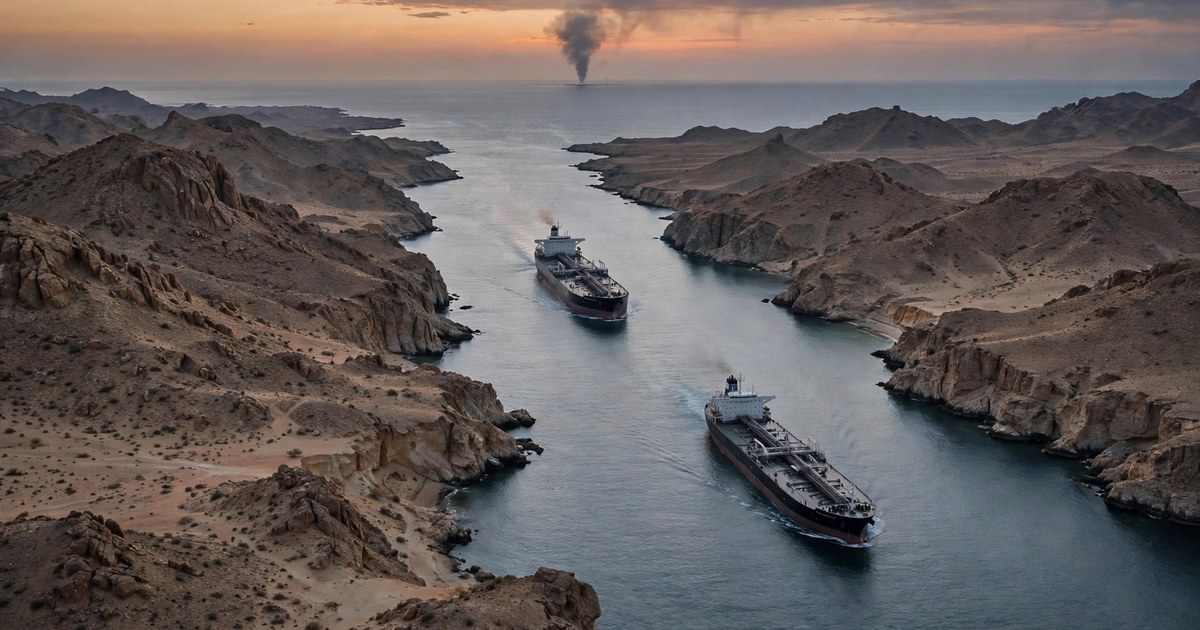
On the night of 7–8 November 2026, the Strait of Hormuz produced three stories at once — and they are not all equally solid. Iran's Revolutionary Guard said Strait of Hormuz tankers hit mines and caught fire. Twenty-one minutes earlier, the United States had confirmed firing on a cargo ship in the nearby Gulf of Oman. And on Sunday morning, the United Arab Emirates announced it had rescued 22 crew from a burning cargo ship. One claim, one confirmed strike, one rescue with no stated cause — and telling them apart matters, because the strait carries about a fifth of the world's traded oil.
Strait of Hormuz tankers hit mines: what Iran claims
Iran's Islamic Revolutionary Guard Corps (IRGC) Navy said early on Sunday, 8 November, that two oil tankers had struck naval mines and caught fire in the Strait of Hormuz, according to a statement carried by the Guard's official outlet Sepah News and reported by the Xinhua news agency. One tanker hit mines east of the strait and the other while crossing the waterway, the statement said. Both vessels had switched off their navigation and GPS systems and were trying to pass through what Iran called an "unauthorised" route, the IRGC said. The statement gave no names, flags, destinations or casualty figures for either vessel.
The Guard warned that any vessel cooperating with what it called the "aggressive" US Army and entering the area in defiance of Iranian regulations would "definitely" hit naval mines, Xinhua reported. The announcement came at 20:56 GMT on Saturday, 7 November — 21 minutes after the United States disclosed its own strike on a commercial vessel in the Gulf of Oman.
The M/V Huda: the strike the US confirms
US Central Command (CENTCOM) said on social media platform X that its forces had disabled a commercial vessel in the Gulf of Oman after its civilian crew "ignored repeated warnings and attempted to violate the naval blockade against Iran multiple times", the Associated Press reported. A US military aircraft fired precision munitions at the stern of the St. Kitts-flagged M/V Huda at about 20:35 GMT on Saturday, disabling the ship after CENTCOM forces directed the crew to abandon targeted spaces.
The Huda is the fifth merchant ship US forces have disabled since the blockade began in July, CENTCOM said. Since July, US forces have redirected 147 commercial vessels, according to the command. The Associated Press noted that the last confirmed US strike on a cargo vessel before this one was nearly a month earlier in the Gulf of Oman, and that Saturday's disclosure came after at least two instances in which CENTCOM did not announce military strikes it had taken in the region.
The strike followed a statement on Friday by US President Donald Trump that the US military had carried out new limited strikes against Iran, targeting an Iranian air defence system, the Associated Press reported.
UAE rescues 22 crew from a burning cargo ship
Hours after the Strait of Hormuz tankers hit mines claim was announced, the United Arab Emirates National Guard announced on Sunday that it had rescued 22 crew members from a cargo ship that caught fire in the Gulf of Oman, Reuters reported. The Guard's Coast Guard Division evacuated 22 Arab nationals after receiving a distress report about a fire aboard the vessel, gave them first aid and handed them over to the relevant authorities. All 22 were reported to be in stable condition.
The UAE did not identify the ship, did not say what caused the fire, and did not link the rescue to the M/V Huda or to any attack, Reuters and the ANI news agency reported. The rescue is a separate incident from an earlier one on 10 October, when the UAE Coast Guard rescued 22 Asian nationals from a burning oil tanker in the Arabian Gulf — the same number of people, a different ship, a different sea. News reports on Sunday explicitly noted the parallel, which is why the two rescues should not be confused.
Confirmed or claimed: the Strait of Hormuz tankers hit mines reports
The three events of the night sit on very different footing. The Huda strike is confirmed by the military that carried it out, with the vessel named, flagged and timed. The UAE rescue is confirmed by the force that carried it out, with the number of people and their condition stated. The mine strikes, by contrast, are so far claimed only by Iran, with no vessel named and no independent confirmation.
That matters because the Guard has made near-identical mine claims on successive days. On 6 November it announced, in almost the same wording, that two tankers had struck mines and caught fire in the strait — the latest in a series of mine claims stretching back to late October, when Iran said four tankers had hit mines. The Joint Maritime Information Center and US Central Command have not substantiated the earlier claims, and CBS News reported there was "no confirmation of any incidents from maritime officials" for the 6 November claim, according to maritime trade press reports. CENTCOM has said at various points during the conflict that "no ships have hit mines in the Strait of Hormuz", the shipping publication gCaptain reported.
Explosions were also reported on Saturday evening on Qeshm Island and in the port of Jask, as well as in Sirik and Bandar Abbas, Iranian state media said. It is not clear whether those blasts are linked to the mine incidents, and the semi-official Tasnim news agency, citing an unnamed source, denied that the sounds heard on Qeshm Island were missile strikes, the Times of India and the Associated Press reported.
Why it matters: oil, shipping and the blockade
The Strait of Hormuz is 21 nautical miles wide at its narrowest point, and about a fifth of the world's traded oil historically flowed through it before Iran declared it closed on 26 October. Shipping in the strait has been at a near standstill since late February, when Iran tightened its grip on the waterway and barred safe passage to vessels belonging to or affiliated with Israel and the United States. The International Maritime Organization has counted at least 125 ships attacked in the strait and neighbouring waters since February, with October recording 34 attacks, the highest monthly total since the conflict began.
Oil markets had not yet reacted to Saturday night's events when trading closed on Friday. Each time Strait of Hormuz tankers hit mines reports surface, insurers and shipowners reprice the risk within hours, and Friday's close gave no read on this claim yet. Brent crude closed Friday at $98.32 a barrel, virtually unchanged on the day, after settling at $98.29 on Thursday — up 3.88% in a rebound from Wednesday's $94.62 close, its lowest since 31 August. The deeper cost sits below the headline price: transport costs per barrel for Hormuz crude reached about $21 in early October, up from roughly $6.50 in September, according to CNBC, citing Braemar shipping analyst Mary Melton. War-risk insurance premiums for crossing the conflict zone climbed from about 0.25% of hull value before the war to between 6% and 10% by October, according to the insurance broker Marsh.
The night's events also landed a day after another escalation: on 7 November, Iran announced it was lifting the self-imposed 2,000 km cap on the range of its ballistic missiles, a limit in place since 2017. The United States had struck Iran's Qeshm Island on 3 November, and the two sides held talks in Doha on a plan to reopen the strait.
What happens next
Four things will settle how big this night was. First, whether the Joint Maritime Information Center, insurers or ship-tracking firms confirm the two tankers — their names, flags and crews — or whether the claim fades like the earlier ones. Second, how oil trades when markets open on Monday, after a week in which Brent fell sharply and then rebounded. Third, whether either navy steps up enforcement: the US has now disabled five merchant ships, and Iran has warned that more vessels will hit mines. And fourth, whether the diplomacy survives — the Doha talks produced a two-day plan to reopen the strait, but each night of enforcement actions makes that plan harder to carry out.
For now, the honest summary of the night is narrower than the headlines: a confirmed American strike, a confirmed Emirati rescue, and an Iranian claim about two tankers that no independent authority has yet verified. Until the Strait of Hormuz tankers hit mines claim is confirmed or dropped, that distinction is the story.
Sources: Associated Press (via Military.com), Reuters, ANI, IANS, Xinhua, Sepah News, TASS, US Central Command, UAE National Guard / Emirates News Agency, Times Now, CBS News, gCaptain, CNBC, Marsh, OilPrice.com.