
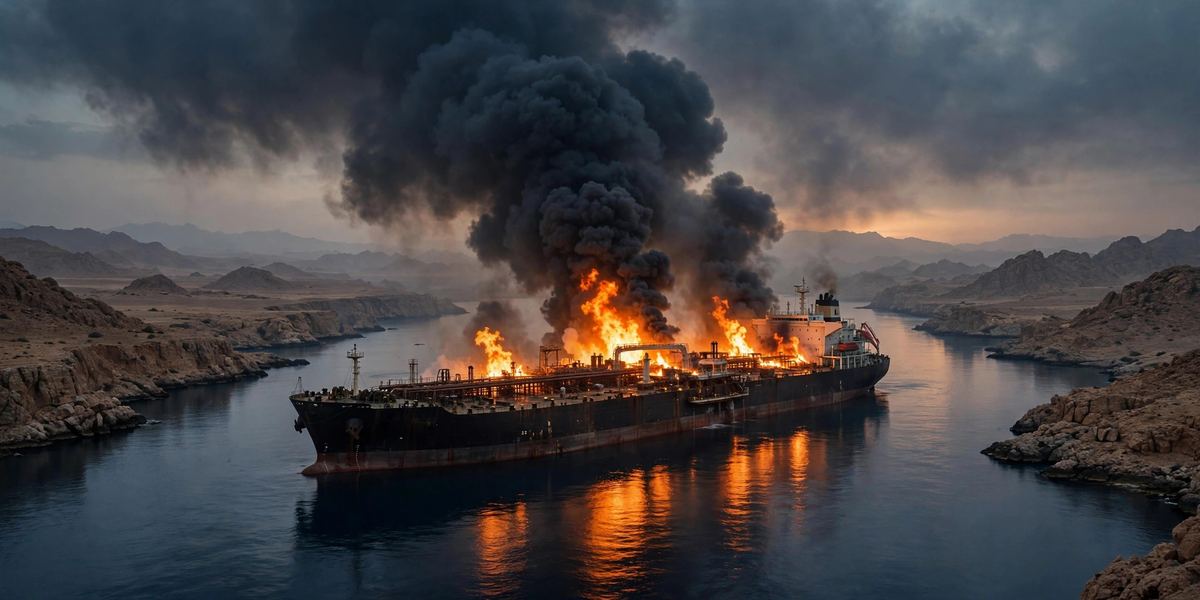
A supertanker carrying more than two million barrels of crude oil has exploded and caught fire in the Strait of Hormuz after striking a sea mine, according to Iran's Islamic Revolutionary Guard Corps (IRGC). The incident, reported on Saturday 17 October 2026, is the most serious in a week of escalating attacks on shipping in the narrow waterway that carries roughly a fifth of the world's traded oil — and it has already sent crude prices surging. The story is trending per news coverage.
In a statement carried by Iranian state media, the IRGC Navy said the vessel struck a mine while "attempting to pass through an unauthorised route" in the Strait, causing a "massive explosion" and a "fierce fire." Iran's Fars news agency posted a video appearing to show a vessel ablaze at sea. The IRGC said the tanker had switched off its positioning and radar systems in an attempt to evade detection, and accused it of trying to transit the waterway with the support of the United States military. The exact location of the incident was not disclosed, and the fate of the crew had not been detailed in the Iranian account. As with earlier claims in this conflict, the cause — a mine strike — comes from Iranian military sources and had not been independently confirmed at the time of writing.
What is not in doubt is the message Tehran attached to the incident. "The Strait of Hormuz is closed, and the consequence of defying Iranian regulations in the Strait of Hormuz is burning in the fire of trust in the terrorist US army," the IRGC Navy said in its statement, warning all vessels against violating Iranian rules governing passage through the waterway. The warning follows a pattern: earlier this week, the IRGC Navy commander, Admiral Ali Ozmai, had warned that any ship disabling its navigation equipment would be treated as hostile. The tanker in Saturday's incident is said to have done exactly that — sailing "dark," with its Automatic Identification System (AIS) transponder and radar switched off.
Why the Strait of Hormuz matters so much
The Strait of Hormuz is a narrow channel, only about 30 kilometres (20 miles) across at its narrowest point, between Iran and Oman. Before the current conflict, roughly a fifth of the world's seaborne oil trade — and a large share of its liquefied natural gas — passed through it every day. It is, in effect, the world's most important energy chokepoint: there is no practical alternative route for most Gulf oil exports. Pipelines that bypass the strait exist, but their capacity covers only a fraction of the volumes that normally move by tanker.
That is why the waterway has been at the centre of the confrontation between Washington and Tehran since the Iran war broke out in late February 2026. After US and Israeli strikes on Iranian sites on 28 February, Iran retaliated by hitting US bases and allies across the Middle East, closed the strait, and laid mines to deter vessels from trying to transit. The United States responded with a naval blockade on Iranian ports and has since escorted commercial vessels through the waterway. The two sides have offered sharply different pictures of the situation ever since: Tehran insists the strait is closed and under its control; the US military says commercial vessels have continued to transit "despite unwarranted IRGC aggression," with US Central Command (CENTCOM) reporting hundreds of ships escorted through in recent days.
The truth, as ever in this conflict, sits between the two claims. Crude shipments through Hormuz have partly recovered under US escort — recent seven-day averages had roughly matched pre-war levels for crude oil, though shipments of refined products such as diesel and petrol remained far below normal. But the risk premium on every voyage has soared: war-risk insurance for vessels transiting the strait has climbed sharply, some underwriters have refused cover for ships sailing without active AIS transponders, and the steady drumbeat of attacks keeps crews and owners on edge.
A week of attacks on shipping
Saturday's explosion did not come out of nowhere. It is the latest in a spate of mine strikes and attacks on vessels in and around the strait. Two cargo ships sank near the Strait of Hormuz earlier in the week as attacks on shipping escalated, and the Singapore-flagged container ship GFS Pride caught fire and sank on Wednesday after being hit, according to US Central Command. All 21 crew members of the GFS Pride were safely evacuated, Singapore's Maritime and Port Authority confirmed.
On Wednesday, a UAE-owned cargo ship also caught fire and sank after being struck by a mine in the waterway, with social media footage showing packets of perfume bottles and iPhone boxes floating near the sunken vessel. A day earlier, the UK Maritime Trade Operations office reported a container ship and a tanker each struck by an unknown projectile north of the Musandam Peninsula. According to APAC News Network, at least nine tankers and cargo vessels have been attacked in the Strait of Hormuz since Sunday, as Iran seeks to disrupt oil shipments through the waterway.
The human cost is already mounting. The International Maritime Organization said the attacks this week have left three seafarers injured and two others missing. US forces have also been striking back, including destroying an Iranian surveillance dhow in the Gulf of Oman as Hormuz attacks surged. The pattern is a grim one: each week brings new incidents, new wreckage, and new risks for the civilian crews who keep the world's energy moving.
Oil prices surge toward $110
Markets reacted immediately. Brent crude futures climbed to a session high of $110 a barrel on Friday — crossing that threshold for the first time since May — before settling at about $109.86, up roughly 3.8% on the day. US West Texas Intermediate (WTI) crude rose about 3.6% to settle near $101.50 a barrel. For the week, WTI gained more than 10%, while Brent climbed nearly 4%. Brent is now up about 40% compared with before the war, reflecting an estimated shortfall in daily production of around 14.5 million barrels.
The price spike is not only about the strait. The same week saw Houthi militants in Yemen — who are backed by Iran — launch repeated missile and drone attacks on Saudi Arabia. Saudi Arabia's military said it intercepted multiple missiles over the Red Sea on Friday, including one believed to be headed for the Yanbu oil export terminal, and destroyed three drones over Riyadh and areas in the south. On Tuesday, an attack struck an administrative building belonging to Saudi state oil company Aramco in Dhahran. The Houthis had earlier struck Riyadh's international airport on 10 October, killing 12 people and injuring more than 300. Saudi flight cancellations widened as those Houthi attacks hit aviation and Riyadh airport.
At the same time, Ukraine has pledged to keep striking Russian oil refineries, adding another source of supply disruption to an already tight market. The combination — Hormuz attacks, Houthi strikes on Saudi infrastructure, and strikes on Russian refining — is what traders mean when they talk about a "war premium" in the oil price: a layer of extra cost driven not by supply and demand fundamentals alone, but by the risk that supply could be interrupted at any moment.
The pressure has already reached American drivers. US retail gasoline and diesel prices have climbed to record territory, and the White House has moved to ease the squeeze: President Trump waived parts of the Graham Act's Russia sanctions and tariffs days before a deadline, a move widely read as an attempt to ease market tightening. Countries that depend on Gulf energy are adapting too — Japan has approved energy security bills designed to help its oil importers bypass the Strait of Hormuz.
What happens next
Three questions will shape what comes next. The first is verification: will independent evidence — satellite imagery, vessel tracking data, or statements from the tanker's owner or flag state — confirm the mine strike, identify the vessel, and establish the fate of its crew? Until then, the incident rests on the IRGC's account, and the history of this conflict is full of competing claims.
The second is escalation. The IRGC has made its position explicit: ships that sail without active tracking systems will be treated as hostile, and the strait remains closed under Iranian rules. The United States, for its part, has said it will keep escorting commercial vessels and has warned Iran against attacks on shipping. The two positions are on a collision course, and every new incident raises the risk of a direct clash between US and Iranian forces in the waterway.
The third is the oil market. Brent near $110 is already feeding through to fuel prices and inflation in importing countries. If attacks continue at this pace — nine vessels in a week — insurers may pull back further, more owners may refuse the voyage, and the crude flows that have partly recovered under escort could fall again. That would push prices higher still, and with them the cost of living for millions of people far from the Gulf.
For now, the burning supertanker is the starkest image yet of a conflict that has turned the world's most important oil route into a battleground. The vessel's name, its flag, and the fate of the people aboard remain unconfirmed. What is clear is that the Strait of Hormuz, a waterway most people had never heard of a year ago, is now the place where the global energy system is being tested — one mine, one tanker, and one explosion at a time. Sources: Euronews (17 October 2026), citing IRGC Navy statement via Iranian state media; Press TV (17 October 2026); ABNA (17 October 2026); APAC News Network (17 October 2026), citing International Maritime Organization figures; US Central Command statements as reported by Euronews and APAC News Network (per news coverage, October 2026).