
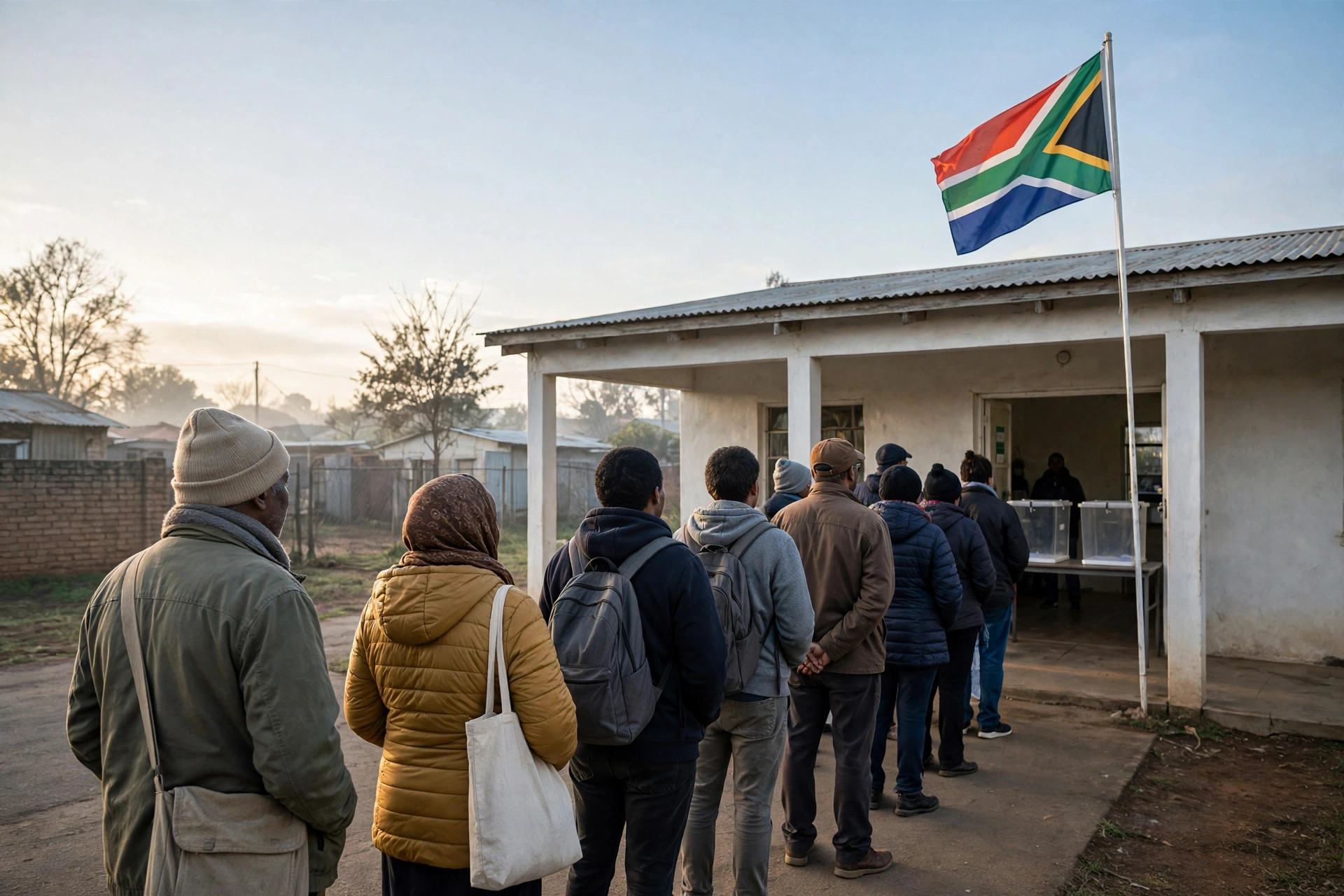
The South Africa local elections 2026 take place on Wednesday 4 November 2026, when voters across the country choose the councils that run their metros and municipalities — the bodies responsible for water, electricity, refuse collection and rates billing. President Cyril Ramaphosa has declared 4 November a public holiday so that people can vote, and voting stations will be open from 7am to 9pm. Special voting for people who cannot reach a station on election day is already under way, running on Monday 2 and Tuesday 3 November from 8am to 5pm, with a record 2,655,067 special votes approved. This guide explains who can vote, what to bring, how the ballots work, and what else changes on 4 November, when fuel prices are also expected to fall.
South Africa Local Elections 2026: When and Where to Vote
Election day is Wednesday 4 November 2026. Voting stations open at 7am and close at 9pm, and anyone who is in the queue at closing time is still allowed to vote. The Electoral Commission of South Africa (IEC) runs 23,696 voting stations, and voters must vote at the station where they are registered — for municipal elections, unlike national elections, there is no voting at a different station. Before election day, the IEC urges every voter to check their registration details and confirm their voting station. That can be done on the IEC website at elections.org.za, by sending an SMS with a 13-digit ID number to 32810, or by sending "Hi" to the IEC WhatsApp number 060 088 0000, which returns the station name and the voter's roll sequence number.
Special voting covers registered voters who cannot get to a polling station on election day itself, including people who are ill, housebound or working on polling day. The IEC approved 2,655,067 special-vote applications for these elections, which is 131 percent more than the number approved for the 2021 local government elections. Approved special voters either receive a home visit from IEC officials or vote at their registered station on 2 or 3 November. The first day of special voting saw some disruption: ballot-delivery delays meant some voting stations in the Cape Metro did not open on time on Monday, a problem the IEC in the Western Cape acknowledged. Voters whose special-vote application was not approved cannot use special voting and must vote on election day at their registered station.
What to Bring and How the Ballots Work
Voters must bring an acceptable identity document. According to the IEC's national guidance, that means a smart ID card, a green barcoded ID book or a valid temporary identity certificate. The IEC says driver's licences, passports, student cards and photocopies of ID documents are not accepted for voting. At the station, an election official verifies the voter's identity and registration, checks the name against the voters' roll, and marks the voter's thumbnail with indelible ink to prevent double voting. The voter is then handed ballot papers, which must be marked in private in the voting booth.
How many ballot papers a voter receives depends on where they live. In a metropolitan municipality, voters receive two ballot papers: a ward ballot to choose a ward councillor, and a local council ballot to elect a political party for the metropolitan council. In a local municipality, voters receive three: a ward ballot, a PR ballot for the local municipal council, and a district PR ballot for representation on the district municipal council. On each ballot, the voter makes one clear X in the box next to the chosen candidate or party. Voters should not write their name, sign the ballot or make extra marks, because that could make the ballot invalid. After marking, the voter folds the ballot papers to keep the choice private and places them in the ballot box as directed by officials.
The elections decide who runs local government for the next five years, and the stakes are practical rather than abstract. Municipal councils set budgets for water, electricity, refuse collection and roads, and they appoint the mayors and ward councillors who oversee delivery. The campaign has also been shaped by a court decision that reinstated 181 ANC candidates, which forced a ballot-printing scramble, and by about 79 million ballot papers printed for the election. Young voters have been a particular focus of the official turnout campaign: Deputy Minister in the Presidency Nonceba Mhlauli urged young people to vote on 4 November and to stay involved afterwards by attending ward and council meetings. For readers following other elections this year, our New Zealand election guide and our report on Slovakia's local elections show how the same questions play out elsewhere.
South Africa Local Elections 2026: Fuel Prices Also Fall on 4 November
Wednesday 4 November is also the day South African fuel prices are adjusted, and this month the change is expected to bring relief. The Department of Mineral and Petroleum Resources is expected to announce the November adjustment before the new rates take effect on 4 November, and Central Energy Fund data points to lower prices. The relief comes from a temporary cut to the General Fuel Levy announced by Finance Minister Enoch Godongwana in the Medium Term Budget Policy Statement on 21 October. From 4 November until 1 December 2026, the levy falls by R1.50 a litre for petrol and R3 a litre for diesel. From 2 December to 5 January 2027, the reduction narrows to R1 a litre for petrol and R1.50 for diesel. The intervention is part of a R10 billion relief package.
The expected pump changes, based on Central Energy Fund projections, are a fall of roughly 33 to 50 cents a litre for petrol and R1.58 to R1.68 a litre for diesel. That would put 95 unleaded at about R29.83 a litre inland and R28.96 at the coast. These are projections, not final prices: the department has yet to publish the official November adjustment, and factors such as the Slate Levy can change the final figure. Without the levy relief, higher international oil prices would have pushed November fuel prices up by more than R1 a litre for petrol and more than R1.40 for diesel. The relief is temporary, and it does not reverse the year's earlier increases: inland 95 unleaded rose from R20.75 a litre in January 2026 to R30.25 in October, a rise of about 46 percent, which adds about R475 to the cost of a 50-litre tank. Voters filling up on election day will still pay far more than they did at the start of the year.
What Happens After Voting Day
Counting begins once stations close at 9pm on 4 November, and the IEC publishes results on its results dashboard as they are captured. Because the elections cover hundreds of councils, full results take time, and coalitions in hung councils may take longer still to form. Market watchers have been calm about the vote: one-week implied volatility on the rand against the dollar has fallen since the start of October and sits well below its one-year average, according to a Bloomberg report carried on 2 November. For voters, the practical steps are simple: check the station before Wednesday, bring the right ID, and allow time, because queues can be long in the evening. Anyone unsure about their registration can check it today through the IEC website, by SMS to 32810, or on WhatsApp to 060 088 0000. Our guide to how voting works explains the mechanics of casting a ballot in more detail.