
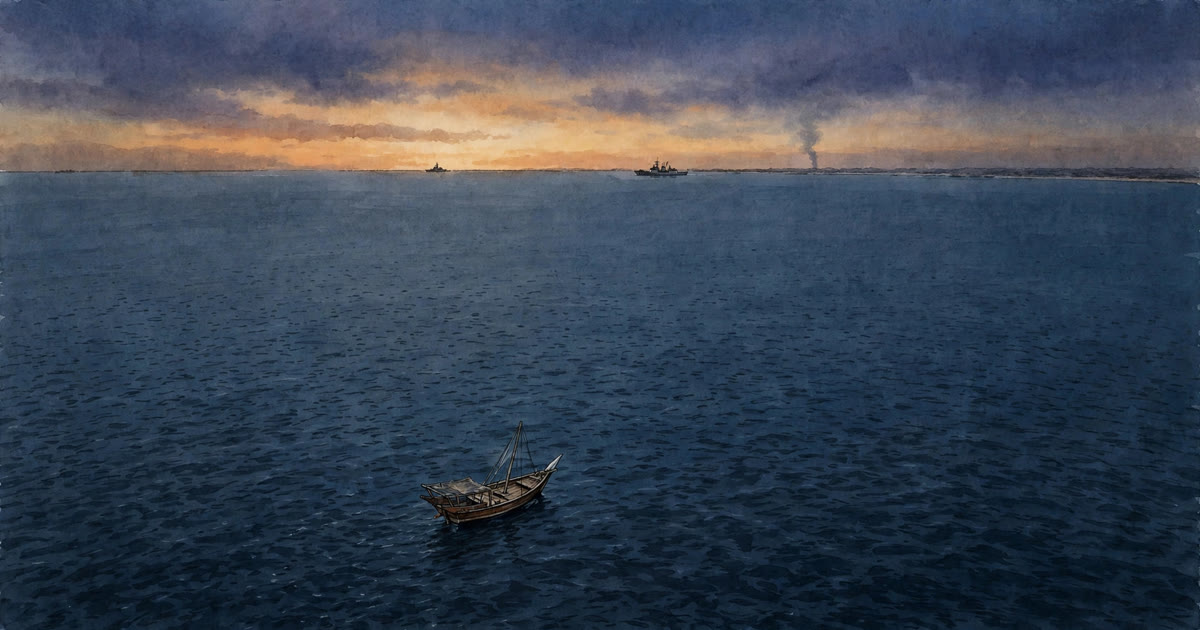
United States forces destroyed an Iranian-affiliated dhow in the Gulf of Oman after determining that the vessel was conducting surveillance and helping to target American warships, U.S. Central Command (CENTCOM) said on Wednesday, October 14, 2026. The disclosure, trending per news coverage across Al Jazeera, the Associated Press, Reuters and maritime trade publications, landed as attacks on commercial shipping around the Strait of Hormuz surged to their most intense tempo since the US-Iran war began.
The dhow episode is a small incident on its own. No one was hurt, and the boat itself was a modest wooden vessel of the kind that has sailed Gulf waters for centuries. What makes it significant is what it reveals about how the war at sea is changing: with much of its coastal radar destroyed, Iran is increasingly relying on small, inconspicuous boats and unarmed spotters to find targets, while the United States is enforcing a naval blockade and striking vessels it says threaten its warships or defy its orders. The result is a crowded, dangerous waterway where civilian mariners, oil tankers and warships are all operating within sight of one another.
What CENTCOM Says Happened to the Dhow
According to CENTCOM, the operation took place on October 6, 2026, but was only publicly disclosed on October 14. In its statement, the command said: “On Oct. 6, U.S. forces destroyed an Iranian-affiliated dhow conducting surveillance and targeting U.S. Navy ships in the Gulf of Oman.” The command said the dhow’s crew was safely removed before the vessel was destroyed, and that efforts to repatriate the crew members were continuing.
CENTCOM did not identify the dhow by name, did not say how many crew members were aboard or what nationality they were, and did not disclose how the vessel was destroyed or exactly how it was conducting surveillance. The Iranian government did not immediately provide a response to the announcement.
Reporting by Reuters, carried by The Business Standard, filled in some of the operational detail. A U.S. military official, speaking on condition of anonymity, confirmed that Iran had changed tactics in one significant way: after the United States destroyed much of Iran’s radar capability, the Islamic Revolutionary Guard Corps (IRGC) had started using unarmed spotters in small boats to identify potential targets, including U.S. naval vessels. In a previously unreported incident last week, the official said, the U.S. military determined that Iranian spotters were operating from a dhow, calling in targets to the IRGC. U.S. forces confronted the vessel, told its occupants to abandon ship, and then destroyed it. There were no casualties, the official said.
CENTCOM also accused the IRGC of repeatedly targeting civilian mariners and U.S. Navy warships in regional waters during the past seven months. The dhow’s destruction, in the American account, was therefore not an isolated act but part of a broader campaign to deny Iran the eyes it needs to pick targets in the Gulf of Oman and the Strait of Hormuz.
A Surge of Attacks on Commercial Shipping
The disclosure came against a backdrop of rapidly escalating attacks on commercial vessels. According to data analysis from maritime security sources and incidents reported to the British navy-affiliated agency United Kingdom Maritime Trade Operations (UKMTO), there have been at least five incidents in the past 48 hours involving tankers and other commercial ships around the Hormuz area, including drone strikes. That approximately mirrored the rate of attacks on October 3–5, pointing to a new escalation, according to data from the International Maritime Organization. “There is a tempo increase in strikes, which looks deliberate,” one maritime security source said.
The recent run of incidents includes a container ship and a tanker each struck by an unknown projectile north of the Musandam Peninsula, reported by UKMTO on October 13. On Wednesday, Iran’s Revolutionary Guards Navy said a container ship sank south of the strait after striking a naval mine and catching fire. That sinking followed an earlier incident in which two cargo ships sank near the Strait of Hormuz after projectile strikes. The Guards also claimed a strike on a third supertanker on October 12, which has not been independently confirmed.
One tally cited in coverage counted twelve vessels attacked between October 5 and 11, including six on Sunday alone, with a tanker and a container ship struck on Tuesday. The prominent secretary of Iran’s Supreme National Security Council, Mohsen Rezaei, affirmed that the IRGC was striking vessels nightly. “We target five or six of these every night,” he told state television. “Hormuz is under the control of the Islamic Republic.” U.S. Central Command rejected Iran’s claim that the strait is under Tehran’s control and that approaching U.S. Navy warships would be sunk.
Tehran’s stated logic, as reported by Al Jazeera’s live coverage, is defiant: Iran says it does not seek an endless war, but vows to fight until the United States accepts its demands, even as ships sink in Hormuz. Iranian officials have said they are deploying new tactics against shipping in an effort to keep oil prices high and influence the U.S. midterm elections, with one official saying the new offensive approach started about ten days ago. Iran did not disclose operational details.
The Blockade Behind the Confrontation
The dhow’s destruction is inseparable from the U.S. naval blockade of Iran. CENTCOM said the October 10 operation against the Panama-flagged cargo vessel Ocean Molica, also known as Arika Sun, brought the number of commercial vessels disabled during the renewed blockade to four. In that case, the command said, a U.S. fighter jet disabled the vessel’s propulsion after its crew ignored repeated warnings while attempting to violate the American naval blockade against Iran. A similar enforcement action earlier in the conflict saw a U.S. fighter jet disable a ship breaking the Iran blockade.
Since enforcement resumed on July 14, CENTCOM said, 135 ships had been turned around and 10 tankers linked to the IRGC had been destroyed. The blockade is paired with extended sanctions as Washington tries to pile economic pressure on Tehran to reach a deal to end the conflict. U.S. President Donald Trump has been weighing next steps against Iran, but has said he will not attack again before the November midterm vote, according to reporting on the administration’s deliberations. The war — and its reported $3 billion monthly price tag — has become a key issue on the U.S. campaign trail ahead of the November 3 midterm elections, which will decide control of Congress.
Iran, for its part, has been unwilling to risk its remaining fast boats, one U.S. official said, and has been unable to prevent a ramp-up in oil exports through the strait, particularly after U.S. strikes devastated its navy. That asymmetry helps explain the turn to small boats and spotters: when radar stations and fast attack craft are gone, a fishing dhow with a radio and a pair of eyes becomes a targeting system.
Why the Strait of Hormuz Matters So Much
The Strait of Hormuz is the world’s most important oil chokepoint, a narrow waterway between Iran and Oman through which a large share of the world’s seaborne crude and liquefied natural gas passes. When attacks rise there, the effects ripple far beyond the Gulf: shipping insurance costs climb, tanker operators reroute or demand naval escorts, and oil prices carry a war premium that feeds into fuel prices, inflation and central-bank decisions worldwide.
The physical flow data tells a more measured story than the attack headlines alone. As of late September, crude transiting Hormuz reached a seven-day average of 13.5 million barrels a day, matching the prewar baseline, as U.S. military escorts boosted shipments and pipelines redirected flows. Refined products told a different story: product shipments through the strait averaged 677,000 barrels a day, compared with 3.6 million before the war. Crude and products combined averaged 14.2 million barrels a day, about 80 percent of the prewar baseline of 17 million. The disruption is concentrated in diesel, jet fuel and gasoline, which is why product prices and pump prices have climbed faster than crude.
Governments are already adapting. Japan approved energy bills designed to bypass the Strait of Hormuz, a sign that major importers are treating the risk as structural rather than temporary. The broader regional escalation has also included strikes beyond the waterway, including the Houthi missile strike on the Saudi Aramco headquarters in Dhahran, which showed how the conflict is spilling across the Gulf’s energy infrastructure.
What to Watch Next
Three questions will determine where this confrontation goes. First, will the attack tempo keep rising? The past week’s pace — multiple vessels struck in a matter of days, with Iran openly claiming nightly strikes — suggests the IRGC intends to keep pressure on shipping through the U.S. election period. Second, will the United States respond to the dhow disclosure with new rules of engagement for small boats, and will that raise the risk of a miscalculation in crowded waters? And third, will diplomacy find an opening? The United States is enforcing its blockade and sanctions while saying it wants a deal; Iran is vowing to fight until Washington accepts its demands while insisting it does not want an endless war. Between those positions, the waterway that carries a fifth of the world’s oil remains the most dangerous stretch of sea on the planet.
For now, the dhow’s destruction stands as a window into a war that has moved from radar stations and warships to spotters in small boats — and a reminder that in the Gulf of Oman, even a single wooden vessel can become a front line.
Frequently Asked Questions
What happened to the Iranian-affiliated dhow?
According to U.S. Central Command, U.S. forces destroyed an Iranian-affiliated dhow in the Gulf of Oman on October 6, 2026, after determining it was conducting surveillance and helping to target U.S. Navy ships. CENTCOM disclosed the operation on October 14. The command said the crew was removed before the vessel was destroyed.
Were there any casualties when the dhow was destroyed?
No. Both CENTCOM and a U.S. military official cited by Reuters said the crew was safely removed from the vessel before it was destroyed and that there were no casualties. CENTCOM said efforts to repatriate the crew members were ongoing. The vessel’s name, crew size and nationalities were not disclosed.
Why is Iran using small boats and spotters to find targets?
According to a U.S. military official, the United States destroyed much of Iran’s radar capability, so the IRGC began using unarmed spotters aboard small boats to identify potential targets, including U.S. naval vessels. Small boats are harder to detect and attribute than radar stations or fast attack craft, but they are also far more vulnerable once identified.
How bad are the attacks on shipping around the Strait of Hormuz?
Attacks have surged to their highest tempo since the war began, with at least five incidents in the past 48 hours involving tankers and other commercial ships, according to UKMTO reports and maritime security data. Twelve vessels were reportedly attacked between October 5 and 11, including six on one Sunday. At the same time, crude flows through the strait have largely recovered to prewar levels, while refined-product shipments remain sharply depressed.
What does this mean for oil prices and ordinary consumers?
Continued attacks keep a war premium in oil prices and raise shipping and insurance costs, with the sharpest effects in refined fuels such as diesel, jet fuel and gasoline. That can feed into pump prices and inflation. If attacks ease or diplomacy advances, the premium could fade; if the tempo keeps rising, energy markets and importers such as Japan, India and South Korea will face more disruption.
Sources: U.S. Central Command statement (via gCaptain, Al Jazeera, Associated Press); Reuters reporting on Iran’s shifting shipping tactics (via The Business Standard); United Kingdom Maritime Trade Operations incident reports; Al Jazeera live coverage of the Iran war.