
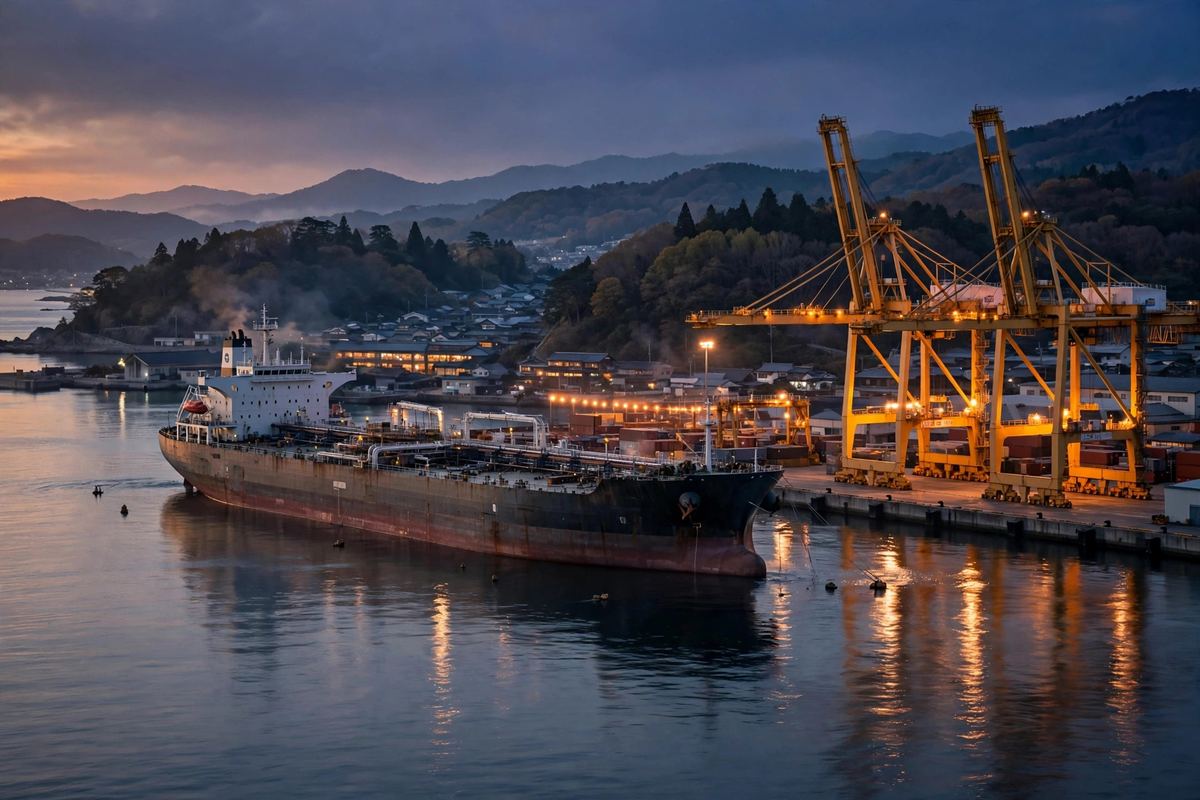
On October 13, 2026, Japan's cabinet approved three bills aimed at strengthening the country's energy supply security, Industry Minister Ryosei Akazawa said at a press conference in Tokyo — the most concrete legislative step yet in a months-long government drive to reduce the country's dependence on the Strait of Hormuz. The package would create a grant programme to help oil importers pay the extra cost of shipping crude via routes that bypass the strait, allow the government to backstop tanker insurance when foreign reinsurers withdraw coverage, and expand the powers of the state-backed Japan Organization for Metals and Energy Security (JOGMEC). The government plans to submit the bills to parliament during the current extraordinary Diet session, according to Reuters and OilPrice.com.
Background: Japan's Hormuz problem
Japan is one of the world's largest energy importers, and its reliance on the Middle East is extreme: in 2025, the country sourced 94% of its crude oil imports from the region, with 93% of those shipments passing through the Strait of Hormuz — the narrow waterway between Iran and Oman that carries a significant share of global oil traffic. Any disruption in that corridor, from military escalation to insurance market stress, translates almost immediately into higher freight and insurance costs for Japanese refiners, and ultimately into higher fuel and electricity prices for households and factories.
The risks are not theoretical. Escalating Middle East tensions have already pushed Japan's oil import bill to record highs, with freight and insurance costs surging alongside crude prices, according to energy market reporting. In August 2026, the government unveiled a comprehensive plan to strengthen energy supply resilience, with specific legislative measures expected to be finalised by the end of the year. The three bills approved on October 13 are that plan's legislative core.
The economics behind the urgency are visible across Asian markets. Recent oil-driven swings in Asian equity markets have shown how quickly energy shocks can spill over into the wider economy, hitting the Nikkei alongside regional indexes. Japan's vulnerability is structural: the country must import virtually all of its fossil fuels, so the price and reliability of imported crude and liquefied natural gas (LNG) feed directly into domestic inflation and industrial costs.
What happened: the three bills explained
The first and most consequential bill would create a grant programme to compensate importers for the higher transportation costs of sourcing crude oil and fuels via alternative routes that avoid strategic chokepoints such as the Strait of Hormuz. Under the proposed scheme, importers — including oil refiners, trading houses and petrochemical manufacturers — would submit procurement plans to the government in advance; once officials confirm the plans are not overly dependent on Hormuz, the importers become eligible for grants covering the incremental shipping costs.
Crucially, the scheme would be fully funded by contributions from a broad base of industry participants — oil refiners, traders and petrochemical manufacturers — rather than drawing on general tax revenue, according to the industry ministry. That design spreads the cost of national energy resilience across the companies that benefit most directly from secure supply, while shielding taxpayers from the bill.
The second bill addresses insurance. It would allow the government to cover part of insurance payouts for oil tankers and other vessels carrying petroleum products and LNG if foreign reinsurers are unable to provide coverage because of heightened geopolitical tensions, an industry ministry official said. Marine insurance markets are often the first to seize up in a crisis: when reinsurers withdraw from high-risk corridors, shipowners can be left unable to sail even if the physical route is open.
The third bill amends the law governing JOGMEC, the state-backed Japan Organization for Metals and Energy Security, so the agency can invest in infrastructure needed to secure alternative supply routes, including pipelines. Until now, JOGMEC's remit has been narrower; the amendment would turn it into a more active investor in the physical corridors — pipelines and related logistics — that could carry energy to Japan without relying on vulnerable sea lanes.
"Through these three bills, we aim to improve supply security by diversifying sources of crude oil and other fossil fuels and reducing related risks," Akazawa told the press conference, as reported by Reuters.
Why it matters
The package matters for three overlapping reasons: energy prices, inflation, and industrial resilience. Japan imports nearly all of its fuel, so any disruption in Hormuz feeds quickly into petrol prices, electricity bills and the cost of running factories. The grant programme is designed to make the economically rational choice — diversifying supply — affordable for importers before a crisis hits, rather than scrambling to reroute after one does.
The timing also intersects with monetary policy. The International Monetary Fund said in its World Economic Outlook, released October 13, that the Bank of Japan will likely raise interest rates gradually "toward a neutral setting" despite slower growth, as higher energy prices feed inflation — as reported by Reuters. The BOJ raised rates to a 31-year high of 1.25% in September, and the IMF projects Japan's economy will grow just 0.7% in 2026 and 0.7% in 2027, with fiscal support measures partly cushioning the energy shock. Japan's heavy reliance on imported fuel and raw materials, the Fund noted, makes its economy particularly vulnerable to the inflationary impact of the energy shock and a weak currency.
There is also a broader industrial logic. Energy resilience underpins the competitiveness of Japanese manufacturers, from refineries to the export-oriented industries that power the economy. Japan's deepening economic partnership with India shows how Tokyo is simultaneously diversifying its economic ties across Asia — and reliable energy underpins all of it. Meanwhile, Japanese industrial investment across Southeast Asia reflects the same strategic instinct: spread exposure, reduce single points of failure.
Key facts at a glance
- Japan's cabinet approved three energy-supply security bills on October 13, 2026; they will be submitted to the extraordinary Diet session for parliamentary debate.
- Bill one creates industry-funded grants compensating importers for higher transport costs on routes bypassing the Strait of Hormuz.
- Bill two lets the government backstop part of tanker and LNG-vessel insurance payouts when foreign reinsurers withdraw amid geopolitical tensions.
- Bill three amends the JOGMEC law so the state agency can invest in alternative supply-route infrastructure, including pipelines.
- In 2025, Japan sourced 94% of its crude imports from the Middle East, with 93% passing through the Strait of Hormuz.
- The bills follow a comprehensive energy-resilience plan unveiled in August 2026, with legislative steps expected by year-end.
What happens next
The bills now go to parliament, where debate will take place during the current extraordinary Diet session. Passage is not automatic: lawmakers will scrutinise the details, including the size of the industry contributions that will fund the grant programme and the precise trigger conditions for the government insurance backstop. Those implementation details will determine how attractive the scheme actually is for refiners and traders weighing a reroute.
Energy analysts will also be watching for early signs of behaviour change — whether Japanese importers begin locking in more non-Hormuz supply contracts, and whether the insurance backstop steadies freight and reinsurance markets. The grants only work if importers use them; the government's task will be to make the alternative routes financially competitive with the cheap, short Hormuz corridor.
For households and businesses, the immediate effect is indirect. The bills are a preventive measure, not a price cut — but if they succeed in diversifying Japan's oil lifelines, they could dampen the next energy-price spike before it reaches the petrol pump. With the IMF flagging energy shocks as a live inflation risk for Japan, that insurance value is the whole point.