
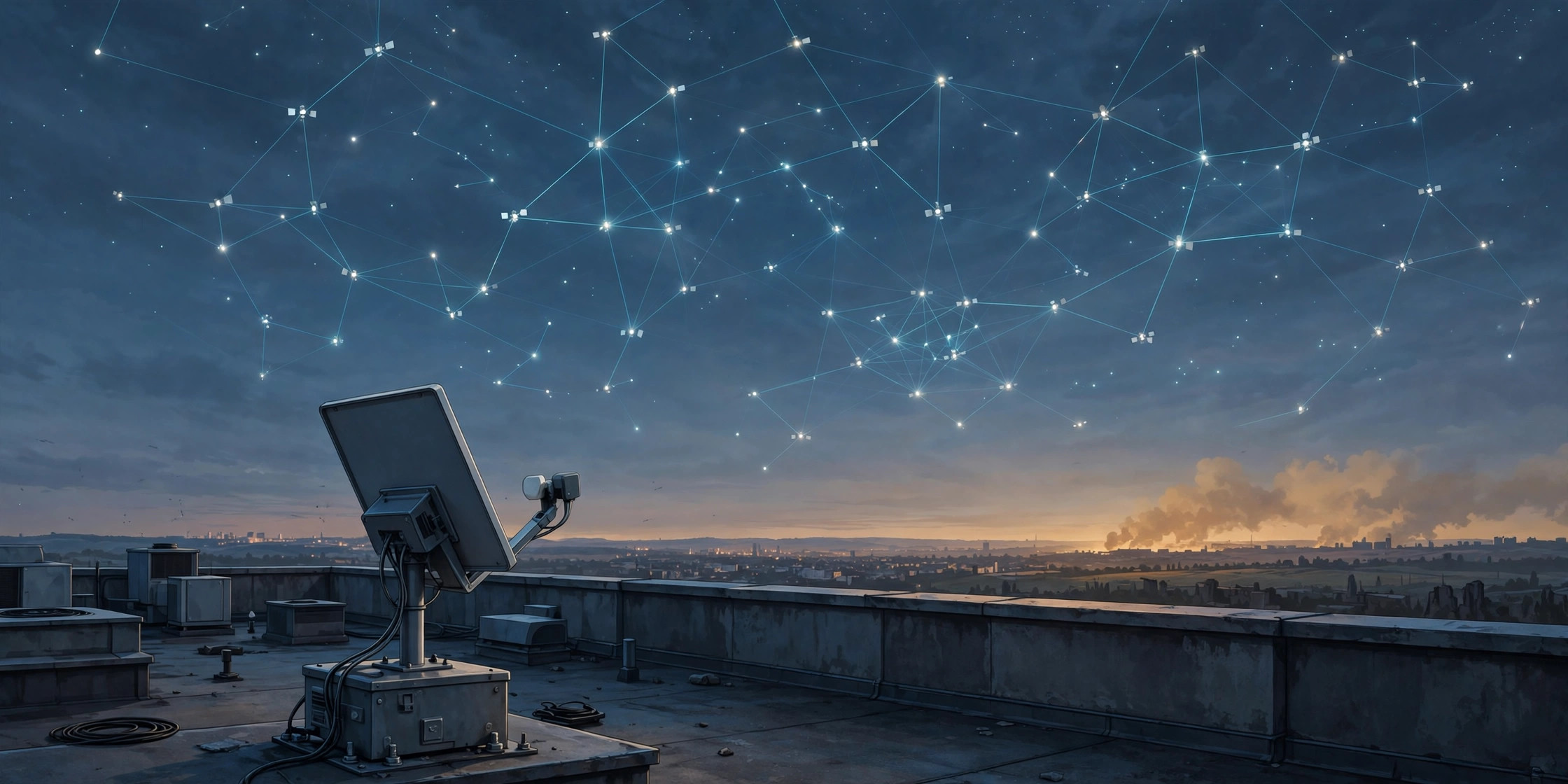
Starlink Ukraine service is restored. After more than a week of speed restrictions that disrupted Ukrainian military operations, Ukraine's defence ministry confirmed on Saturday 24 October 2026 that Starlink and Starshield connections are once again stable at speeds above 400 kilometres per hour — the level its forces need for front-line logistics and for defending against Russian attack drones. The story is trending per news coverage worldwide, because the restoration came with a fresh twist: SpaceX chief Elon Musk publicly accused Ukraine of violating Starlink's terms of service by using the civilian satellite network for offensive drone strikes. The episode has turned a piece of battlefield infrastructure into a public row between Kyiv, SpaceX and Washington — and it has raised an awkward question with no clean answer: who actually controls the connectivity Ukraine's military depends on?
President Volodymyr Zelenskyy announced the restoration himself. "Starlink and Starshield have resumed operations at their pre-restriction speeds. The speeds are now at the level we need," he wrote on Telegram on Saturday, adding that the recovery began overnight and was sufficient by Saturday morning. Ukraine's defence minister, Yevhenii Khmara, told journalists the ministry was recording stable connections at more than 400 km/h. "This is crucial. This really matters: for our frontline logistics, for defending Ukraine against jet-powered Shaheds," Zelenskyy said, referring to Russia's fast attack drones.
Starlink Ukraine speed cap: what changed on 14 October
The trouble began overnight between 13 and 14 October 2026, when Ukrainian terminals started losing their satellite link whenever they moved faster than about 100 miles per hour (160 km/h). The restriction hit Starshield, the military-grade package built on SpaceX's Starlink network, rather than the civilian service used by households and businesses. Ukraine's forces received no advance warning. Serhii Beskrestnov, a presidential adviser on defence technology, said on Telegram that the lack of notice "led to the disruption of several missions," and Ukraine's 7th Rapid Reaction Corps reported connection drops of 10 to 20 seconds at speeds of 110 to 120 km/h. In some cases, terminals reportedly began dropping even at 60 to 70 km/h, suggesting an uneven rollout rather than a clean technical cutoff.
The 160 km/h figure mattered because of the physics of drone warfare. Russia's jet-powered Shahed attack drones fly at roughly 370 km/h, and Ukraine's interceptor drones — which rely on the satellite link for in-flight control — need to move fast to catch them. Capped at 160 km/h, the interceptors were, in the words of one Ukrainian assessment, close to useless against the fastest incoming threats. The restriction also hampered Ukraine's own strike drones and disrupted front-line communications, forcing commanders to cancel or rework missions. The speed limit was reportedly applied without warning on 14 October, and even after a partial easing, Ukrainian defence ministry sources were still reporting connection losses at 161 km/h as late as the morning of 23 October.
Musk accuses Ukraine of violating Starlink terms
Hours after Zelenskyy confirmed the restoration, Musk gave his own version of events on X. "Ukraine military violated Starlink terms of service and used it for offensive drone strikes to kill people. That loophole was closed last week," he wrote. "Using Starlink, a civilian commercial service, for offensive drone strikes to kill people has never been allowed, nor should it be." Musk maintained that decisions about Starshield — the military-grade tier — rest with the US government, which owns and controls that service even though SpaceX operates the underlying network, while the civilian Starlink service is limited to civilian and defensive uses.
Kyiv pushed back on the substance. Beskrestnov said Ukraine was "physically unable" to use Starlink for long- and medium-range attack drone operations, and that long-range strikes on targets inside Russia, including oil refineries, operated at speeds of no more than 70 to 90 km/h and did not rely on Starlink. Ukraine's general staff and defence ministry did not immediately comment on Musk's allegation. The dispute over who ordered the restriction has never been fully resolved: Reuters reported, citing US and Western officials, that the directive originated inside the White House, while the White House and the secretary of state have denied ordering it, and the Wall Street Journal reported that President Donald Trump telephoned Musk on Wednesday and asked him to address the slowdown. Service improved soon afterwards, though not all limits were lifted at once.
Starlink Ukraine explained: Starlink vs Starshield
Understanding the row means understanding the two services. Starlink is SpaceX's commercial broadband satellite constellation, sold to households, businesses, travellers and — since the first weeks of Russia's full-scale invasion in 2022 — donated and contracted in large numbers to Ukraine. Starshield is a separate, hardened tier built on the same satellite network for US government and allied military use. Ukraine's access to Starshield runs through a US Department of Defense contract, which is why the question of who gave the order — SpaceX, the Pentagon or the White House — has been so politically charged. Musk has said Starshield limits are decided by the US military and ultimately the president; US officials have variously denied ordering the cap or described it as a decision "to slow down internet or slow down speed so that certain drones couldn't use it."
The cap also had a defensive origin story that complicates the blame game. SpaceX had earlier whitelisted only Ukraine-registered terminals after Russia began bolting Starlink Mini terminals onto its own strike drones to slip past Ukrainian jamming — a move that, according to Ukrainian commanders, cut Russia's drone campaign by as much as 40 percent. The same network that shields Ukraine can therefore be reconfigured, by a settings change, into a constraint on Ukraine. That is what makes the episode so unsettling for Kyiv and for other governments watching: a decision with battlefield consequences can be executed as a change of service terms, without a public signature.
What the Starlink Ukraine restoration means for the war
For Ukraine's military, the immediate effect is practical. Stable connections above 400 km/h restore the interceptor drones' ability to chase jet-powered Shaheds, keep front-line logistics linked, and let commanders plan missions without building in a speed penalty. The restoration also arrives alongside a diplomatic push: Russia agreed on Wednesday to resume three-way negotiations with Washington and Kyiv next month, and Kyiv and Moscow agreed on Friday to a localised ceasefire brokered by first lady Melania Trump around Oleshky, a war-ravaged town in the Russian-occupied Kherson region. Whether the restored connectivity holds through those talks — and whether Musk's accusation hardens into a new set of terms — will shape how much Ukraine can rely on the network in the months ahead.
For the wider world, the episode is a warning about dependence on a single private network for a public, military-critical function. Ukraine has no alternative at comparable scale today: Amazon's Leo constellation and European low-earth-orbit alternatives exist, but none currently matches Starlink's terminal footprint or operational track record for Ukraine's drone programmes. Kyiv is now pushing toward a connectivity option it can control more directly, but that will take time and money it can ill afford mid-war. The Starlink Ukraine saga began as a technical setting and became a test of sovereignty — and the test is not over. Musk's accusation, Zelenskyy's confirmation and the unresolved question of who ordered the cap all point to the same conclusion: the restoration solves the speed problem, but not the control problem.
Related reading: Trump Called Musk to Lift Ukraine Starlink Restrictions, Report Says, Putin Agrees to Resume Trilateral Ukraine Talks in November After Witkoff Meeting, Zelensky Would Accept a Front-Line Freeze to End the Ukraine War, and Elon Musk Says a Tesla–SpaceX Merger Could Work. Here's What It Would Mean.
Sources: BBC News; Reuters via AnewZ; Fox Business; The Wall Street Journal via Fox Business; The Sun; Thames Compass; Tech Insider; Ukrinform via Thames Compass.