
SpaceX $74 billion is the number Elon Musk's company has put on its biggest bet yet beyond rockets. On Thursday 12 November 2026, SpaceX said it will spend more than $74 billion building two artificial intelligence supercomputing campuses — more than $24 billion at its Starbase site in Texas and roughly $50 billion in Cochise County, Arizona. The Arizona campus alone could draw up to 6 gigawatts of power at full buildout, spread across nine buildings on 747 acres of high desert near the town of Willcox. Neither campus is a done deal. Both face public votes on 9 December, and in Arizona a petition carrying 2,400 signatures is asking county officials to deny the permit. Here is what the plan builds, what it costs, who still has to say yes, and why a rocket company that went public in June 2026 now earns more than half of its revenue from AI.
What the SpaceX $74 Billion Plan Actually Builds
The two campuses do the same job in very different places. At Starbase, on the Texas Gulf Coast, SpaceX plans a supercomputing facility on about 444 acres between Boca Chica Boulevard and the Port of Brownsville, near the city's landfill. It would run on its own gas-fired power plant and generate its own electricity rather than drawing from the public grid, and it would train what SpaceX calls frontier AI systems — the largest, most capable models — for medical research, emergency response, advanced manufacturing and national security, while supporting development and testing of future space-based computing. Construction there is already under way: SpaceX says the Texas project has generated more than 3,000 construction jobs so far and would support more than 500 permanent roles once operating. The company has also committed $220 million to Brownsville-area water and wastewater infrastructure.
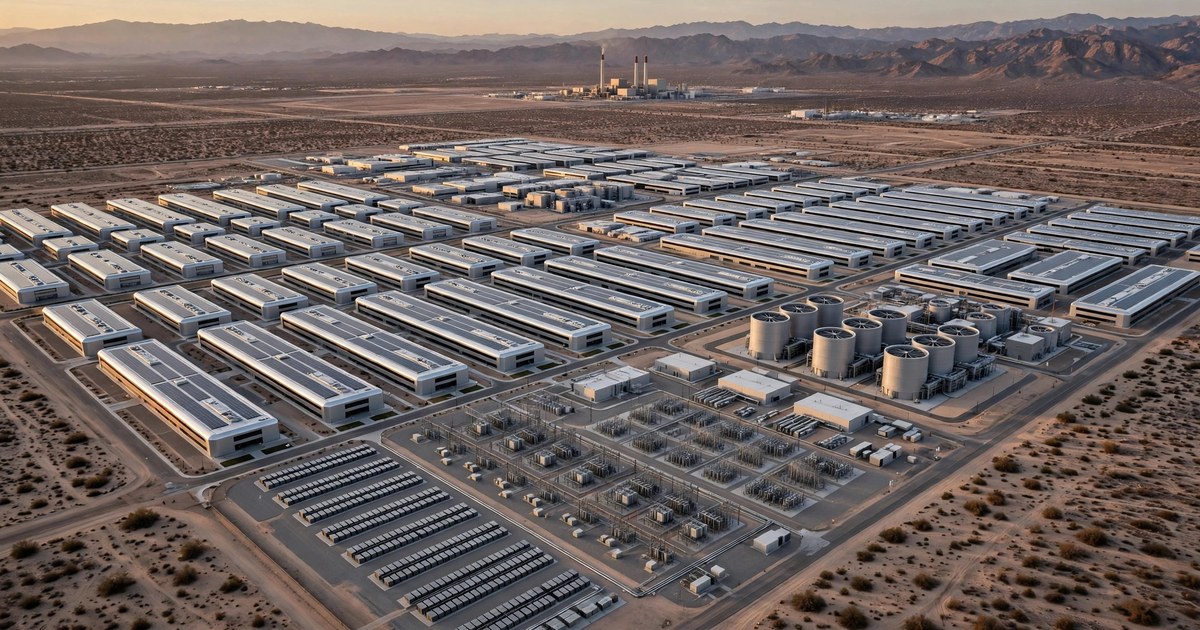
The Arizona campus is the bigger of the two and the earlier in its life. The plan calls for nine single-storey compute buildings of about 493,000 square feet each, plus electrical buildings, an operations and security building, and outdoor yards for dry coolers, transformers and battery storage, built in four phases of about 1.5 gigawatts each to reach 6 gigawatts at full buildout. SpaceX says the campus would use dry cooling with no planned industrial groundwater use, and estimates total water use at full buildout at up to 10 acre-feet a year across all site purposes. It could cut power bills for members of the local electric cooperative by up to 20%, according to Reuters. SpaceX estimates approximately 5,500 construction jobs at peak and 1,000 permanent jobs — 6,500 jobs in all.
The Arizona application was filed by Tombstone Resources LLC, a SpaceX affiliate, for 747 acres along US Highway 191 near the Willcox Playa. SpaceX confirmed at a public meeting on 4 November that it was behind the proposal. The $24 billion Texas figure comes from a Starbase city notice, and the $74 billion total is the sum of the two projects as SpaceX stated it in its announcement, reported by Reuters and confirmed by The Wall Street Journal.
SpaceX $74 Billion AI Campuses Face Two Votes on 9 December
The money is promised; the permission is not. Both projects face a public decision on the same day, 9 December 2026. In Arizona, the Cochise County Planning and Zoning Commission will hear the special use application, SU26-22, at 2:00 p.m. Cochise County does not allow data centres by right, so the campus needs that permit before anything can be built, and a petition with 2,400 signatures asks officials to deny it. The Arizona power arrangements with the local electric cooperative also still have to be finalised.
In Texas, the Starbase City Commission is due to consider a property-tax abatement and an economic development agreement for the project on 9 December. The $24 billion Texas estimate covers the initial phases while allowing for future expansion, according to a Starbase public hearing notice that identifies Space Exploration Technologies Corp. as the owner and applicant for the gas-fired power plant and supercomputing facility.
That shared date is the first real test of the plan. A yes in both places keeps the timetable moving; a no in Cochise County would stall the larger, $50 billion half of the investment, and a rejected abatement in Starbase would change the economics of the Texas site. SpaceX has not disclosed accelerator suppliers, network architecture or commissioning schedules for either campus, so the votes are also the first public moment when the projects stop being a press release and start being a planning record.
Why Arizona's 6 GW Campus Is the Harder Sell
Scale is the Arizona problem. A 6 gigawatt campus would draw close to ten times the capacity of the nearby Apache Generating Station, which is why negotiations with the local grid sit at the centre of the timeline. The site is desert, so water is the second question, and SpaceX's answer is dry cooling, no industrial groundwater use, and a capped 10 acre-feet a year — a figure the company has put in writing. The third question is local consent: 2,400 signatures on a petition to deny the permit is a substantial number in a rural county, and the 9 December hearing is where that opposition gets its formal airing.
Texas is the easier half of the plan precisely because it is further along. The Starbase site already generates its own electricity, the gas plant is part of the application rather than a new negotiation, and construction jobs already exist there. The contrast is the story of the whole announcement: one campus is an expansion of something already happening, and the other is a $50 billion proposal that still has to win over a county, a cooperative and a regulator.
What the $74 Billion Means for SpaceX's AI Business
The announcement lands at a moment when SpaceX's business has already tilted away from rockets. Reuters reported that the company's AI segment generated more than half of its revenue in the third quarter of 2026, and quarterly revenue nearly doubled between the second and third quarters, from $7.814 billion to $14.575 billion, according to filings with the US Securities and Exchange Commission. SpaceX went public in June 2026, and the AI computing business is now the growth engine the public market is being asked to value.
That context explains the scale. The $74 billion follows an earlier $40 billion AI financing, confirmed in a filing in October, that covers leased computing capacity — a deal this site covered when the filing landed. Musk had already warned in October about the economics of renting AI compute from neocloud providers, which is part of why owning the campuses matters to SpaceX. The spending also fits a wider pattern of AI infrastructure investment this year, including Meta's $37.5 billion stock offering, priced in October as Nvidia invested $3 billion. The two campus projects are the physical side of the same push: owned supercomputing sites to train the models that the leased capacity serves. But the figure itself deserves a caution. It is SpaceX's own number, and none of it is contracted capacity or revenue. The company gave no split between buildings, power and chips, no dates past the first phase in Arizona, and no supplier names. A campus announcement is a spending plan, not a revenue line.
What Happens Next
The next date that matters is 9 December, when the Cochise County hearing and the Starbase tax-abatement vote both take place. After that, the questions are practical: whether the Arizona power arrangements close, whether the county permit survives any appeal to the Board of Supervisors, and when SpaceX names the chip suppliers and a commissioning schedule for either site. The longer question is whether a company that built its name launching rockets can run some of the largest computing sites on Earth — and whether the two counties that have to host them agree to the deal. The $74 billion is on the table. The permission is not.
Sources: Reuters; The Wall Street Journal; Bloomberg; The Hindu Business Line; Data Center Dynamics; Texas Tribune.