
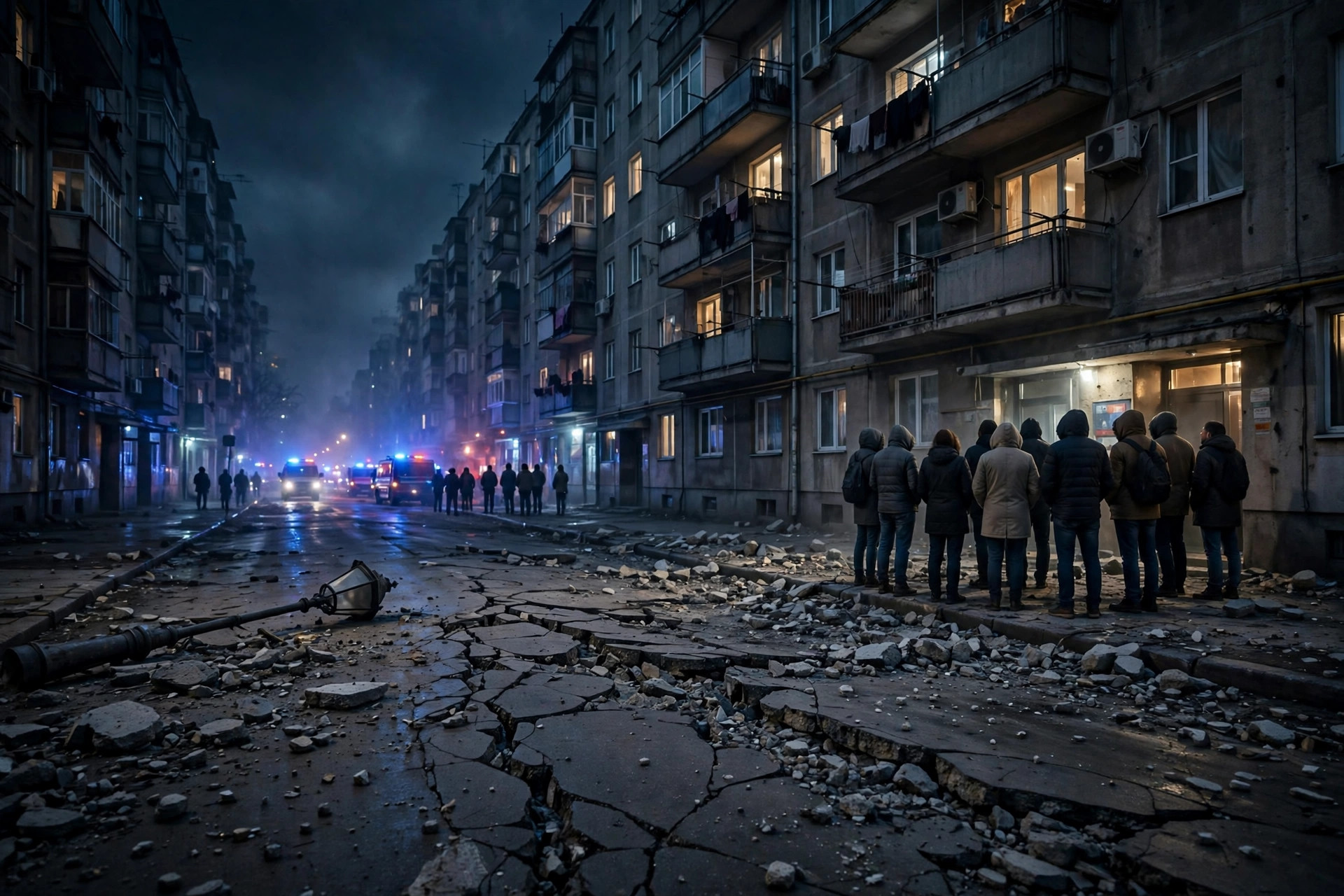
Romania earthquake warnings lit up phones across the country in the early hours of Wednesday 18 November 2026, and the number many people saw first was not the number seismologists settled on. A magnitude 5.7 earthquake, according to Romania's National Institute for Earth Physics, known as INFP, struck Romania's Vrancea seismic zone at 02:48 local time, at 02:48:55 by the precise timing. The depth was first given as 107.1 kilometres and later revised to 120.8 kilometres, and the epicentre was about 48 kilometres south of Focșani and 74 kilometres east of Brașov, in Vrancea and Covasna county. Google's Android earthquake alert displayed an initial estimate of 6.5 on some phones, and that figure spread quickly. It was an early automated estimate, not the quake's magnitude, and the gap between 6.5 on a phone screen and 5.7 from INFP is the heart of this story. Two people were injured by falling furniture and a wardrobe door inside their homes, several others suffered panic attacks, and emergency crews found no material damage and no deaths. This article explains what happened, why the numbers differ, and why a quake that caused so little damage was felt so widely.
Romania earthquake: what happened in Vrancea
The Romania earthquake struck the Vrancea seismic zone at 02:48 local time on Wednesday 18 November 2026, at 02:48:55 by the precise timing given in the reporting. INFP, Romania's National Institute for Earth Physics, put the magnitude at 5.7, and that is the figure this article uses as the Romanian institute's measurement. The depth was revised from 107.1 kilometres to 120.8 kilometres, which makes it a deep earthquake by the standards of most quakes people feel, and the epicentre was about 48 kilometres south of Focșani and 74 kilometres east of Brașov, in Vrancea and Covasna county. The revised INFP intensity was VI, which describes strong shaking felt by many people indoors, with some furniture moving and objects falling. Two people were injured by falling furniture and a wardrobe door inside their homes, and several others suffered panic attacks, according to the reporting. Emergency crews from IGSU, the emergency inspectorate, checked nine counties and Bucharest and found no material damage, and no deaths were reported. The quake was felt strongly in Bucharest and across eastern and southern Romania, including Iași, Galați, Buzău, Brăila and Constanța, and it was also felt in Moldova, in the capital Chișinău, and in Ukraine and Bulgaria. Seismologists described it as the most significant quake in Romania in recent years, according to Digi24, and a magnitude 5.7 is classed as moderate.
Romania earthquake: why the numbers differ — 5.3, 5.7 and 6.5
The reason the Romania earthquake seemed to have three magnitudes at once is that different agencies measure the same shaking in different ways, and the phone alert was a different kind of number altogether. INFP put the magnitude at 5.7. Other agencies measured it differently: the European-Mediterranean Seismological Centre, EMSC, gave 5.3, the United States Geological Survey, USGS, gave 5.3, and Romania's Department for Emergency Situations gave 5.6. INFP's own preliminary report gave a moment magnitude of 5.8, with a possible range of 5.4 to 6.1. That range is the honest way to read the early figures: the institute's first calculation came with an uncertainty band, and the final figure of 5.7 sits inside that band. The differences between 5.3, 5.6 and 5.7 reflect different instruments, different stations, different methods and different moments in the calculation, and they are normal in the first hours after a quake. The 6.5 that appeared on some phones is a different matter. Google's Android earthquake alert displayed an initial estimate of 6.5, and that was an early automated estimate, not the quake's magnitude. Automated alerts are designed to warn people fast, so they publish a first estimate before the full data has been processed, and that first estimate can be higher than the figure the institutes settle on. The 6.5 was the number that reached people first, and the 5.7 was the number that survived the full calculation, and the gap between them is a story about speed against accuracy rather than a disagreement about what happened underground.
Why a deep quake is felt so far away
The depth of the Romania earthquake is the key to why it was felt across such a wide area. The depth was revised from 107.1 kilometres to 120.8 kilometres, which puts the source of the shaking far below the surface, and deep quakes in the Vrancea zone are known for being felt over long distances. The shaking was felt strongly in Bucharest, which is a long way from an epicentre about 48 kilometres south of Focșani and 74 kilometres east of Brașov, and it was felt across eastern and southern Romania, in Iași, Galați, Buzău, Brăila and Constanța. It crossed borders too: it was felt in Moldova, including the capital Chișinău, and in Ukraine and Bulgaria. A shallow quake of the same magnitude would shake a smaller area more violently near the epicentre and fade quickly with distance, while a deep quake spreads its energy over a wider area, so more people feel it even though the shaking at any one place is less destructive. That is consistent with what the emergency crews found: IGSU checked nine counties and Bucharest and found no material damage, and no deaths were reported, even though the shaking was strong enough to injure two people inside their homes and to cause panic attacks in several others. The revised INFP intensity of VI describes that pattern — strong shaking, furniture moving, objects falling — rather than the damage to buildings that a shallower quake of the same size might cause. The depth, in other words, explains both the reach of the shaking and the limited damage.
Why no RO-ALERT went out
Romania's official RO-ALERT system sent no warning for the Romania earthquake, and that absence is part of the story that needs explaining. The reporting states the fact plainly — no RO-ALERT warning was sent — and it does not give a reason from the authorities for why the system did not trigger. What the reporting does show is that a different alert did reach people: Google's Android earthquake alert displayed an initial estimate of 6.5 on some phones, and that was the warning many people saw. The two systems work differently. RO-ALERT is the official Romanian system, and the Android alert is an automated system run by Google that uses phone sensors to detect shaking and issue an early estimate. On this occasion the automated system issued a figure, and the official system did not issue a warning at all. The contrast is what people noticed in the early hours: a phone showing 6.5 from an automated alert, and no message from the official system. The reporting does not say whether the official system failed, whether the quake did not meet its trigger, or whether the timing of a deep quake at 02:48 local time played a part, and this article does not guess at a reason. What can be said is that the absence of a RO-ALERT warning, set against the presence of the Android alert, is now one of the questions the event raises, and it is a question for the authorities who run the official system to answer.
Injuries, damage checks and the areas that felt it
The human impact of the Romania earthquake was limited, and the reporting gives a precise account of it. Two people were injured by falling furniture and a wardrobe door inside their homes, and several others suffered panic attacks. Those are the only injuries reported, and no deaths were reported. Emergency crews from IGSU checked nine counties and Bucharest and found no material damage, which is a thorough check across the area where the shaking was felt most strongly. The list of places where the quake was felt shows how wide the shaking spread: in Romania, it was felt strongly in Bucharest and across eastern and southern Romania, including Iași, Galați, Buzău, Brăila and Constanța, and beyond Romania it was felt in Moldova, including the capital Chișinău, and in Ukraine and Bulgaria. The epicentre, about 48 kilometres south of Focșani and 74 kilometres east of Brașov in Vrancea and Covasna county, sits in a zone whose quakes are felt far from their source, and the list of towns and capitals that reported shaking matches that pattern. The injuries — falling furniture and a wardrobe door inside homes — are the kind of harm a strong but not destructive quake causes: objects move, people are startled, and the damage is to what is inside a room rather than to the building itself. The panic attacks reported alongside the injuries fit the same picture: a quake at 02:48 local time, when most people were asleep, that shook homes strongly enough to wake them and move furniture, without damaging the buildings around them.
Vrancea, 1977 and what seismologists say next
The Vrancea zone produces most of Romania's earthquakes, according to the reporting, and that history is the background to the 18 November quake. The zone's most famous event is the deadly quake of 1977, which the reporting names as the reference point for Vrancea's danger, and the 18 November quake is described by seismologists as the most significant quake in Romania in recent years, according to Digi24. A magnitude 5.7 is classed as moderate, which puts the 18 November event in context: it is large enough to be felt across several countries and to injure people indoors, but it is not in the class of the 1977 quake, and the damage check supports that reading, with IGSU finding no material damage across nine counties and Bucharest. Aftershocks remain possible, according to the reporting, and that is the normal warning after a quake of this size: the ground can continue to move in smaller shocks after the main event, and people in the affected area should expect that possibility. The depth revision, from 107.1 kilometres to 120.8 kilometres, and the magnitude range in INFP's preliminary report, from 5.4 to 6.1 around a moment magnitude of 5.8, show how the picture sharpened as more data came in. The final INFP figure of 5.7, the EMSC and USGS figures of 5.3, and the Department for Emergency Situations figure of 5.6 are the numbers that now stand, and the early automated estimate of 6.5 on some phones is the number that did not. For related recent shaking, see the magnitude 5.1 earthquake in Crete, Cyclone Xavier, a category 5 storm in the Cook Islands, and Voyager 1 reaching one light-day away on 18 November.
Why it matters and what happens next
The Romania earthquake matters for two reasons, and both are about information as much as about shaking. The first is the gap between the number people saw and the number the institutes settled on: Google's Android alert showed an early automated estimate of 6.5 on some phones, while INFP put the magnitude at 5.7, EMSC and USGS at 5.3, and the Department for Emergency Situations at 5.6. That gap is not a mystery once the process is understood — an automated alert publishes fast and revises later, while an institute's figure comes after the full calculation — but it is a gap that can alarm people in the middle of the night, and it shows why the source of a number matters as much as the number itself. The second reason is the absence of a RO-ALERT warning from Romania's official system, set against the fact that the quake was felt strongly in Bucharest and across eastern and southern Romania and in three neighbouring countries. What happens next is practical: aftershocks remain possible, and people in Vrancea and the wider felt area should expect smaller shocks; the emergency checks by IGSU across nine counties and Bucharest found no material damage, and no deaths were reported, so the immediate response is over; and the questions about the alert systems — why the automated estimate read 6.5, and why the official system sent no warning — are now questions for the authorities and for Google to answer. The quake itself, at magnitude 5.7 and a revised depth of 120.8 kilometres, was the most significant in Romania in recent years, according to Digi24, and it is a reminder that the Vrancea zone, which produces most of Romania's earthquakes and produced the deadly quake of 1977, is still active.
Sources: Valahia.news, NatureWorldNews, Mediafax, Digi24, EMSC, November 2026.