
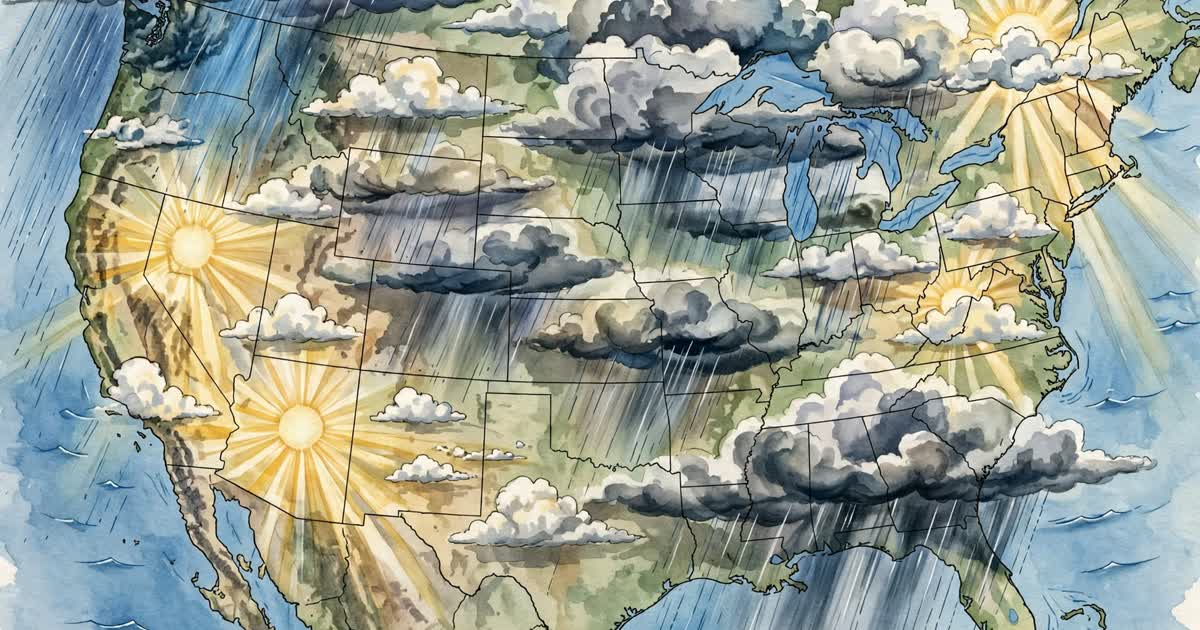
Every morning, millions of people check a US weather forecast before deciding what to wear, whether to travel, or how to plan a weekend outdoors. A forecast is far more than a single temperature number: it bundles temperature, precipitation chances, wind, humidity, and hazards into one short summary, and learning to read each part helps you make better decisions every day.
The US weather forecast system is built around the National Weather Service, which divides the country into local forecast offices that issue detailed outlooks for their areas. Private apps and websites then repackage that official data with their own models and maps. Knowing which source to trust, and when, is the key skill this guide teaches.
How to Read a US Weather Forecast
A typical the American weather forecast starts with the headline numbers: the high and low temperature, the chance of precipitation, and a short condition phrase such as sunny, partly cloudy, or showers likely. The chance of precipitation deserves special attention, because it describes the probability that a measurable amount of rain or snow falls somewhere in the forecast area, not the share of the day that will be wet. A 40 percent chance does not mean rain for 40 percent of the day.
Below the headline, a good US weather forecast adds hourly detail, wind speed and direction, humidity, and the feels-like temperature, which accounts for wind chill in winter and heat index in summer. Check the hourly view when timing matters, for example before a morning run, a school trip, or a drive over a mountain pass. Daily summaries hide short bursts of heavy rain or a sharp afternoon temperature drop that the hourly view reveals clearly.
US Weather Forecast by Zip Code and City
Searching a US weather forecast by zip code gives you the most local outlook available, because the National Weather Service tunes its forecast to small geographic areas rather than whole states. Two towns twenty miles apart can sit on opposite sides of a rain band or a temperature boundary, especially near coasts, lakes, and mountains. Always enter your exact location rather than relying on the nearest big city.
City-level forecasts are useful for travel planning, but they smooth over local variation. If you are visiting a large metro area, check the forecast for the specific neighbourhood or suburb where you will stay, and recheck it on arrival. Elevation also matters: a forecast for Denver will not match conditions in the foothills above it, and a coastal forecast will differ sharply from one issued a few miles inland.
Reading US Weather Radar Like a Pro
Radar maps are the most powerful part of any US weather forecast app, because they show where rain, snow, and storms actually are right now, not just where models expect them. Green shades mean light rain, yellow and orange mean moderate to heavy rain, and red or purple usually signal intense storms or hail. Motion matters more than colour alone: a storm moving toward you at speed deserves more attention than a slow-moving patch of light rain.
Learn to read radar in layers. The base reflectivity view shows precipitation intensity, while velocity view reveals rotation inside storms, which forecasters use to spot tornado potential. Most free apps offer a radar loop, and watching the last hour of movement tells you whether a storm is strengthening, weakening, or changing direction. Radar cannot see every shower, especially in mountainous areas, so treat it as a guide alongside the written forecast.
Severe Weather Warnings in a US Weather Forecast
The US weather forecast warning system uses three levels that are easy to confuse but important to separate. A watch means conditions are favourable for severe weather in the area, so stay alert. A warning means dangerous weather is happening or imminent, so act now. An advisory covers less dangerous conditions that still need caution, such as dense fog or minor flooding. The distinction between watch and warning is the single most important safety concept in American weather.
Warnings arrive through phone alerts, weather radio, television, and apps, and the most serious ones, such as tornado warnings and flash flood warnings, should never be ignored. Keep a weather radio or an app with location-based alerts enabled, and know in advance where you would shelter for a tornado or where high ground is during flooding. A US weather forecast is only useful if its warnings reach you in time and you have a plan ready.
Planning Travel and Outdoor Life Around the US Weather Forecast
Seasonal patterns shape every US weather forecast, and a little climate knowledge prevents most surprises. Summer brings afternoon thunderstorms to much of the east and south, wildfire smoke to parts of the west, and hurricane risk to the Gulf and Atlantic coasts from June through November. Winter brings lake-effect snow near the Great Lakes, ice storms across the mid-South, and blizzards on the northern Plains.
For road trips, check the US weather forecast along your whole route, not just your destination, and build in buffer time for mountain passes and desert heat. For outdoor events, set a weather decision point the day before and a backup plan, rather than hoping conditions improve. Forecasts improve dramatically within 48 hours of an event, so a seven-day outlook is for rough planning only, while the one-to-two-day forecast is the one to act on.
US Weather Forecast Apps and Tools Worth Using
Choosing the right tools makes any US weather forecast easier to use. The National Weather Service website and app give official forecasts without advertising clutter, while popular commercial apps add polished radar, minute-by-minute rain predictions, and custom alerts for home, work, and travel locations. Pick one primary app for daily use and one backup source, so a single app outage or model error never leaves you blind before an important trip.
Customise alerts to your life: lightning alerts if you work outdoors, flood alerts if you live near a river, and winter storm alerts if you commute by car. Too many alerts cause people to ignore them, so turn off generic notifications and keep only the warnings that change your decisions. A US weather forecast becomes genuinely useful when it reaches you at the right moment, in a form you actually read, rather than sitting unopened in an app you never check.
For related guidance, see Barbados weather and hurricane season guide, Japan weather forecast and typhoon warnings guide, New Zealand weather warnings guide.
Sources: National Weather Service (weather.gov), National Oceanic and Atmospheric Administration (NOAA), Federal Emergency Management Agency (FEMA) severe weather guidance.