
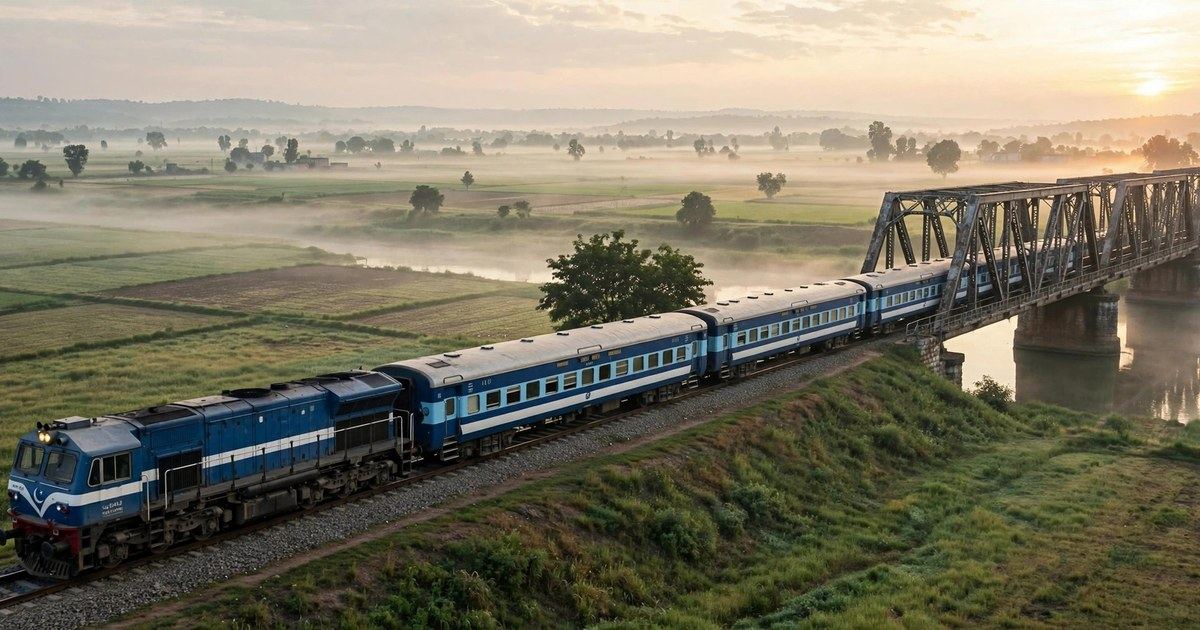
A passenger train travelling the length of Pakistan left the tracks in the early hours of Tuesday, October 13, 2026, in one of the country's deadliest rail accidents in recent years. The Rehman Baba Express, en route from Karachi to Peshawar, derailed near Sher Shah Bridge in Multan, Punjab province, with all 14 coaches going off the rails. At least five passengers were killed and more than 30 injured, according to police and rescue officials — though, as is common in the first hours of a disaster, the casualty figures are still being reconciled across reports.
The story is trending per news coverage across the Associated Press, AFP, Dawn, Geo News, The News, and the Indian and international press. It is also the latest in a grim series of Pakistani rail accidents that have renewed scrutiny of the country's ageing railway network and its maintenance record.
What happened, where and when
The derailment occurred at around 5:15 am local time on Tuesday morning, as the train passed through the Sher Shah area near Multan — one of Punjab's major railway junctions. The Rehman Baba Express is a long-distance passenger service that connects Karachi, the port city on the Arabian Sea, with Peshawar in the northwest, crossing virtually the entire length of the country. The accident interrupted one of Pakistan's most important passenger corridors, with services linking the south of the country to the north.
According to railway spokesman Kaleem Akhtar, cited by the AP, the train left the tracks in the Sher Shah area near Multan's railway station. Rescue officials said 13 of the 14 coaches had been cleared within hours of the accident, while rescue work was continuing inside the remaining coach. Several of the derailed carriages had overturned, forcing emergency teams to extract passengers trapped inside.
The injured were shifted to Nishtar Hospital in Multan for treatment, where medical teams were treating a range of injuries. Pakistan Railways arranged alternative transport and refunds for affected passengers, and a relief train was dispatched to the site to help clear the track. Railway authorities later announced that train operations through Lodhran and Jahanian had been fully restored.
The shifting casualty figures — and why they differ
Readers will notice that different outlets are reporting different numbers, and that is worth explaining rather than glossing over. The AP reported at least four killed; a Pakistan Railways spokesperson confirmed five fatalities to Dawn; Geo News, citing police and rescue officials, also reported five dead and 30 injured; and one Pakistani outlet put the toll at six killed with 30 injured. Rescue 1122 officials initially reported a higher number of injured passengers than the hospitals had confirmed.
Such discrepancies are normal in the immediate aftermath of a major accident: some figures count bodies recovered at the scene, others count only hospital-confirmed deaths, and injured passengers are often counted at multiple facilities. What is consistent across every report is the core fact: multiple passengers were killed — at least four, and likely five or more — and around 30 or more were injured. The figures are expected to firm up as rescue operations conclude and hospitals complete their assessments.
The driver's account
Rehman Baba Express driver Rizwan Abbas described the moment of the derailment to Dawn, and his account is already central to the investigation. He said the train was travelling at approximately 100 kilometres per hour when the incident occurred. The signal was clear as the train passed through the Sher Shah station area, he said — but he then felt a sudden, strong jolt. Abbas applied the brakes and brought the locomotive to a stop. Only when he stepped down did he discover that the passenger coaches behind him had derailed and were lying off the tracks.
Abbas maintained that the train had been in working condition before the incident. The 100 km/h speed is broadly consistent with normal running speeds for an express passenger service on that section of line — and investigators will now examine whether a track defect, a mechanical failure, or something else entirely caused coaches to leave the rails at speed. A clean signal and a sudden jolt point, at least initially, toward infrastructure rather than signalling as the likely avenue of inquiry.
The unconfirmed claim about coach nine
One passenger told reporters that railway workers had repaired the nuts and bolts of coach number nine near Rohri, further down the line, before the accident. The claim has not been independently verified, and it was not immediately clear whether the reported repair was in any way linked to the derailment. But if the inquiry confirms it, the question of what was done to that coach — and why — could become a decisive thread in the investigation. Maintenance records for the affected rake will be among the first documents investigators request.
The official response
Prime Minister Shehbaz Sharif took notice of the incident within hours, expressing grief over the deaths and directing the relevant authorities to expedite rescue operations and ensure the injured received the best possible medical treatment without delay. President Asif Ali Zardari likewise directed an immediate inquiry, according to Pakistani media.
Federal Minister for Railways Hanif Abbasi expressed sorrow over the loss of life and extended his condolences to the families of the deceased. According to an official statement, he directed authorities to provide the best possible medical treatment to injured passengers, and said compensation would be provided to the victims and their families in accordance with Pakistan Railways' insurance policy. Abbasi travelled to the accident site to assess the situation and review rescue efforts, and instructed the inspector of railways to investigate the cause of the derailment.
Police have also opened an investigation into the cause, running in parallel with the railway ministry's inquiry. For now, the cause of the derailment has not been officially established.
A crash amid Pakistan's rail-safety crisis
This accident did not happen in a vacuum. Pakistan's railways have suffered a series of serious incidents in recent years, and the Sher Shah derailment will inevitably be measured against the worst of them. In August 2023, the derailment of the Hazara Express near Nawabshah in Sindh killed at least 30 people and injured more than 100 — the deadliest Pakistani rail accident in years — and renewed national debate about railway safety and maintenance.
The underlying problems are well documented: ageing rolling stock, deferred track maintenance, strained operating budgets, and an overloaded network. Each major accident produces the same cycle — an inquiry ordered, compensation announced, promises of reform — followed by the next accident. For a country where railways remain a lifeline for hundreds of thousands of daily passengers, the safety question is not technical curiosity; it is a matter of public survival.
The accident also fits a grim international pattern of major transport disasters dominating the news this month. For more on how rescue and emergency systems respond under pressure elsewhere, see our coverage of the Djibouti boat disaster on the Yemen crossing and the emergency response to Tropical Storm Rachel in Southern California. The accident also comes at a moment of wider regional turbulence, from the escalation in the Gulf — see Saudi Arabia's retaliation against the Houthis — to the ongoing scrutiny of infrastructure across South Asia.
What the inquiry must establish
The investigation has four central questions to answer. First, the state of the track: investigators will examine the rails, sleepers, and ballast around Sher Shah Bridge for fractures, buckling, sabotage, or wear beyond safe limits. Second, the maintenance record: what work was done on coach nine near Rohri, as the passenger claimed, and what do the maintenance logs show for the whole rake? Third, speed and operating practice: the driver's 100 km/h figure must be cross-checked against the data recorder, where fitted. Fourth, human and systemic factors: were schedules, fatigue, and supervision within prescribed limits?
The credibility of the inquiry itself will be under scrutiny. Past Pakistani rail investigations have been criticised as slow and inconclusive. The railway minister's decision to order the inspector of railways — the sector's technical authority — to lead the investigation is a standard first step; whether the findings are published in full and acted upon will determine whether this inquiry breaks the pattern.
What happens next
Three things to watch in the coming days. First, the confirmed casualty toll: expect the numbers to settle as hospitals and rescue teams complete their counts. Second, the inquiry's preliminary findings: Pakistani rail investigations typically release initial conclusions within days, and these will indicate whether attention is focusing on track, rolling stock, or operations. Third, accountability and compensation: the railway minister has promised insurance-policy compensation, and past accidents have seen suspensions of station staff and maintenance supervisors — but rarely senior officials.
Longer term, the accident will test whether Pakistan's political system can convert another rail disaster into the sustained infrastructure investment the network needs. Until the inquiry reports, one certainty stands: a train that left Karachi for Peshawar never arrived, and families across the country are waiting for answers. Rail travel saw another serious incident in Europe, where a minibus collided with a train at the Channel Tunnel terminal in France, injuring 19 people.
Sources
Reporting drawn from the Associated Press and AFP (13 October 2026); Dawn, Geo News, and The News (Pakistan, 13 October 2026); Rescue 1122 and Pakistan Railways official statements; Mint/AFP coverage of the accident; plus background on the August 2023 Hazara Express derailment.