
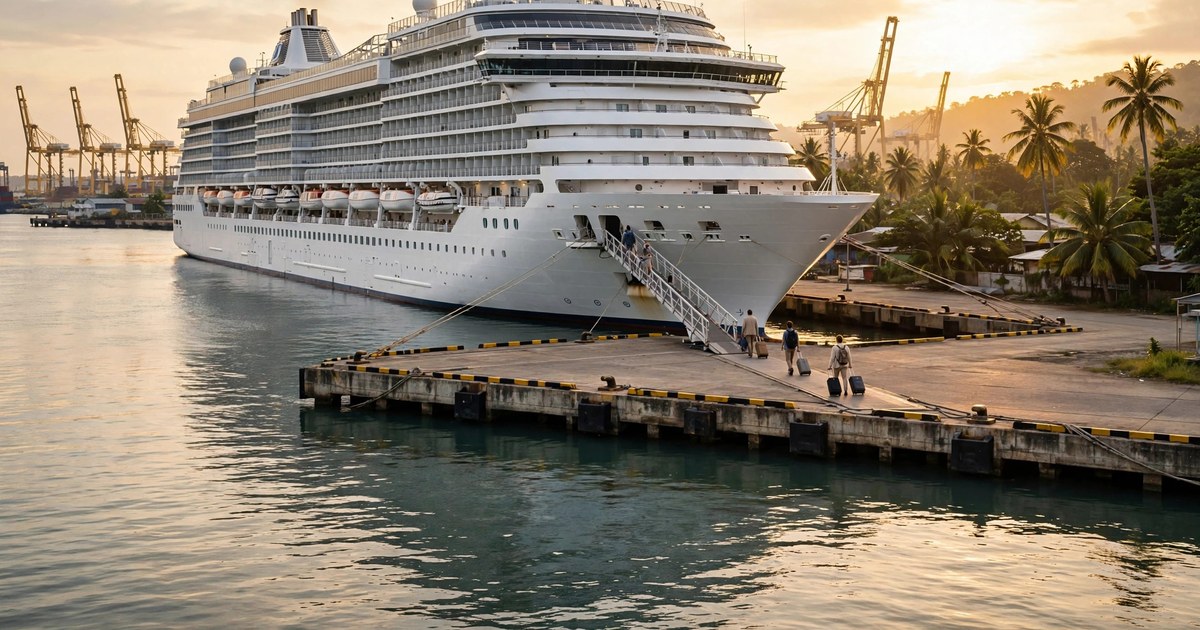
The Villa Vie Odyssey, a ship marketed as a permanent home at sea, is trending per news coverage after its voyage was suspended in Cambodia and the people living aboard were ordered to leave. The Villa Vie Odyssey had been sailing for more than two years on a repeating world voyage when its operator, Florida-based Villa Vie Residences, announced on Tuesday, 27 October 2026, that it could no longer secure the fuel needed to keep going. In the Cambodian port of Sihanoukville, 203 passengers from 15 countries, most of them Americans, were given seven hours to pack their belongings and disembark. A further 156 crew members were also aboard when the ship arrived in Cambodia, according to provincial officials quoted in the reporting.
For the residents, the Villa Vie Odyssey was not a holiday cruise. It was home. Some had bought cabins outright, some were renting, and some had sold houses and cars to move aboard for a life of continuous travel. The suspension therefore left them not just without a holiday, but without the home they had planned their lives around, in a port city far from where many of them started. Some arranged flights out of Cambodia quickly. Others stayed in Sihanoukville, waiting in local hotels while they worked out what to do next, and while the company said it was trying to restructure and find new funding.
What happened to the Villa Vie Odyssey in Cambodia?
The Villa Vie Odyssey arrived in Sihanoukville from Thailand on 23 October 2026, according to Long Dimanche, the deputy governor of Preah Sihanouk province, who was quoted by Reuters and AFP. The stop was scheduled to last five days, and the ship was due to continue on to Vietnam. Instead, the voyage stopped there. Villa Vie Residences announced the suspension on Tuesday, 27 October, and residents were told to leave the ship by 2 p.m. that day, with about seven hours to collect their belongings. Reporting based on the company notice said crew members would remain aboard to maintain the vessel and its essential systems while the ship entered what the company called a temporary layup.
The numbers explain why the story has drawn so much attention. The ship can house 650 people, but only 203 passengers were aboard, alongside 156 crew. The passengers came from 15 countries and were mostly Americans, according to the deputy governor. Social media videos recorded by residents showed confusion and disappointment as the news spread aboard, while others said they would use the unexpected stop to explore South East Asia. The ship is scheduled to refuel before leaving Cambodia on Saturday, the deputy governor told reporters, although that refuelling is about the vessel itself, not a resumption of the passenger voyage, and no restart date for residents has been announced.
Accounts differ on how much help residents received once ashore. Randy Cassingham, a blogger aboard the ship who has been receiving cancer treatment and had previously taken breaks in Thailand for treatment, wrote that the company had done nothing to help passengers find accommodation, had not provided a list of hotels, and had not offered to pay for lodging. Villa Vie founder Mikael Petterson, by contrast, has been reported as saying the company is covering accommodation and local transport, but will not pay for flights out of Cambodia. Readers should treat both accounts as the respective positions of those involved, because the company and the passengers describe the same days very differently, and no independent adjudication of the accommodation dispute has been published.
Why did the Villa Vie Odyssey run out of money for fuel?
The company blames fuel costs, and the figures it published are stark. Villa Vie Residences said its monthly fuel expense, calculated on an equivalent per-cabin basis, had historically averaged about 1,800 US dollars. In parts of Asia it had recently reached an estimated 6,000 to 8,000 dollars per cabin. The company said it could not simply pass an increase of that scale on to residents, and that the resulting shortfall had placed its operating model under unsustainable financial pressure. It said it had already tried to cut consumption by slowing the ship and spending longer in port, but the savings were not enough.
The company links the spike to the war in Iran and the resulting pressure on fuel and shipping in the region. That context is consistent with the wider reporting on the conflict, including US warnings about strikes on Iran after the midterm elections and the way oil hit 117 dollars as strike warnings grew. Fuel is one of the largest single costs for any cruise operator, and a residential ship that sails continuously, rather than returning to a home port on a fixed seasonal schedule, is exposed to fuel prices on every leg of its itinerary. When prices more than tripled on the routes the ship was sailing, according to the company, the gap between what residents were paying and what the voyage cost became too large to bridge by slowing down alone.
It is important to be precise about what the company actually said. Villa Vie Residences said it was unable to secure the fuel necessary to continue operations. That is not quite the same as saying the tanks were empty on arrival in Cambodia. The dispute, on the company account, is financial: fuel at the prices now being charged in parts of Asia would cost far more than the operating model allows. Passengers and outside observers may fairly ask why the warning signs were not shared earlier, and one resident was reported as saying she had bought a cabin in August without being told about the financial trouble, after selling her house and car. That account, reported second-hand through another resident, has not been independently confirmed, but it captures the central complaint now being made by residents: that they committed life savings to a home at sea without knowing how fragile the finances had become.
Who was on board, and what happened to residents?
The 203 passengers were a mix of retirees, remote workers and long-term travellers, according to the reporting from Sihanoukville. Many had invested substantial savings in the promise of permanent life at sea, and the itinerary was the attraction: a repeating three-and-a-half-year journey visiting more than 400 ports. For people who had given up a fixed address, the ship offered a bedroom, meals, medical facilities and a community that moved with them. Losing that in a single afternoon, with seven hours to pack, is why the human side of the story has travelled so widely, beyond the business pages where a cruise suspension would normally sit.
The practical consequences were immediate and uneven. Residents who could afford flights, or who had somewhere else to go, left Cambodia quickly. Others remained in Sihanoukville, in hotels, while they waited for information about refunds, credits or a resumption of the voyage. The cancer patient whose account was widely quoted, Randy Cassingham, said he decided to travel to Thailand to be with his doctors again, because life aboard had made treatment easier: he could rest in his own bed whenever he needed to, in a way that other kinds of travel made difficult. His account underlines a point that applies to many older residents aboard: for people with health conditions, a stable floating home is not a luxury, it is the arrangement that makes travel possible at all.
Crew members, by contrast, stayed with the ship. The company notice said crew would remain aboard to keep essential systems running during the layup, which is standard practice when a vessel is laid up: a ship cannot simply be switched off and left. The 156 crew members therefore remained in Sihanoukville with the vessel, while the passengers dispersed. What happens to the crew over the coming weeks, and whether they continue to be paid during a layup, has not been publicly clarified in the reporting available so far.
What is a residential cruise, and what did residents pay?
A residential cruise is different from an ordinary cruise holiday. Instead of booking a cabin for a week or two, residents rent or buy a cabin for months or years, and the ship becomes their home while it sails a long, repeating itinerary. Only a handful of ships in the world operate this way, and the Villa Vie Odyssey was one of the best known, precisely because it promised an endless voyage: keep sailing, keep visiting new ports, and never have to pack and unpack again. The ship itself is about 200 metres long and Bahamas-flagged, and it had been cruising the world for at least 755 days when the voyage was suspended, according to Reuters.
The prices explain both the appeal and the stakes. Advertised purchase prices for cabins ranged from about 120,000 dollars for an inside villa to about 440,000 dollars for villa suites, with monthly fees of roughly 2,000 to 10,000 dollars depending on the cabin. Renting was also an option. Those figures are the advertised prices reported in the coverage, not a single bill that every resident paid, and the exact terms varied by cabin and contract. Even so, they show why the suspension is financially serious for residents: the sums involved are comparable to buying a small home, and the money was committed on the understanding that the home would keep moving for years.
The model depends on a delicate balance. The operator must fill enough cabins, at high enough fees, to cover fuel, crew, food, maintenance, port charges and insurance, while sailing continuously. If fuel costs triple, or occupancy stays well below the 650-person capacity, that balance breaks quickly. The Villa Vie Odyssey was sailing with 203 passengers against a capacity of 650, which means the fuel bill was being spread across far fewer paying cabins than the ship was built for. That occupancy gap, combined with the fuel spike, is the commercial background against which the suspension should be understood, even though the company has presented fuel as the immediate cause.
What happens next for the Villa Vie Odyssey?
Villa Vie Residences announced the suspension on 27 October and said it had outlined 60 days to restructure and seek new funding. No financing agreement had been completed when the announcement was made, and the company warned that no outcome is assured. It has not announced whether cabin owners will receive refunds or credits, and it has not announced a date for the ship to resume its voyage with residents aboard. The next 60 days will therefore determine whether the Villa Vie Odyssey sails again as a residential ship, is sold or chartered to another operator, or remains laid up while its future is decided.
For residents, the questions are practical and urgent. They need to know whether money paid for cabins and future fees will be returned, whether belongings left aboard can be recovered in an orderly way, and whether the company will honour the accommodation and transport help its founder has described. For the wider cruise and travel industry, the episode is a cautionary tale about a business model that promises permanence on a vessel exposed to war, fuel markets and geopolitics. A home that floats is still subject to the price of fuel, and when that price moves violently, the home can stop moving with very little warning.
Anyone following the story should watch for three things. First, any financing announcement within the 60-day restructuring window, which would be the clearest sign the voyage could resume. Second, a clear statement on refunds and credits, which has not yet been published. Third, what happens to the ship itself after its scheduled refuelling in Cambodia: whether it stays laid up in Sihanoukville, moves elsewhere, or finds a new operator. Until those questions are answered, the 203 passengers who were ordered off in seven hours remain the human centre of a story that began as a dream of endless travel and ended, for now, in a Cambodian port.
Sources: reporting by Reuters, the Associated Press and AFP from Sihanoukville and statements from Villa Vie Residences, as covered on 28 October 2026; statements from Preah Sihanouk deputy governor Long Dimanche as quoted in that reporting.