
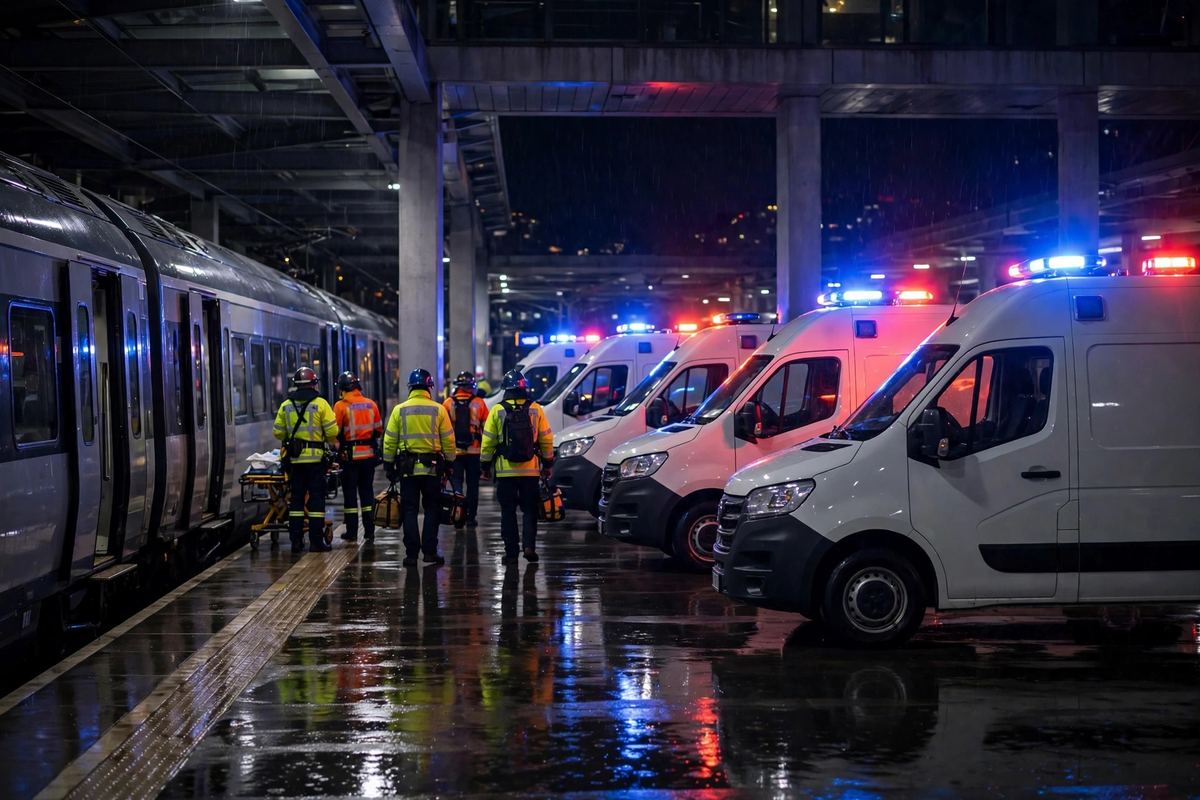
Nineteen people were injured on the evening of Thursday, 15 October 2026, when a minibus collided with a train at the Eurotunnel terminal in Coquelles, near Calais, on the French side of the Channel Tunnel. French authorities said none of the injuries were life-threatening and no deaths were reported, although several people were seriously hurt and two were evacuated by helicopter to a hospital in Lille. The accident occurred at the loading platform where vehicles board Le Shuttle services through the tunnel to England. Emergency services, including ambulances, a helicopter and police, responded quickly, and the injured were taken to hospitals in Calais, Boulogne, Dunkirk and Rang-du-Fliers. The incident briefly disrupted operations at one of Europe's most important transport links, but Eurostar passenger services and freight traffic resumed after a short stoppage.
The details of what happened have been pieced together from statements by the Pas-de-Calais prefecture and the sub-prefect of Calais, Agathe Cury. The minibus was carrying truck drivers of various nationalities who were preparing to board a Le Shuttle service through the Channel Tunnel. At about 7:27 p.m. local time, the minibus collided with a train at the loading dock. According to Cury, there were two Le Shuttle trains at the loading dock at the time: one was being loaded with lorries to travel through the Channel Tunnel, while the other was poised for departure after earlier loading. For a reason that currently remains unknown, the minibus collided with the departing train. The vehicle did not overturn, but the impact injured the driver and 18 passengers. Cury said the passengers were workers about to board Le Shuttle, men of different nationalities. It was not immediately clear whether any British nationals were among the injured.
The casualty figures varied slightly between early reports, reflecting the confusion that often follows a serious accident. The prefecture of Pas-de-Calais confirmed 19 people involved, including the driver, with no deaths and no lives in danger. Some reports described five people as severely hurt, while others said two people sustained serious injuries requiring helicopter evacuation. The two accounts are not necessarily contradictory: the number classified as seriously injured can change as patients are assessed, and different agencies may use different definitions. What all reports agreed on was that, despite the severity of the impact, no one was killed and no injuries were considered life-threatening. Given that the collision involved a bus and a train at a busy terminal, that outcome was fortunate, and it reflects both the speed of the emergency response and the fact that the bus did not overturn.
The emergency response was substantial. The prefecture said significant resources were immediately mobilised by Eurotunnel, followed by operations under the authority of the prefect of Pas-de-Calais. Ambulances, fire crews and police attended the scene, and a helicopter evacuated the most seriously injured to Lille. The injured were distributed among several hospitals to avoid overwhelming any single facility. The sub-prefect of Calais was present at the site, and a press briefing was scheduled for 10:15 p.m. to provide an initial update. The speed and scale of the response reflect the fact that the Eurotunnel terminal is a high-risk site with well-rehearsed emergency plans, precisely because it handles thousands of vehicles and passengers every day in a confined area where trains, buses, lorries and cars move in close proximity.
The impact on cross-Channel travel was limited but not negligible. The accident resulted in a temporary halt to allow for the evacuation of the injured, and authorities confirmed that the incident did not disrupt freight services or Eurostar passenger traffic in the longer term. Eurostar issued a statement reassuring passengers that its services to and from London remained operational and unaffected, describing the incident as occurring several kilometres away from the Channel Tunnel itself and saying it did not involve or impact Eurostar trains. Some reports indicated that two Eurostar services were cancelled on Thursday evening and that shuttle services were suspended for about 90 minutes. Those discrepancies likely reflect the difference between the immediate disruption during the emergency response and the resumption of normal operations once the scene was cleared. For passengers, the practical effect was delays and some cancellations on the evening of the accident, with normal service resuming thereafter.
The Channel Tunnel is one of the most important pieces of transport infrastructure in Europe. Opened in 1994, the 50.5-kilometre undersea tunnel links Folkestone in Kent, England, with Coquelles near Calais in France. It carries Eurostar high-speed passenger trains between London, Paris, Brussels and Amsterdam, Le Shuttle vehicle-carrying trains for cars, lorries and buses, and freight trains. More than 10 million passengers a year travel through the tunnel, along with millions of vehicles and tonnes of freight. The Eurotunnel Calais Terminal in Coquelles serves as the continental gateway for Le Shuttle, which transports road vehicles through the tunnel. Because the tunnel is the only fixed link between Britain and continental Europe, any incident there attracts immediate attention, even when, as in this case, the tunnel itself is not directly involved.
The cause of the collision remains under investigation. Authorities have not yet said why the minibus collided with the departing train, and it would be wrong to speculate. Investigations into transport accidents typically examine a range of factors, including the movements of the vehicles, the layout of the terminal, signage and signals, visibility, speed, and the actions of the drivers involved. The prefecture said investigations into the cause of the crash were expected to follow once emergency services concluded their work. The findings, when they are published, may lead to changes in procedures at the terminal, such as revised traffic management, additional barriers, or changes to the way buses and trains are coordinated at the loading platform. Until then, the official account is that the reason for the collision is unknown.
The accident came at a busy time for France, with authorities preparing for another nationwide day of demonstrations on Saturday, 17 October, amid continuing student protests. That context is relevant only in that it added to the demands on police and emergency services. The Channel Tunnel accident itself appears to have been an isolated incident, not connected to the protests or to any wider security issue. French authorities have treated it as a transport accident, and there is no suggestion of any deliberate act.
For travellers, the incident is a reminder of the safety systems that underpin cross-Channel travel. The Channel Tunnel has an extensive safety regime, including strict controls on vehicles, ventilation, fire detection, and emergency evacuation procedures. The Le Shuttle terminals on both sides of the Channel are designed to separate vehicle traffic from train movements as far as possible, and the fact that the bus did not overturn and that no one was killed reflects both the design of the vehicles and the speed of the response. Passengers using the tunnel in the days after the accident were advised to check service updates before travelling, as investigations and any remedial work could cause minor delays. The broader lesson is that even well-managed transport systems can experience accidents, and that the test of a system is not whether accidents never happen, but how quickly and effectively it responds when they do. In this case, the response was rapid, the casualties were treated promptly, and the vital link between Britain and France was restored within hours.
Related reading: EU leaders meet on energy and Ukraine
Related reading: UK shares near one-month high