
A Rare and Serious Incident in a British City Centre
Police officers being shot is exceptionally rare in the United Kingdom. Unlike in many other countries, most British police officers do not routinely carry firearms, and gun crime overall remains low by international standards. When a shooting does involve a police officer, it becomes national news — and it raises urgent questions about public safety, armed policing, and how such incidents are investigated.
That is what happened in the early hours of Sunday, October 18, 2026, in Nottingham, a city in England's East Midlands. A male police officer who approached two suspects in the city centre was shot, suffering a wound to his foot. What followed was a fast-moving investigation that led to four arrests across two counties within about a day — and a reassuring statement from police that there was no wider threat to the public.
What Happened
At around 4:50am on Sunday morning, a male police officer approached two suspects on Angel Row, a street in Nottingham city centre, according to reporting by The Times and the PA news agency. During the encounter, the officer was shot in the foot with what appeared to be a sawn-off shotgun. A sawn-off shotgun — a shotgun with its barrel and stock shortened — is an illegal weapon in the UK, associated with serious criminal use.
The officer was taken to hospital, where his condition was described as stable. The injury, while serious, was not life-threatening, and he was expected to remain in hospital while receiving treatment.
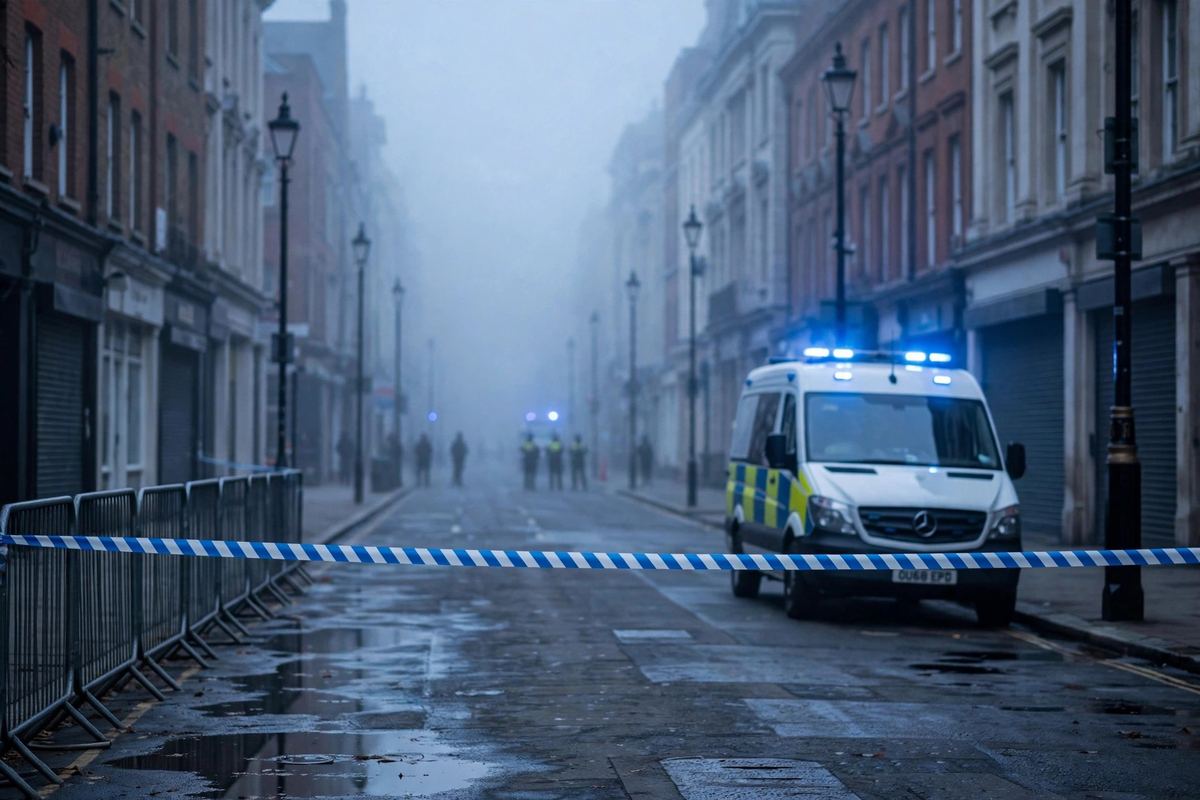
Police moved quickly to secure the scene. A cordon was put in place around the area while forensic officers examined it, and residents and early-morning passers-by were asked to avoid the area. The cordon has since been lifted, though police said a heightened presence would remain in the area as the investigation continued.
The Arrests
Within hours of the shooting, the investigation produced its first arrests. On Sunday evening, officers stopped a vehicle in Radford, an area of Nottingham, and arrested three people: a 27-year-old woman on suspicion of grievous bodily harm (GBH) with intent and possession of a firearm with intent to endanger life, and a 24-year-old man and a 25-year-old woman on suspicion of assisting an offender.
Early on Monday morning, a fourth person was arrested: a 30-year-old man, stopped in Bedfordshire, also on suspicion of assisting an offender. The fact that one suspect was stopped in a different county suggests the investigation moved quickly to track movements beyond Nottingham itself.
Police also confirmed that a weapon had been recovered. Recovering the firearm is a significant step in any shooting investigation: it allows forensic examination that can link the weapon to the scene and, potentially, to suspects.
All four arrested individuals remain suspects at this stage. Under British law, a person is innocent until proven guilty, and reporting on arrests must avoid prejudicing any future trial. The police have not released the names of those arrested.
The Police Response
Assistant Chief Constable Claire Rukas of Nottinghamshire Police addressed the incident publicly, saying detectives would "work tirelessly to establish exactly what happened" and describing it as an "appalling incident." Her comments reflected both the seriousness with which the force treats an attack on one of its own and the determination to give the public a clear picture of events.
Crucially, police said there was nothing to suggest a wider threat to the public. That assessment matters: in the immediate aftermath of a shooting, one of the most important things a police force can do is tell residents whether they need to change their behavior — stay indoors, avoid an area, remain vigilant. In this case, the message was that the incident appeared to be contained, while a visible police presence would continue to reassure the community.
The speed of the arrests — four suspects in custody within roughly 24 hours, across Nottingham and Bedfordshire — also sends a signal about the resources devoted to the case. Attacks on police officers are treated with the highest priority in British policing, both because of the danger they represent and because of their impact on officer morale and public confidence.
Why It Matters
Shootings involving police officers are vanishingly rare in Britain. To put it in context: England and Wales see a small number of police firearms operations each year, and the vast majority of frontline officers carry no gun. When an officer is shot, it is not just a crime story — it becomes a test of how the criminal justice system, the media, and the public handle an event that challenges assumptions about safety in British cities.
The incident also touches on broader debates about armed policing in the UK. From time to time, serious incidents prompt discussion about whether more officers should carry firearms or whether specialist armed response units — which every force maintains — are sufficient. Those debates tend to be measured in Britain, where public support for the tradition of largely unarmed policing remains strong, but each incident adds data to the conversation.
There is a further dimension: trust. Nottinghamshire Police, like all British forces, depends on public cooperation to solve crimes. How openly and quickly the force communicates — the cordon, the arrests, the statement that there is no wider threat — is part of maintaining that trust, especially in communities that may already feel anxious after a shooting in their city centre.
Key Facts
- A male police officer was shot in the foot at around 4:50am on Sunday, October 18, 2026, on Angel Row in Nottingham city centre, with what appeared to be a sawn-off shotgun.
- The officer was taken to hospital and is in a stable condition.
- A 27-year-old woman was arrested on suspicion of GBH with intent and possession of a firearm with intent to endanger life.
- A 24-year-old man and 25-year-old woman were arrested on suspicion of assisting an offender after a vehicle stop in Radford, Nottingham, on Sunday evening.
- A 30-year-old man was arrested on suspicion of assisting an offender after being stopped in Bedfordshire early Monday.
- A weapon has been recovered; the cordon has been lifted with a heightened police presence remaining.
- Assistant Chief Constable Claire Rukas said detectives would "work tirelessly to establish exactly what happened."
- Police say there is nothing to suggest a wider threat to the public.
What Happens Next
The investigation is now in its evidence-gathering phase. Detectives will be conducting forensic analysis of the recovered weapon and the scene, interviewing witnesses, reviewing CCTV footage from the city centre, and questioning those in custody. Under British law, suspects can be held for questioning for a limited time before police must charge them, release them, or apply for extended detention — so decisions about charges could come relatively soon.
If charges follow, the case would move through the criminal justice system, beginning with a court appearance and potentially leading to a trial. Because of the seriousness of the alleged offences — GBH with intent and firearms offences carry lengthy potential sentences — the case would likely be heard in the Crown Court.
The injured officer's recovery will also be closely watched, both by colleagues and by the public. Police forces in the UK have well-established welfare procedures for officers injured in the line of duty, and the force is expected to support him through treatment and rehabilitation.
For Nottingham, the coming days will be about returning to normal. The lifted cordon and the visible police presence are designed to do exactly that: show that the city centre is safe, that the investigation is under control, and that life goes on. The deeper questions the incident raises — about illegal firearms, about the safety of unarmed officers, about community trust — will be debated for longer, in council chambers, in Parliament, and on the streets of Nottingham itself.
Related reading: France's recent curfews after violent protests show how another European country is handling public-order challenges this month, while a major US Supreme Court ruling on a terrorism case illustrates how the justice system processes high-stakes criminal matters.
Policing pressures are making headlines on the other side of the Atlantic as well: an entire Georgia town's police force has resigned in a row with its mayor.
Police shootings have forced reckonings elsewhere too: in Mississippi, an officer and the interim police chief resigned after a fatal shooting of a one-year-old boy.