
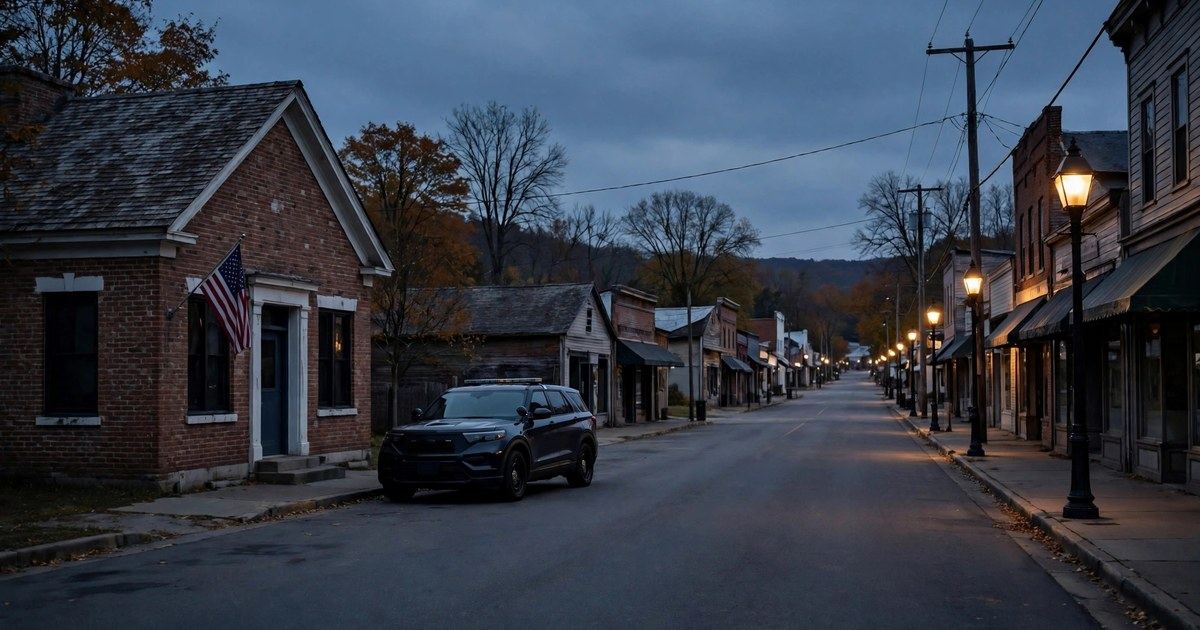
In small-town America, the police department can be just a handful of officers — and when all of them walk out at once, the town is left with no police at all. That is what happened in Milner, Georgia, a town of just 772 people according to the 2020 census. On October 19, 2026, city manager Tausha Grose stood before a heated council meeting and announced that the entire full-time police force — all five full-time officers, including Police Chief Lamar Bunn — plus most of the reserve officers had resigned. Then Grose announced that she, too, was resigning, effective October 30, with the department's last day set for October 28.
The resignations followed an explosive allegation: Chief Bunn accused Mayor Craig Timmons of secretly placing a tracking device on his truck and monitoring him through City Hall security cameras. What follows is a full explainer on Milner's tiny police force, what happened at the October 19 meeting, the tracker allegation and the wave of resignations, the background disputes that led up to the crisis, and what happens next for a town suddenly without its own police.
Background: Milner and its tiny police force
Milner is a small city in Lamar County, Georgia, with a population of 772 recorded in the 2020 census — the kind of community where local government is personal and everyone knows everyone. Towns this size typically run very small police departments: in Milner's case, the entire full-time force consisted of just five officers, led by Chief Lamar Bunn, supported by a group of part-time reserve officers.
Small departments like this often operate with little margin for error. Losing one officer is a staffing crisis; losing all five full-time officers plus most reserves at once is the effective end of the department. That is the position Milner now finds itself in, and it raises immediate practical questions about who keeps the town safe and how its local government functions going forward.
What happened at the October 19 council meeting
The crisis broke into the open at a council meeting on October 19, 2026, described as heated. City manager Tausha Grose informed the council that the resignations had already been submitted: every full-time officer, including the chief, was leaving, along with most of the reserve officers. The resignation letters cited fundamental differences over leadership, as well as legal and ethical issues — language that signaled the dispute went far beyond ordinary workplace grievances.
Then Grose delivered her own news: she was resigning as city manager, effective October 30. The department's last day of operation was set for October 28, giving the town a matter of days before its police force ceased to exist. In one meeting, Milner lost both its entire police department and its top city administrator.
The tracker allegation and the resignations
At the center of the storm is a startling accusation by Chief Lamar Bunn against Mayor Craig Timmons. Bunn alleged that the mayor secretly placed a tracking device on his truck — a tracker bought, Bunn said, with the mayor's personal funds and installed without the knowledge of the city council or the city administrator — and that Timmons had also been monitoring him on City Hall security cameras.
Bunn characterized the alleged surveillance as a violation of the Fourth Amendment, the part of the U.S. Constitution that protects against unreasonable searches. Bunn also used the moment to deny rumors of an affair with Grose, addressing speculation head-on. Captain Craig Walton, one of the departing officers, demanded an independent investigation into Mayor Timmons, signaling that the officers want the allegations examined by someone outside the town's own politics.
Timmons, for his part, had no comment when confronted at the meeting, and he had not responded to inquiries from WSB-TV. The mayor's silence has left the allegations unanswered in public, adding to the uncertainty hanging over the town.
The background disputes
The tracker allegation did not emerge from nowhere. Behind it lay a set of running disputes between the town's leadership and its police department. Two issues in particular had been sources of friction: police overtime, and officers' use of city vehicles for part-time work.
These are classic small-town flashpoints. Overtime spending is one of the few budget lines a tiny municipality can argue over in detail, and the use of city-owned vehicles outside official duties raises questions about resources, liability, and fairness that can quickly become personal in a community of a few hundred people. The resignation letters' reference to "fundamental differences over leadership" suggests that trust between the mayor's office and the department had broken down well before the tracker claim surfaced.
What happens next
Milner now faces a series of urgent practical and political questions. The most immediate is public safety: with the department's last day set for October 28, the Lamar County Sheriff's Office is expected to step in and cover the town. County-level coverage is a common fallback for small municipalities, but it typically means fewer officers dedicated to the town itself and longer response times than a local department provides. For a community used to knowing its officers by name, the shift to relying on county deputies would also change the day-to-day relationship between residents and law enforcement.
Then there is the question of accountability. Captain Walton's demand for an independent investigation into Mayor Timmons puts pressure on authorities outside Milner to look into the tracker allegation. Whether such an investigation materializes — and what it finds — will shape how the town understands what happened and whether anyone is held responsible.
Finally, there is a more existential conversation. Former council member Skip Seda has floated the idea of unincorporating the city — dissolving Milner's municipal government altogether. For a town of 772 that has just lost its police force and its city manager in a single meeting, the question of whether it can still govern itself is no longer theoretical. Whatever residents decide, the events of October 19 have made Milner a vivid case study in how quickly local government can unravel when trust between elected leaders and the people who serve under them collapses.
Sources: People, NY Post, Police1, FOX 5 Atlanta, WSB-TV, October 2026.
Milner's collapse is not the only small-town police crisis: in Senatobia, Mississippi, an officer and the interim chief resigned after the fatal police shooting of a one-year-old.