
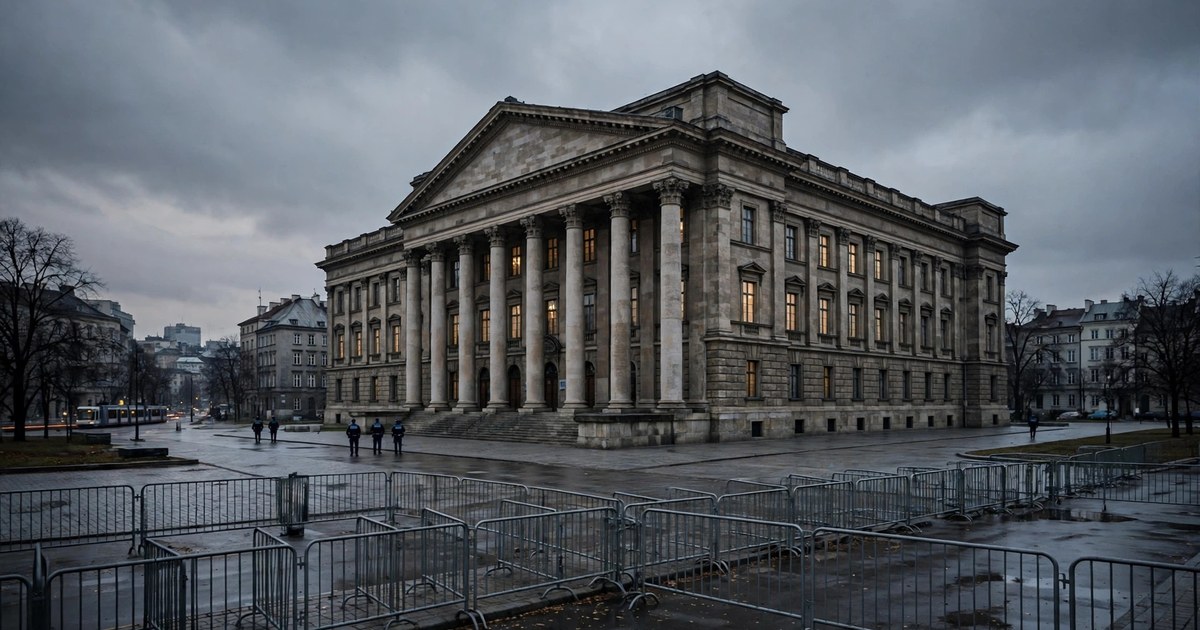
The Poland constitutional crisis escalated sharply on Friday, 30 October 2026, when police surrounded the headquarters of the country's Constitutional Tribunal in Warsaw, the court's president was suspended in a disputed order, and President Karol Nawrocki turned his plane back mid-flight from a trip to Senegal. The standoff, trending per news coverage across Europe, is a dramatic new flashpoint in a dispute over Poland's top court that began more than a decade ago.
At the centre of the crisis are two rival claims to run the Tribunal, the court that decides whether Polish laws comply with the constitution. One side says the Tribunal's president and vice-president were lawfully suspended for one month; the other side calls the move an unlawful takeover and a coup d'état. Neither claim has been settled by a court, and the legality of the suspensions remains contested.
This article explains what happened on 30 October 2026, why the Poland constitutional crisis started, who the key people are, and what to watch next.
7 Key Facts About the Poland Constitutional Crisis
- Police surrounded the Constitutional Tribunal in Warsaw on Friday, 30 October 2026. Officers were deployed around the court's headquarters after protests and incidents outside the building, including dangerous objects being thrown at police, according to Reuters. Reports differ on how far inside officers went: Reuters reported that police entered the premises, while police said their presence was limited to the exterior of the building.
- The Tribunal's president and vice-president were suspended, in an order whose legality is disputed. Judge Anna Korwin-Piotrowska signed an order suspending Tribunal President Bogdan Święczkowski and Vice-President Bartłomiej Sochański for one month and claimed leadership of the court as its longest-serving member. The announcement appeared on the Tribunal's website at about 6 p.m. local time, and the two men's profiles were removed from the site.
- The suspended president rejected the order and called it a coup d'état. Święczkowski refused to accept the suspension, and the Tribunal's account on social media said its website had been unlawfully seized, that Korwin-Piotrowska was not a legitimate judge, and that Święczkowski remained president.
- President Karol Nawrocki turned his plane back from a trip to Senegal. Nawrocki was en route to Senegal when the confrontation unfolded. He said: "At such a moment, the President must be in Poland. I'm interrupting my flight to Senegal. I'm returning."
- At least three people were detained outside the court. Police detained at least three people after they climbed or cut through the perimeter fence with power tools in an attempt to force entry. Protesters, many of them supporters of the Law and Justice party (PiS), gathered outside the building, some chanting "Tusk traitor".
- Poland's justice minister moved to lift the immunity of the two suspended leaders. Justice Minister Waldemar Żurek, who also serves as prosecutor general, said he had submitted requests to lift the immunity of Święczkowski and Sochański so that criminal charges could be brought against them for allegedly preventing lawfully elected judges from performing their duties.
- Prime Minister Donald Tusk defended the action as restoring the rule of law. Tusk wrote on X: "Restoring the rule of law is our duty. After years of PiS-led lawlessness, this is a difficult process, sometimes painful, and it requires decisive action. There is no other way."
Why the Poland Constitutional Crisis Started
The Poland constitutional crisis did not begin on 30 October 2026. It is the latest chapter in a political conflict over the Constitutional Tribunal that began in 2015, when the Law and Justice party (PiS) won control of both the presidency and parliament and appointed judges to the court in a process the European Court of Human Rights later considered irregular. The European Union opened Article 7 proceedings against Poland, and Brussels at one point froze European funds over Poland's judicial drift.
The Tribunal is Poland's highest constitutional court. It has 15 judges who serve single nine-year terms, are elected by the Sejm, the lower house of parliament, and must take an oath of office before the president. It decides whether laws passed by parliament comply with Poland's constitution, which makes control of the court politically powerful.
Donald Tusk returned as prime minister in December 2023 at the head of a coalition that has refused to recognise the legitimacy of several judges appointed under the previous PiS government, and has not published some of the Tribunal's rulings. The dispute sharpened in 2026: the current Sejm elected eight judges to the Tribunal, but President Nawrocki, a PiS ally elected president in 2025, administered the oath to only three of them. The other five took their oaths in parliament instead, and Święczkowski refused to allow them to take up cases, leaving the institution effectively paralysed, in Reuters' words.
European courts have weighed in. On 5 May 2026 the European Court of Human Rights issued an interim measure in Dziurda and Others v. Poland, directing Polish authorities not to obstruct four judges elected on 13 March 2026 from taking up and exercising their duties. The Court of Justice of the European Union found serious violations involving the Tribunal in December 2025, and the Council of Europe's Venice Commission adopted an opinion in October 2026 on the president's powers in oath-taking for judges.
That unresolved question, what happens when a president refuses to administer the oath the law requires, is at the heart of the current standoff. As rule-of-law expert Jakub Jaraczewski has noted, the law requires newly elected Tribunal judges to take an oath before the president, but it does not say what happens when the president refuses to administer it.
Who Are the Key People in the Poland Constitutional Crisis?
Karol Nawrocki, President of Poland. A PiS ally elected president in 2025, Nawrocki has refused to swear in five of the eight judges elected to the Tribunal in 2026. He cut short his official trip to Senegal on 30 October 2026 to return to Warsaw, and was expected to hold consultations with the president of the Supreme Court.
Donald Tusk, Prime Minister. Tusk has led Poland's government since December 2023. He says his government's actions are about restoring the rule of law after years of what he calls PiS-led lawlessness.
Bogdan Święczkowski, President of the Constitutional Tribunal. A former national prosecutor and PiS-era appointee who has led the court since late 2024, Święczkowski was suspended for one month under Korwin-Piotrowska's disputed order. He rejected the suspension and accused those involved of staging a coup d'état.
Anna Korwin-Piotrowska, judge. Elected by the current Sejm majority in March 2026, Korwin-Piotrowska signed the order suspending Święczkowski and Sochański and claimed leadership of the Tribunal as its longest-serving member. Her status as a judge is disputed: she has not taken the oath before the president, which critics say the law requires before a term of office may begin.
Bartłomiej Sochański, Vice-President of the Constitutional Tribunal. Sochański was suspended alongside Święczkowski for one month under the same disputed order.
Waldemar Żurek, Justice Minister and prosecutor general. Żurek has asked for the immunity of Święczkowski and Sochański to be lifted so criminal charges can be brought against them.
Jarosław Kaczyński, leader of Law and Justice (PiS). Kaczyński appeared outside the Tribunal's headquarters, called the events an attack on the court, and said Poland was "becoming a police state". Kaczyński has also raised the idea of Poland leaving the European Union; see our report on the Poland EU exit talks.
What Happens Next in Poland?
The rival claims to lead the Constitutional Tribunal remain unresolved. It is not established whether the suspensions are legally effective, what authority police relied on to bar the two leaders from the building, or whether the judges who entered the building can perform judicial duties. No judicial determination has established that a coup occurred, and the domestic legality of the announced measures remains contested.
Several things will decide how the crisis develops. First, whether the immunity of Święczkowski and Sochański is lifted and criminal charges follow. Second, whether the judges elected by the current Sejm majority this year are able to take up their duties; the European Court of Human Rights has already told Poland not to obstruct four of them. Third, how the European Union responds: Brussels has clashed with Warsaw over the Tribunal for a decade, and the standoff will test the EU's rule-of-law tools again. The EU's concerns about the rule of law extend beyond Poland, Malta, for example, was ranked 29th in the 2026 World Justice Project Rule of Law Index.
Poland also remains central to European security planning: 1,500 European troops are due to rehearse a Ukraine deployment in a NATO wargame in Poland in November 2026. For now, though, the immediate question is simpler: who is in charge of Poland's top court, and who gets to decide?
Sources: Reuters; The Star News Network; Demócrata; Daily Inference; Polish Press Agency (PAP) reports; Wikipedia (background on the Polish constitutional crisis, 2015–present).