
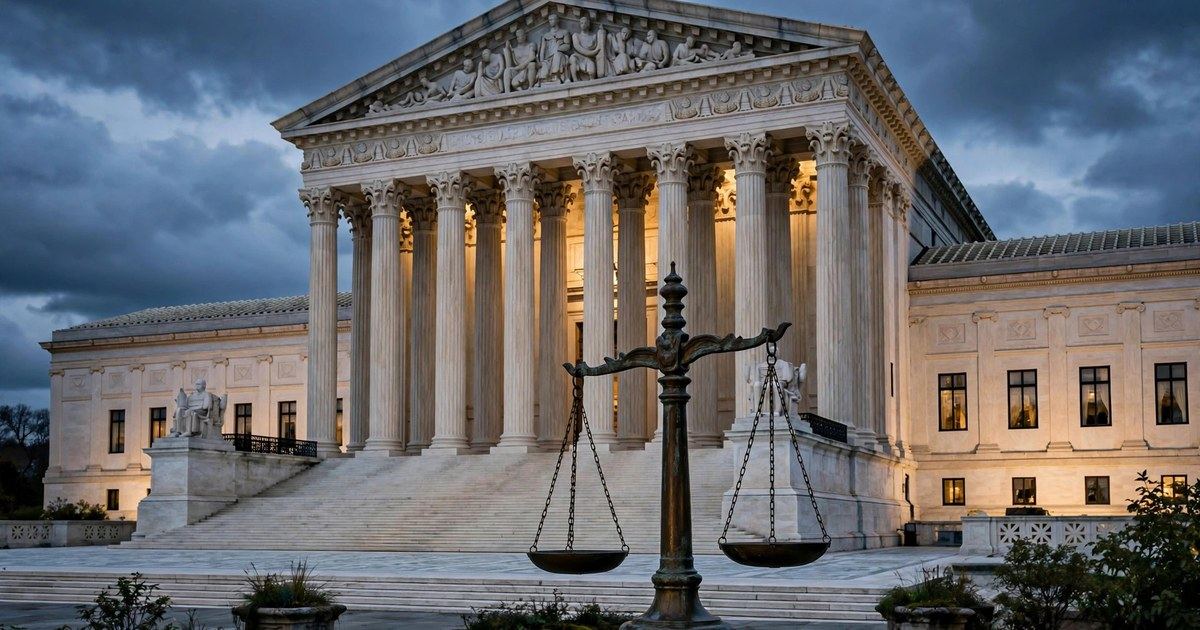
WASHINGTON — The United States Supreme Court on Monday declined to hear a bid by Khalid Sheikh Mohammed, the accused mastermind of the September 11, 2001, attacks, to revive a 2024 plea agreement that would have spared him the death penalty in exchange for a guilty plea — a deal scrapped two years ago by then-Defense Secretary Lloyd Austin. The justices turned away appeals by Mohammed and two co-defendants without issuing a written opinion, leaving in place a lower-court ruling that upheld Austin's decision to void the deals. The story is trending per news coverage, with searches for the case surging on Google Trends on Monday.
The court's action marks the latest milestone in a military prosecution of detainees held at Guantanamo Bay, Cuba, that has been beset by two decades of legal gridlock. In August, a U.S. Air Force judge set the trial for Mohammed and his co-defendants for June 2028. The order means the case that has outlasted every deadline ever set for it will now head, at long last, toward a courtroom — with the death penalty still on the table.
What the court did — and what it did not decide
It is important to be precise about what happened on Monday. The Supreme Court did not rule on whether Mohammed is guilty, nor did it rule on whether the death penalty is available to the prosecution. Instead, it declined to review a procedural question: whether a defense secretary can cancel a plea agreement that military prosecutors had already approved. By denying certiorari, the court left in place the 2025 ruling of the U.S. Court of Appeals for the District of Columbia Circuit, which found that Austin acted within his authority.
The denial of review was unsigned, as is customary, and no dissents were noted. For the defendants, it closes the last major avenue to enforce the 2024 agreements through the federal courts. Pretrial proceedings in the military commission can now resume. The court's quiet, one-line order on the most consequential terrorism prosecution in American history is itself a measure of how routine the legal machinery around the case has become after 23 years — a pattern familiar from the court's handling of other high-profile appeals, as explained in our piece on how the Supreme Court handles major cases.
The 2024 deal and Austin's two-day reversal
The plea agreements for Mohammed and co-defendants Mustafa al Hawsawi and Walid bin 'Atash had been offered and accepted by the U.S. official overseeing the Pentagon's Guantanamo war court — the military commission system created to try foreign terrorism suspects. The deal would have traded guilty pleas for a sentence of life in prison without parole, taking execution off the table and offering what some saw as the best hope of finally concluding the long, painful case.
Within days, the agreement drew sharp criticism from Republican lawmakers. Then-Defense Secretary Lloyd Austin — who served under former President Joe Biden — stepped in two days after the deals were announced and revoked them. Austin said a decision on the death penalty in an attack as grave as September 11 should only be made by the defense secretary himself. The move was the hinge on which the next two years of litigation turned, and it put the Pentagon's civilian leadership directly inside the commission process — a theme that has also surfaced in recent coverage of Pentagon decision-making on major military actions.
Two years of legal ping-pong
Austin's revocation triggered an immediate court fight. A military judge ruled that Austin had lacked the authority to invalidate the plea deals, and that decision was upheld in December by the U.S. Court of Military Commission Review. The judge then scheduled prompt plea hearings, and for a moment it appeared the agreements would stand.
The D.C. Circuit paused those proceedings and, in a 2-1 panel decision in July 2025, sided with the government. The majority found that Austin "indisputably had legal authority to withdraw from the agreements." Defense attorneys argued that Austin had acted too late and that the government had used a rare legal authority to back him — an argument Mohammed's lawyers called improper. They told the Supreme Court that because the case is of such high national importance, the justices should have the final word on whether the plea agreement can stand. On Monday, the justices declined to take that final word.
Trial set for June 2028 — with a weakened prosecution case
In August, Air Force Lt. Col. Michael Schrama ordered Mohammed and three co-defendants — Walid Muhammad Salih Mubarak bin 'Atash, Mustafa Ahmed Adam al Hawsawi and Ali Abdul Aziz Ali — to go on trial before a military tribunal starting June 5, 2028. The proceedings will open with the selection of a panel of service members acting as the jury, followed by opening statements and the prosecution's evidence.
But the government faces a serious obstacle. In August, the same military judge threw out Mohammed's confession to FBI agents, ruling that it was not given voluntarily and cannot be used against him at trial. Mohammed, a Pakistani engineer who went to college in the United States, was subjected to waterboarding and other interrogation measures in secret CIA prisons before being transferred to Guantanamo in 2006.
Prosecutors had already agreed to exclude statements Mohammed made during his time in CIA custody. But they had hoped that his admissions of guilt to a "clean team" of FBI agents — investigators deliberately kept separate from the CIA's interrogation program — would be admissible. The judge's decision strips prosecutors of what they have described as the centerpiece of their case against Mohammed, and it guarantees that the road to 2028 will be paved with further evidence fights.
Who is Khalid Sheikh Mohammed
Mohammed remains the most well-known inmate at the Guantanamo detention facility, which was set up in 2002 by then-President George W. Bush to house foreign terrorism suspects after the 9/11 attacks. He is accused of developing and directing the plot to crash hijacked airliners into the World Trade Center in New York and the Pentagon in Arlington, Virginia, 25 years ago; a fourth hijacked plane crashed into a field in Pennsylvania after passengers fought back. Nearly 3,000 people were killed.
Captured in Pakistan on March 1, 2003, Mohammed was held for more than three years in the CIA's secret prison network before his transfer to Guantanamo in September 2006. He has been in U.S. custody ever since — longer than many of the service members who will sit on the military panel that judges him have been alive. The military commission case against him was formally charged in 2008, arraigned in 2012, and has never reached trial.
Families of victims remain divided
Relatives of September 11 victims have long been split over how the case should end. Some said a full trial was the only path to real justice — and the only way to keep the death penalty in play for the man accused of designing the attacks. Others saw the plea agreement as the best hope of bringing the long, painful case to a conclusion while the defendants are still alive to be sentenced, fearing that another round of litigation would simply push the trial further into the future.
Monday's order does not settle that debate; it merely chooses the forum in which it continues. The case now returns to the military commission, where the same questions — the voluntariness of evidence, the authority of the defense secretary, the logistics of a death-penalty trial at a remote naval base — will be relitigated in pretrial hearings over the next 20 months.
What happens next
With the Supreme Court out of the picture, the immediate next step is the resumption of pretrial proceedings before the military judge. The prosecution must now decide how to build its case without the FBI confession it once considered its centerpiece, and the defense will continue to press the argument that the government's entire theory of the case is tainted by the CIA interrogation program.
The June 2028 trial date — the first firm start date the case has ever had — is the new north star, but veterans of the commission system note that every previous milestone in this prosecution has slipped. For now, the legal position is clear: the 2024 plea deals are dead, the death penalty is back on the table, and Khalid Sheikh Mohammed is going to court.
Sources: Reuters (19 October 2026); USA Today (19 October 2026); TheBullPost (19 October 2026); Military Times (31 August 2026); Google Trends 'Trending now' (19 October 2026).