
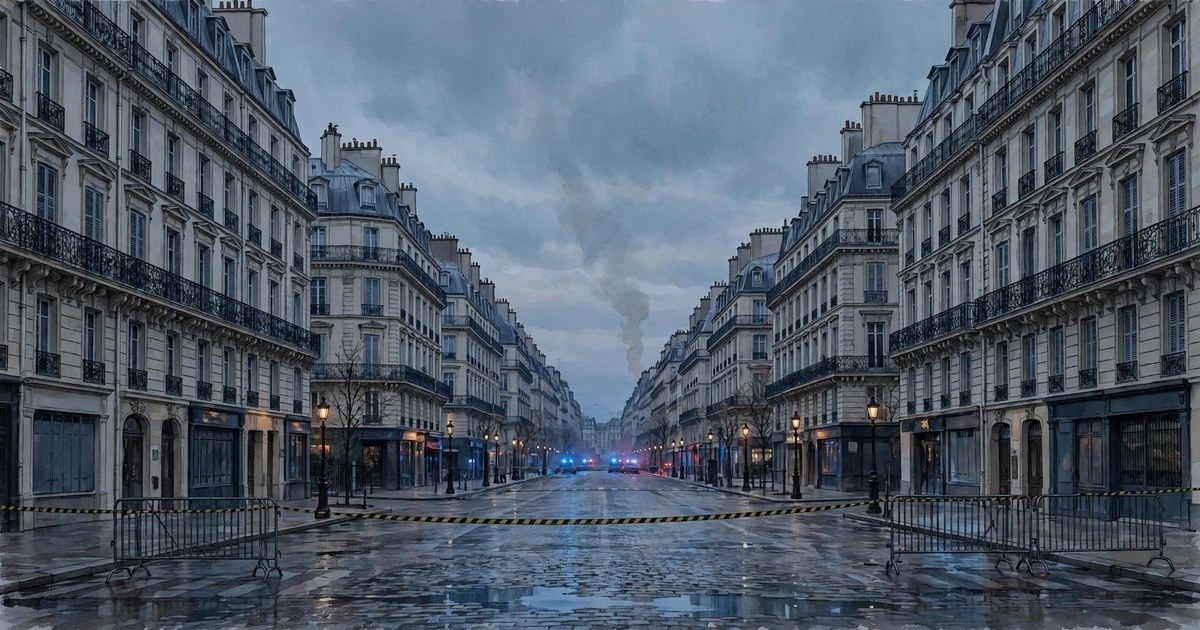
France is imposing localised night-time curfews after a weekend of violent protests left around 2,400 people arrested, nearly 1,000 police officers, gendarmes and firefighters injured, and at least 3,000 businesses damaged or looted across the country. Prime Minister Sebastien Lecornu instructed regional prefects on Sunday to put "very limited" and "localised" curfews in place in the hardest-hit urban areas, while keeping the sweeping 1955 state-of-emergency law on the table if the violence escalates. The story is trending per news coverage.
Speaking after an emergency meeting with top government officials, Lecornu said there was no question of placing entire metropolises like Paris under a blanket curfew, but that targeted restrictions were needed to protect people, shops and public buildings. A map of the areas concerned was expected to be published on Monday afternoon. The measures come after the worst rioting France has seen in years — violence that has shaken the nation just six months before an election to succeed President Emmanuel Macron.
What the prime minister announced
Lecornu said he had instructed the prefects, the government's regional representatives, to enforce curfews only in designated hotspots rather than across whole cities. The curfews were expected to apply first in urban areas where looting was most intense, with Paris, Lyon and Marseille among the cities named in reporting. In Marseille, the prefect banned any protest or other gathering from noon until 8 p.m. on Monday in anticipation of further flare-ups, while protesters in Paris blocked access to the Louvre Museum, forcing it to close.
The prime minister defended the security forces and stressed that invoking the state-of-emergency law of April 3, 1955 remains an active option. Declaring a state of emergency would grant the executive sweeping administrative powers, allowing authorities to restrict movement nationwide, conduct searches without judicial warrants and ban public gatherings. That law was last applied across the whole country after the November 2015 Paris attacks and stayed in force for almost two years.
The scale of the weekend's toll
Official figures paint a picture of violence on a scale not seen since the 2018 yellow-vest protests — and in some measures beyond it. Nearly 2,400 arrests were made over the weekend, about 90 percent of them adults. Authorities estimated Monday that at least 3,000 businesses were damaged or looted in several cities. Nearly 1,000 members of the security forces were reported injured.
CNN reported at least two deaths and serious injuries during the weekend, including people who lost hands in the clashes — though Lecornu said on Sunday that on Saturday itself, "despite scenes of severe violence and extensive property damage, no one was killed, and that is a miracle." Groups set fires to trash bins and vehicles and looted businesses in Paris, Lyon, Marseille and other cities on Sunday evening, following the major violence of Saturday's nationwide demonstrations.
The resignation Macron refused
The political fallout moved fast. Interior Minister Laurent Nunez offered his resignation on Sunday amid mounting criticism of the security response, saying: "I am the minister of the interior, I am responsible for everything that happens on the ground." President Macron refused it, his office saying on Monday that continuity in command of law enforcement was needed "in the current context."
Macron instead instructed Nunez "to take all necessary steps to ensure full transparency about the failures in planning and intelligence-gathering that led to the violence," and asked for "new policing tactics on the ground as quickly as possible." The interior minister himself acknowledged shortcomings in preparations, including what he described as a lack of anticipation in deploying available security personnel.
How it started
The unrest grew out of demonstrations organised for Saturday by trade unions, student groups and activists seeking to revive the yellow-vest movement, which first emerged in 2018 over social inequality. The core grievances were rising living costs and poor conditions in schools — and the demonstrations began peacefully, with the vast majority of protesters remaining peaceful throughout, according to authorities and political leaders. The October 17 mobilisation had already seen students, unions and yellow-vest sympathisers join forces.
But a violent fringe escalated matters: black-clad, hooded groups set fires, broke into shops and government buildings, and battled police in running clashes. Over the weekend, rioters burned the historic city hall of Limoges, prompting Macron to address the nation on Sunday evening. "Those who destroyed must pay," he said. "Those who looted must pay back. Those who sought to bring down the Republic will be held accountable."
Why it is spilling across Europe
The crisis is no longer a purely French affair. Cost-of-living protests have already spread beyond France to Belgium, Italy and Portugal, and CNN reported that the French unrest threatens to spill further into neighbouring countries. The combination of stagnant wages, rising prices and strained public services is shared across much of the continent, which is why the French weekend is being watched closely in other capitals.
What happens next
In the immediate term, all eyes are on Monday afternoon's curfew map and on whether the localised restrictions calm the nights or simply push the violence to new ground. The government has been asked to convene students, teachers, lawmakers, trade unions and business leaders this week to formulate concrete proposals on the underlying grievances — living costs and school conditions.
Politically, the crisis lands at a perilous moment: with a presidential election to succeed Macron six months away, the handling of the unrest is already a battleground between the government, the far right and the far left. Lecornu blamed groups on the radical left for seeking to prolong the disorder until the election. Whether curfews and a promised transparency review are enough to restore order — or whether France reaches for the 1955 emergency law — will define the coming weeks.
The curfew orders mark France's most forceful domestic-security response since the state of emergency that followed the 2015 Paris attacks. Officials stress that the vast majority of demonstrators have remained peaceful, but the authorities argue the curfews are necessary because violent groups have used the mass protests as cover for looting and arson, targeting not just shops but schools and government buildings that symbolise the state.