
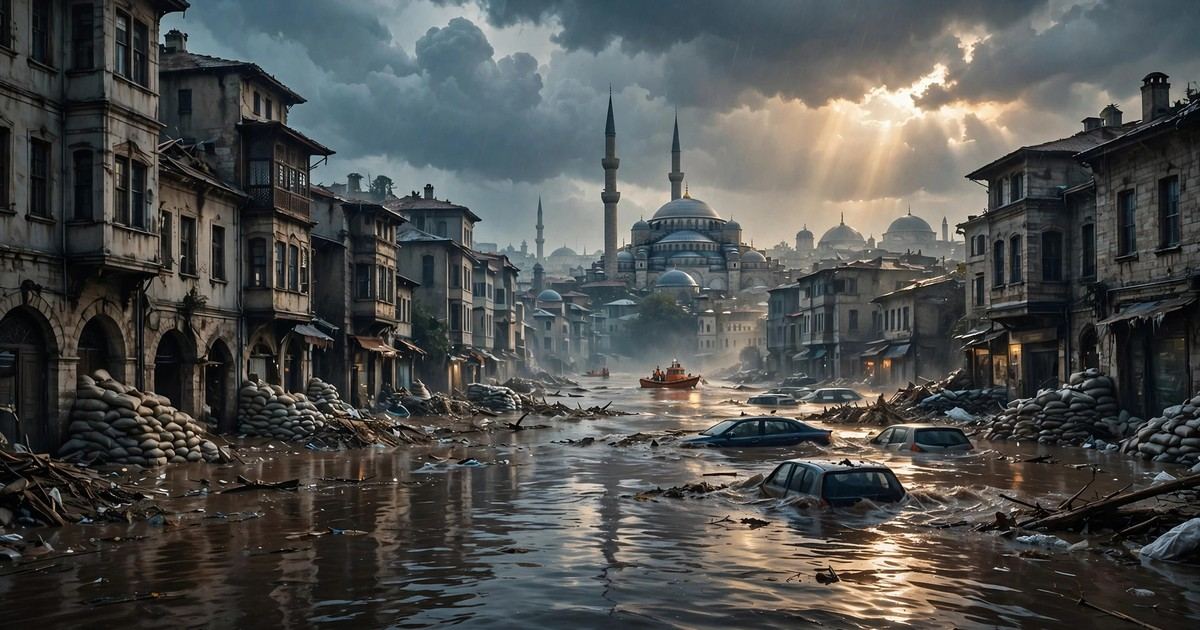
ISTANBUL — Turkey's largest city has endured its heaviest rainfall in 84 years, unleashing flash floods that swept cars through the streets, submerged homes and businesses, and killed eight people across Istanbul and neighbouring Kocaeli province. The disaster, which began on 14 October 2026, is trending per news coverage as authorities launch a massive cleanup and compensation effort, demolish buildings erected on flood-hit streambeds, and continue searching for missing residents five days on.
Governor Davut Gül described the downpour as the heaviest recorded in Istanbul since meteorological measurements began in 1942 — a span of 84 years. The city's Disaster Coordination Centre (AKOM) reported a maximum accumulated rainfall of 277.1 millimetres at Beykoz during the weather system, while Interior Minister Mustafa Çiftçi separately reported localized rainfall of up to 272 millimetres. Turkey's state meteorological service, cited by the Chamber of Meteorological Engineers, measured 186.3 mm in Beykoz, 159.4 mm in Maslak and 132.2 mm in Sarıyer in the single 24-hour interval from 09:00 on 14 October to 09:00 on 15 October. The chamber cautioned that duration, location and intensity matter as much as totals when judging urban flood risk — and in Istanbul's case, all three were devastating.
A city overwhelmed in hours
The rain began lightly, residents of the worst-hit districts said, before a stream further upstream burst its banks and sent a sudden torrent through the neighbourhood. Roads, underpasses, houses and businesses were inundated; vehicles were swept away by floodwater; and in Ayazağa, a neighbourhood in the Sarıyer district on the city's European side, water levels in parts reportedly reached 2.5 metres, rendering around 300 businesses unusable. The Kağıthane Stream overflowed as well, inundating the nearby Hasbahçe and flooding the garden and interior of the historic Sadabad Mosque. Mud flowing from the Historical Peninsula discoloured the Bosphorus, which turned visibly brown.
The storm was not confined to Istanbul. The heavy rainfall also affected other parts of the Marmara Region, including the neighbouring provinces of Kocaeli and Sakarya. A new storm that hit on Saturday night caused the Göçbeyli stream to overflow in Pendik, on Istanbul's Asian side, sweeping a car carrying three people into the water; one passenger escaped and was taken to hospital while search teams kept looking for the other two. In the coastal town of Ağva, the Yeşilçay stream overflowed, inundating homes, businesses, roads and farmland, and residents of an apartment building in Pendik were evacuated as a precaution after nearby ground subsidence.
The scale of disruption was extraordinary for a city of 16 million. Authorities fielded 8,815 emergency calls, rescued 3,050 people, and deployed 46,597 personnel across the city. At Istanbul Airport, 51 incoming flights were diverted and 19 arrivals and departures were cancelled. Schools were closed on 15 and 16 October for inspections, with classes due to resume on Monday, 19 October. Sixteen roads were closed, a temporary motorcycle ban was imposed, and at one point traffic density in the city reached 89 per cent before school closures and a shift to public transport brought it down.
The dead and the missing
The toll rose as bodies were recovered. By 19 October, Governor Davut Gül said six people had died in Istanbul and two more from neighbouring Kocaeli, whose bodies were found in Istanbul, bringing the combined toll to eight, with searches continuing for one more missing person in Istanbul.
The victims identified in Turkish reporting include a 14-year-old boy who was electrocuted after stepping into a pool of water at a park in Balat, a historic neighbourhood on the city's European side, on Wednesday evening; a 34-year-old man who died after slipping while trying to cross a flooded street in the northern district of Sarıyer, striking his head on a curb and being unable to get out of the water; Faik Şentürk, a construction worker who fell into a well while pumping floodwater from a school construction site in Beykoz and died despite being taken to hospital; and a man whose body was found near Sadabat Park in the Kağıthane district. The fifth body, recovered on Sunday amid the cleanup, was reported by Turkish media to be a Turkmenistan national.
Search teams were still combing the Ayazağa area on 18 October for the missing, including Murat Babacanov, a 30-year-old Turkmenistan national who disappeared on the first day of the rain, with the last signal from his phone received near Ayazağa Square; Ahmet Derin, 63, whose vehicle was swept away, with mobile phone footage of the moment he was carried off by floodwater circulating in Turkish media; and Haşim Ciritoğulları, 55, also reported missing in the same disaster. AFAD, police and rescue teams continued search and scanning operations without interruption, while relatives kept vigil at the scene.
Why the rainfall was so extreme
Meteorologist Mikdat Kadıoğlu of Istanbul Technical University attributed the intense rainfall to a specific combination of factors: cold air arriving from the Balkans, moisture transported by northeasterly winds, and comparatively warm Black Sea waters feeding the system. The Istanbul deluge is the latest in a string of extreme-weather events making headlines this month, including Typhoon Champi bearing down on the Marianas in the western Pacific.
The downpour also sharply increased water levels in the reservoirs supplying the city. According to Istanbul's water authority, İSKİ, the average reservoir filling rate rose from 38.06 per cent to 45.22 per cent in a single day, with the Elmalı Reservoir reaching full capacity — a rare silver lining in a week of devastation for a city that routinely frets about its water supply.
Compensation, demolitions and investigations
The floods have dominated Turkey's news cycle even as the country grapples with other headlines, including political turbulence around the Halk TV raid earlier this month. President Recep Tayyip Erdoğan said state agencies were coordinating the flood response and warned that rain could continue, giving what officials described as a "firm instruction" that the state would not leave any citizen "out in the open".
Governor Gül said more than 5,000 people had received emergency payments of 10,000 liras each, with separate compensation for damaged belongings scheduled to begin on 19 October. Damage assessments that began on Thursday were to be completed by Monday. About 900 AFAD volunteers joined cleanup work from Friday, starting in Sarıyer, while vacuum trucks and other vehicles arrived from other provinces. Aon reported more than 3,000 insurance claims after the flooding across Istanbul and five other provinces, with insured losses in Istanbul above ₺4.5 billion (about $91 million) as of 21 October, and about 2,000 homes and 900 businesses seriously damaged.
In a striking move on 18 October, the city began demolishing buildings constructed on flood-hit streambeds — an acknowledgement that structures built across natural water channels worsened the disaster. Justice Minister Akın Gürlek said judicial investigations had been opened into the flood-related deaths, examining the circumstances and establishing whether negligence or wrongdoing contributed to them. Like the Sri Lankan blackout that exposed the fragility of power infrastructure, the Istanbul floods have renewed hard questions about urban planning and drainage in one of Europe's largest metropolitan areas.
Is the danger over?
There is relief in the forecast. In its weekly weather report for 19-24 October, AKOM said the rainy weather that had persisted since the beginning of the week would leave the region as of Sunday, 18 October. No rainfall is expected across Istanbul throughout the coming week, with temperatures forecast to rise gradually and reach 22 degrees by mid-week. Even so, Governor Gül cautioned that the soil was saturated and advised residents to stay home unless necessary, with orange weather alerts in force for 10 provinces and yellow alerts for 26 others on 18 October; Antalya was also hit by heavy rain.
The disaster also extended beyond Turkey. A powerful Mediterranean storm submerged streets and disrupted travel in Spain on Sunday after claiming the life of a woman outside Barcelona, with the weather agency AEMET issuing its highest red alert in the eastern region of Valencia — an area scarred by Spain's deadliest floods in a generation in 2024.
What happens next in Istanbul will be a test of how quickly a megacity can recover from a record-breaking shock: the missing found or mourned, thousands compensated, streambeds cleared of illegal construction, and drainage systems rebuilt for a climate in which "heaviest since 1942" may no longer be a once-in-a-century label. For the families of the eight dead, and the relatives still waiting at Ayazağa Square, the rain has stopped — but the counting is not yet done.
Sources: Wikipedia, 'October 2026 Istanbul floods' (updated 18 October 2026); Anadolu Agency (18 October 2026); Turkish Minute (15 October 2026); europesays.com reports citing Turkish officials, 15-18 October 2026; News TRNC and News KKTC (18 October 2026).