
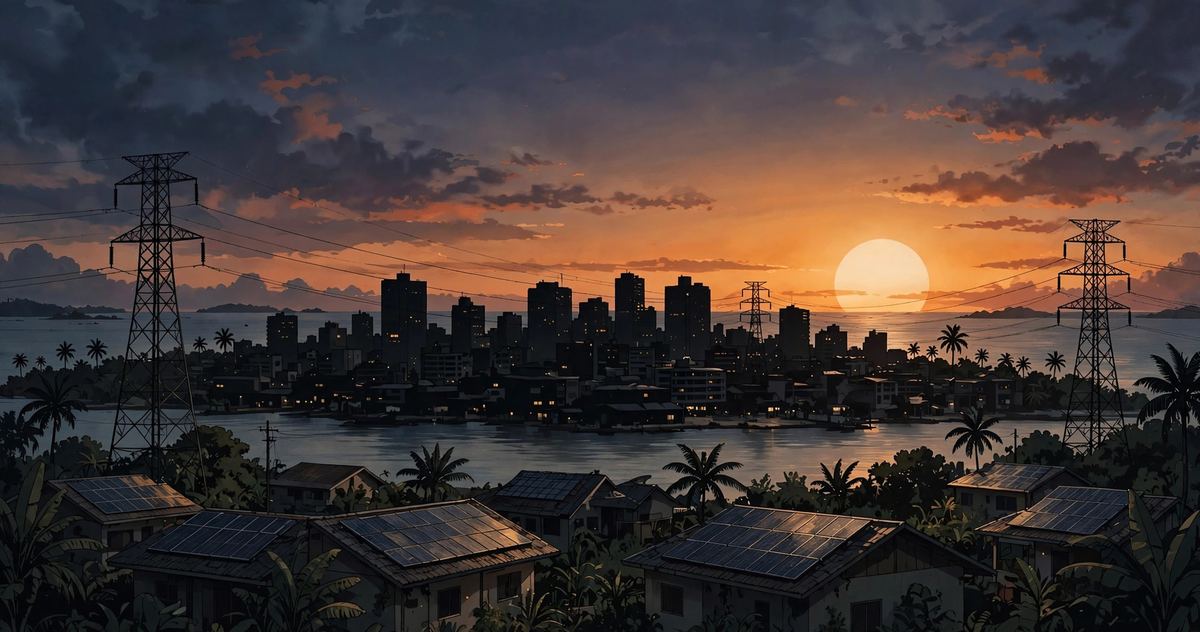
On Saturday 17 October 2026, at around midday local time, the lights went out across Sri Lanka — all at once, and almost everywhere. Homes, hospitals, businesses and government offices lost grid electricity simultaneously as the island nation’s transmission network suffered a total system failure. About 22 million people were left without power for roughly six hours, with supplies returning in stages through the afternoon and evening until the grid was restored around dusk. It was the second time in less than two years that the whole country had been plunged into darkness by a failure linked to its own solar power success.
There is a paradox at the heart of this story, and it is one that energy planners around the world are watching closely. Sri Lanka did not run out of electricity. According to officials, it may have had too much of it — or, more precisely, too much of one kind of it, at exactly the wrong moment. On a bright, sunny Saturday, with weekend demand muted, solar panels across the island were pouring power into a grid that could not absorb it safely. What followed was a cascade that engineers had warned about, and that a previous nationwide blackout in February 2025 had already demonstrated.
What happened on Saturday
The National System Operator confirmed that the grid experienced a total system failure after instability in the transmission network. Early reports put the start of the outage at around noon on Saturday, and the blackout swept across all provinces at once. The state-run power company said engineers suspected the cause was an imbalance created by solar generation outstripping demand in the middle of the day.
Energy Minister Anura Karunathilaka said authorities hoped to restore supplies “stage by stage”, and made an unusual public appeal: he asked owners of rooftop solar systems to disconnect their systems from the grid until engineers gave the all-clear. In a brief statement, he said: “We request rooftop solar system owners to disconnect their systems until further instructions in order to support the restoration efforts.” The appeal was repeated through the afternoon as crews worked to bring the network back in a controlled sequence.
Restoration came in phases. Parts of Colombo, Gampaha, Galle and Badulla were among the first districts to see power return, while other areas waited longer. By the evening, supplies had been restored across the island, according to the state electricity authority. The exact trigger remained under investigation even as the lights came back on: the minister said the cause of the major breakdown was still being examined, though engineers suspected an imbalance caused by high solar generation while demand was muted on a weekend day.
Why too much sunshine can crash a grid
To understand how sunshine can darken a country, it helps to understand what a power grid actually is. A grid is not a warehouse where electricity is stored until it is needed. At every second of every day, the amount of electricity being generated must almost exactly match the amount being used. If generation runs too far ahead of demand, the frequency of the system rises; if it falls behind, frequency drops. Large deviations can damage equipment, trip protective systems, and — if they cascade — bring the whole network down.
Sri Lanka’s numbers show how tight that balance had become. The country has an installed solar power capacity of just over 3,000 megawatts, while typical daytime demand ranges from only 2,000 to 2,500 megawatts. On a bright day, solar alone can therefore, in theory, produce more than the entire country is using. Tax concessions have encouraged consumers to install rooftop solar panels and sell their surplus electricity to the grid, and the government aims to increase solar capacity to nearly 4,400 megawatts within three years — a 388 per cent increase from 2024. That is a remarkable clean-energy achievement. It is also, without matching upgrades to the grid itself, a growing stability risk.
The deeper problem is not the amount of solar power but the kind of power it provides. Traditional power stations — coal, gas, hydro and nuclear plants — use large spinning turbines that are physically synchronised with the grid. That spinning mass gives the system what engineers call inertia: a built-in resistance to sudden changes in frequency, like the flywheel on an old engine. Solar panels have no spinning parts. They connect to the grid through inverters, which convert their direct-current output into alternating current. Inverter-based generation provides energy, but it does not naturally provide inertia. When solar forms a large share of supply and conventional plants are running at minimal output, the grid becomes lighter, faster and more fragile. A modest disturbance — a fault at a substation, a sudden voltage dip — can then produce frequency swings that trip large numbers of inverters offline at once, turning a small problem into a total collapse in seconds.
Analysts describing Saturday’s event pointed to exactly this “sunny Saturday” dynamic: high rooftop solar output on a bright day coinciding with lower weekend demand, a large share of non-synchronous generation, and conventional plants minimised. In such conditions, a disturbance can produce voltage or frequency deviations, large-scale inverter disconnections, and a cascade that outruns the grid’s automatic protections.
The Kotmale and Norochcholai threads
Solar oversupply is the leading suspected factor, but it may not be the whole story. The minister said a breakdown at the Upper Kotmale Power Station in the central hill country was suspected to have contributed to the outage, and reports indicated that a technical issue at a Kotmale facility had been detected a day earlier. Separately, reports said all three generating units at the Norochcholai Lakvijaya coal power plant had shut down during the event, deepening the shortfall while restoration was under way.
That sequence matters, because it shows how a grid failure is rarely a single failure. A plausible chain is that an initial disturbance or plant problem destabilised an already fragile, solar-heavy system, and the resulting cascade knocked out generation and transmission together. The official investigation will have to establish the precise trigger and the order of events. Until then, the honest description is that the outage was a system-instability failure in which excess solar generation is the prime suspect, with a hydropower-station fault as a possible contributing factor.
Why solar owners were told to switch off
To many Sri Lankans, the minister’s appeal sounded backwards. Families had installed rooftop solar panels precisely to protect themselves from power cuts. Now they were being asked to disconnect them in the middle of a blackout.
The reason is the way a dead grid is brought back to life. Restarting a power system from a total blackout is known as a “black start”, and it is one of the most delicate operations in electrical engineering. Engineers must rebuild the grid piece by piece, reconnecting generation and load in a carefully controlled sequence so that voltage and frequency stay within safe limits at every step. Uncontrolled power flowing into a partially restored grid — including from thousands of rooftop solar systems feeding in whenever the sun shines — can cause voltage fluctuations, trip protective equipment, and undo hours of restoration work. Disconnecting rooftop solar was therefore not a judgement on solar power itself; it was a way to give engineers a clean, predictable system to rebuild.
The frustration was nonetheless real. For households that had invested in solar to escape the country’s recurring power cuts, the blackout plus the shutdown order meant no relief at all during the outage. That frustration is now part of the political pressure for a transparent investigation and for fixes that prevent a repeat.
What broke in daily life
A total grid failure reaches far beyond dark rooms. Major water treatment plants at Ambatale and Biyagama briefly halted operations during the outage, and the water agency urged people to conserve supplies because power cuts could affect water delivery. Hospitals switched to emergency generators. Mobile networks became congested as millions of people tried to contact family and find information at the same time, and internet services and mobile connectivity were disrupted. Public transport and businesses faced operational difficulties, and industries suffered losses from the hours of downtime.
The disruption was contained within a day, and no casualties were reported in the coverage of the event. But the breadth of the impact is the point: electricity is the foundation under hospitals, water, communications, transport and finance. When it fails everywhere at once, even a relatively short outage reveals how thin the margin is between normal life and systemic strain.
The February 2025 precedent
Sri Lanka has been here before. On 9 February 2025, the entire grid shut down on a bright, sunny Sunday, and it took more than six hours to restore supplies. An independent expert committee later found that the blackout was primarily caused by low system stability — low inertia — because solar power was supplying more than half of the country’s demand at the time. The trigger was a disturbance at the Panadura grid substation that caused a sudden voltage drop. With conventional thermal plants running at minimal capacity, the grid could not absorb the shock, and the failure cascaded into an islandwide blackout.
The committee recommended a series of fixes: updated inverter settings, selective curtailment of solar output when the grid is stressed, battery storage, synchronous condensers — machines that provide inertia without generating power — and real-time inertia indicators in the grid control room so operators can see how fragile the system is at any moment. Some steps were taken. But the recurrence of a total blackout within twenty months shows that the deeper lesson — that high penetration of inverter-based generation without matching grid strength and controllable resources creates a system prone to rapid cascade — had not been closed with sufficient speed.
What would actually fix it
Energy analysts and the Colombo Telegraph’s assessment of the event point to a consistent set of priorities. First, grid-scale battery storage and other fast-responding resources that can inject or absorb power in fractions of a second, providing the fast frequency response that solar panels cannot. Second, enforceable technical standards for inverters, so that rooftop systems ride through disturbances instead of tripping offline en masse. Third, better real-time visibility and control of distributed generation, so the system operator knows how much rooftop solar is feeding in and can manage it. Fourth, stronger black-start and selective “islanding” capability, so hospitals, water plants, security nodes and key communications can keep running even if the main grid fails. And fifth, an independent technical review of the 17 October event, comparable to the process that followed February 2025, to establish what happened and create accountability for implementing the fixes.
None of this requires slowing the solar transition. Batteries, condensers, smarter inverters and curtailment rules are the standard toolkit that solar-heavy grids in Australia, California, Germany and elsewhere are already deploying. The lesson of Sri Lanka is that the toolkit has to be built at the same speed as the panels themselves. Adding generation capacity without adding flexibility and stability is like widening a highway without strengthening its bridges: the traffic moves faster until the day it does not move at all.
Why the world is watching
Sri Lanka is an extreme case — an island grid with no interconnections to neighbouring countries, a solar fleet larger than its daytime demand, and a tropical climate that delivers intense midday sun. But the underlying pattern is global. As countries race to add solar and wind, grids everywhere are getting lighter, faster and more inverter-dependent. The same physics applies in Texas, South Australia and southern Europe, where operators have already faced moments when renewable output exceeded demand and the system had to be managed carefully to avoid instability.
The Sri Lankan experience also carries a political warning. Clean-energy transitions depend on public trust. When a blackout is linked, fairly or not, to solar power, it hands ammunition to those who argue that renewables are unreliable — even though the real failure is the absence of storage, inertia and grid management, not the panels on the roof. Governments that want to keep public support for solar need to be able to show that the grid is being hardened at the same pace as the energy mix is changing.
For Sri Lanka itself, the stakes are immediate. The government’s plan to push solar capacity toward 4,400 megawatts within three years would deepen the very imbalance that officials suspect caused Saturday’s blackout, unless storage, inverter standards and grid controls advance in parallel. The next sunny Saturday will come soon. Whether it brings another islandwide failure depends on how quickly the lessons of the last two blackouts are turned into hardware, rules and investment.
What we still do not know
As of the latest reporting, the precise trigger of the 17 October blackout remains under investigation. The suspected solar imbalance, the Upper Kotmale breakdown and the Norochcholai shutdowns are all part of the picture, but the official sequence of events has not yet been published. The government is expected to face calls for a transparent inquiry, and the Ceylon Electricity Board and the relevant ministries will be under pressure to explain what has changed since February 2025 — and what will change now. For a country of 22 million people who have now lost power islandwide twice in twenty months, those answers cannot come soon enough.
Britain knows the cost of keeping a grid in balance all too well: it paid a record £505 million in a single month just to keep the lights on.