
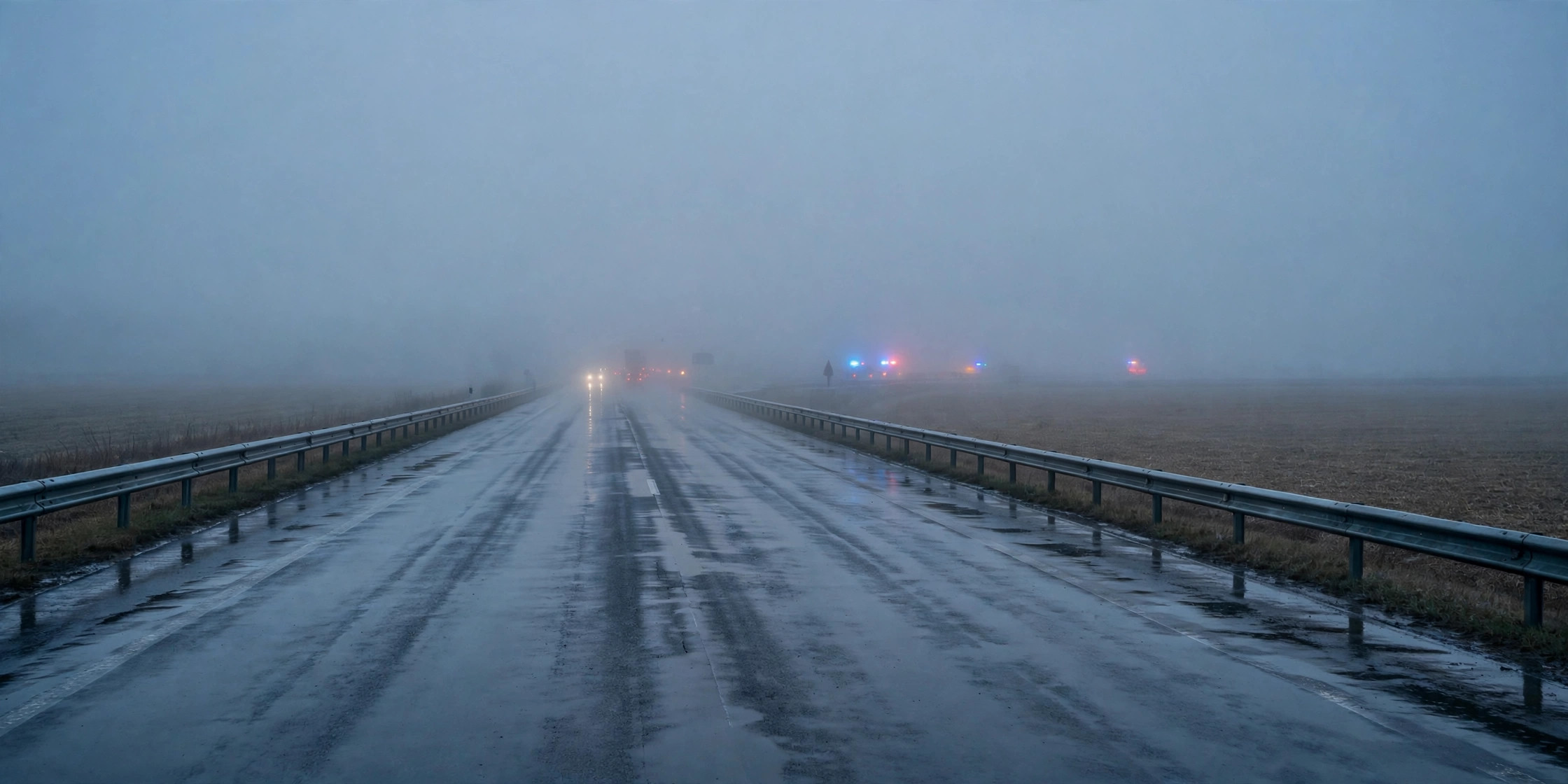
Trending per news coverage: a Bulgaria motorway pile-up in dense fog killed at least 11 people and injured 51 others on the Trakia motorway near Yambol on Tuesday 10 November 2026, in one of the country's worst road disasters in years. Two chain-reaction crashes, minutes apart on opposite carriageways, closed the motorway in both directions, and Bulgaria declared Wednesday 11 November a national day of mourning. The death toll moved through the day as officials revised their counts, and with 13 of the injured in critical condition, the final figure may still change.
What happened on the Trakia motorway near Yambol
The first emergency call came in at about 7:10 a.m. local time, from the Trakia motorway between the Zimnitsa and Kabile junctions near Yambol, in southeastern Bulgaria. On the carriageway heading towards Burgas, at around kilometre 289, a lorry and a passenger bus collided. An Interior Ministry official, Lyubomir Nikolov, said a grain truck had blocked the path of the bus, triggering the first chain-reaction crash. Minutes later, vehicles began colliding on the opposite carriageway, towards Sofia, at around kilometre 294. Mangled cars and trucks were strewn along about a kilometre of motorway, the Bulgarian news agency BTA reported from the scene.
The crashes happened in sudden, dense fog, and the Bulgaria motorway pile-up closed the Trakia in both directions for the day. Visibility had initially been about 70 to 80 metres, Nikolov said, before dropping to roughly 10 metres, leaving drivers almost no time to react to the vehicles ahead. Police said their initial assessment pointed to reduced visibility from fast-forming dense fog, a wet road surface and speeds unsuitable for the conditions, the Associated Press reported. The Trakia motorway, the main highway linking the capital, Sofia, with the Black Sea port of Burgas, was closed in both directions for the day, and traffic was diverted along detour routes.
Bulgaria motorway pile-up death toll: 11 or 12?
The number of dead changed several times through Tuesday, which is why different reports give different figures. Early accounts from local authorities put the toll at five, then at least 10. Health Minister Katya Ivkova said 10 people had died at the scene and two more had died while being taken to hospital, taking the toll to 12. Prime Minister Rumen Radev told reporters there were 11 dead and 48 injured. Later in the day, the Health Ministry issued a statement putting the toll at 11: 10 people had died at the scene and one more had died after being admitted to hospital. Bulgarian National Radio and the state news agency BTA also reported at least 11 dead in their evening coverage. That was the latest official count until 12 November, when a twelfth person — the most critically injured patient, being treated in hospital in Sliven — died, taking the toll to 12, Bulgarian National Radio reported.
The number of injured moved as well. Ivkova said 46 people had been taken for medical treatment; the later Health Ministry statement said 51 people had been admitted to hospitals in nearby cities, 13 of them critically injured. The Xinhua news agency, carried by Bernama, reported 48 injured. The figures differ because they were given at different times of a fast-moving rescue operation, not because different events were counted. No victim identities had been released by Tuesday evening, and Nikolov said there were no children among the dead or injured.
The number of vehicles is also reported differently. Yambol regional governor Georgi Chalakov estimated that about 50 cars and trucks were involved. The Interior Ministry later put the total at 86 vehicles: 63 in the first pile-up on the Burgas-bound carriageway and 23 in the second, on the Sofia-bound side. The Sliven regional governor spoke of more than 70. The 86 figure comes from the Interior Ministry's later count, while the lower estimates came from officials speaking earlier in the day.
Emergency response and a national day of mourning
Regional governor Georgi Chalakov declared a partial state of emergency in three municipalities in the Yambol region, Yambol, Tundzha and Straldzha, taking effect at 7:30 a.m. on 10 November. Police officers, firefighters and ambulance crews were deployed to the closed section of motorway, and the rescue operation was coordinated by Commissioner Ivan Dinev, director of the Regional Directorate for Fire Safety and Civil Protection in Yambol. The Bulgarian outlet Novinite reported that a Spartan military transport aircraft was deployed to help move the injured, and Radev dispatched government aircraft to the scene.
Prime Minister Rumen Radev declared Wednesday 11 November a national day of mourning for the victims of the Bulgaria motorway pile-up. The disaster comes a week after Bulgaria elected its first female president, and it has put the country's road safety record back in the spotlight. The crash is the latest deadly transport accident in the region this month, after the Egypt train collision that killed 7 near Cairo and the Izmir steel plant explosion that killed at least 17 workers in Turkey.
Why fog pile-ups happen, and Bulgaria's road safety record
A fog pile-up is a chain reaction. When visibility collapses from tens of metres to about 10 metres in seconds, drivers meet stopped or slow-moving traffic they cannot see until it is too late to brake, and each collision creates the next one. A wet road makes it worse, because braking distances grow just as sight lines shrink. That is what the early evidence points to in the Bulgaria motorway pile-up: fog that formed fast, a wet surface, and speeds that did not match the conditions. Investigators have not announced a formal determination of the cause, and the exact sequence of the collisions is still being established.
The Bulgaria motorway pile-up also lands on a country with the worst road death rate in the European Union. Bulgaria recorded 71 road fatalities per million inhabitants in 2025, the highest rate in the EU, according to European Commission figures, and 456 people were killed in road traffic accidents in Bulgaria in 2025. Bogdan Milchev, chairman of the Road Safety Institute, a non-governmental organisation, told Bulgarian National Radio that the motorway section should have been closed earlier, blaming the government. The Trakia motorway itself is 360 kilometres long, and its final section opened on 15 July 2013 after 40 years of construction.
What happens next after the Bulgaria motorway pile-up
The death toll has already moved once since the crash: a twelfth person — the most critically injured patient — died in hospital in Sliven on 12 November, taking the toll from 11 to 12, Bulgarian National Radio reported. Both carriageways of the Trakia motorway have reopened: traffic toward Sofia resumed at about 1 a.m. on 11 November, and the Burgas direction followed about two hours later.
The investigation is now with the National Investigation Service, which has taken over both pre-trial proceedings. Police have detained a Romanian truck driver — the only person held so far — and 44 witnesses have been questioned, with around 100 people expected to be questioned in total, Yambol district prosecutor Doychin Doychev said. Investigators are trying to establish whether the Romanian-registered truck slowed down or stopped in the fog before the pile-ups began; the driver says he slowed because of the fog and because a broken-down vehicle was ahead of him. Ten investigators, three forensic specialists and a mobile forensic laboratory are working the case, and 51 forensic medical examinations have been commissioned.
Three things are worth watching next. First, whether the death toll moves again: 13 people were critically injured, so the count of 12 may yet rise. Second, what the investigation concludes about the fog, the road surface and the speeds involved, and whether Milchev's criticism that the road should have been closed leads to changes in how Bulgarian motorways are managed in fog. Third, whether the national day of mourning on 11 November becomes the moment Bulgaria confronts a road death rate that has led the European Union.
Sources: BBC News; Al Jazeera; Associated Press; Agence France-Presse; Bulgarian National Radio; BTA; Xinhua; Balkan Insight.