
The EU 72 hour emergency kit guidance published on 3 November 2026 is one of those stories that sounded alarming in headlines and calmer in the document itself. The European Commission asked households across the European Union to be able to cover their essential needs for at least 72 hours if power, water, phones or shops stop working, and some coverage quickly turned that into a warning that every family must stockpile supplies at once. The reality is more measured. The guidelines are non-binding recommendations, not a law, and they do not order anyone to buy a specific kit. They set out what households should be able to do for themselves during the first three days of a crisis, while emergency services organise help, and they leave the details to national governments. This article explains what the Commission actually published, what belongs in a 72-hour kit, and why the headlines sounded scarier than the document.
The guidelines were presented on 3 November 2026 by Hadja Lahbib, the European Commissioner for Equality, Preparedness and Crisis Management, at the ninth European Civil Protection Forum in Brussels. The document is formally a Commission Communication, dated 30 October 2026, titled Guidelines on Population Preparedness under the EU Preparedness Union Strategy, and it is accompanied by five staff working documents that explain how member states can put each part into practice. It is part of the Preparedness Union Strategy, the plan the Commission launched in March 2025 after a report by former Finnish president Sauli Niinisto. The strategy takes an all-hazards approach: extreme weather, floods, wildfires, earthquakes, power outages, cyberattacks and other hybrid threats, as well as geopolitical tensions and pandemics. Recent incidents show why that breadth matters, from the cyberattack on France's blood banks to the Crédit Mutuel Arkéa cyberattack and the bomb threats that disrupted European flights. The Commission has proposed an annual EU Preparedness Day on 23 October, starting in 2027, to keep the message in public view.
What the EU 72 hour emergency kit guidelines actually say
The EU 72 hour emergency kit guidelines cover four areas, and the household kit is only the first of them. The central recommendation is that households should be encouraged to prepare supplies to cover their essential needs for at least 72 hours: water, food, medicines, a means of communication and cash. The Commission describes seven categories of essential needs in total: food, water, heat and light, medicines, hygiene, information and payments. It deliberately reasons in needs rather than products. The text does not give a shopping list, set quantities at European level, or name brands. Member states are expected to turn the needs into items and amounts that fit their own circumstances, and the Commission stresses that the effort must remain affordable and must complement the response of emergency services, not replace it. The other three guidelines look beyond the household. Preparedness should be built into school curricula, without becoming a separate subject, with training for teachers so children learn how to act in a crisis. Evacuation planning and warning systems should be designed so people with disabilities are not left behind. And public warnings should be clear, consistent and easy to understand, so people know what to do when an alert arrives.
Why the EU 72 hour emergency kit is not a legal requirement
The EU 72 hour emergency kit guidance is a recommendation, and the Commission has described it as non-binding. No household in the European Union is legally required to buy a kit, keep a set amount of supplies, or prove that it is prepared. The guidelines are addressed mainly to national authorities, asking them to help their citizens prepare, rather than to citizens directly as an order. That distinction matters, because much of the online reaction treated the announcement as a new obligation. It is not. The Commission has also said the recommendations may be reviewed as authorities gather feedback and learn from putting them into practice. The 72-hour figure itself is a minimum starting threshold, not a prediction that help will arrive exactly on the third day. The Commission's own document notes that building communication too tightly around a fixed duration reduces flexibility if the recommendation ever moves from 72 hours to a week, forcing authorities to explain why the number changed. The point of the three days is to buy time for emergency services and civil protection to organise assistance after a major disruption, not to set a countdown.
What goes in a 72-hour kit
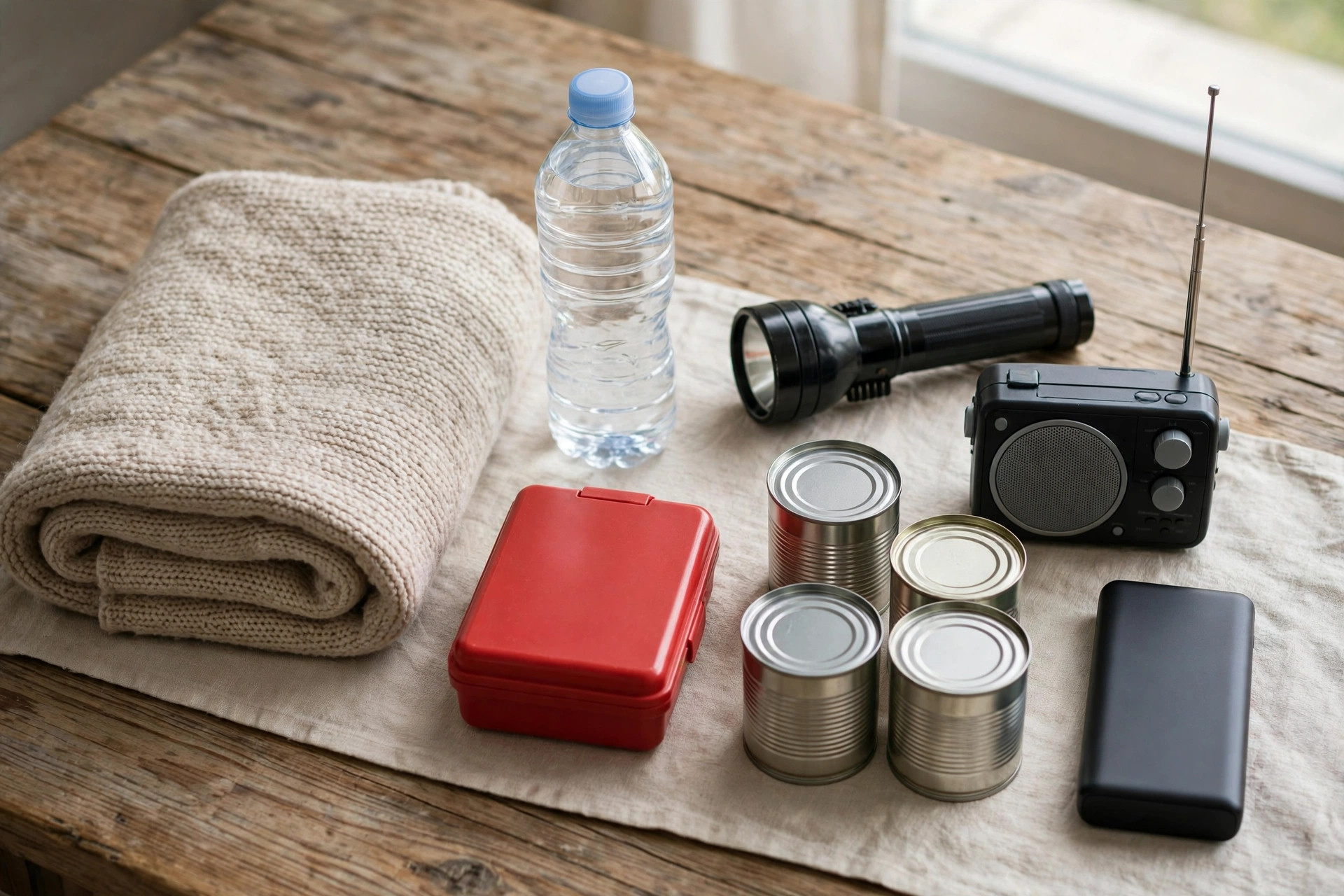
Although the Commission sets no EU-level quantities, the guidance and the coverage of it point to a consistent set of items. Water comes first, for drinking, cooking and washing, and food should be the kind that keeps at room temperature and needs neither cooking nor water to prepare, such as tins, cereal bars and nuts. A first-aid kit and personal or prescription medicines belong in the kit, along with hygiene products. For communication and light, the guidance recommends a torch with batteries or a dynamo, a portable radio to receive official information, spare batteries and a power bank for charging devices. Copies of identity cards, passports and insurance policies should be kept in a waterproof case, together with a small amount of cash in small notes and coins, plus an offline digital payment method where one exists. A ready-to-carry emergency bag is also recommended, so a household can leave quickly if evacuation is ordered. Families are encouraged to draw up a simple emergency plan, including how to contact each other if phones fail, and to learn practical skills such as giving first aid or cooking without electricity. None of this requires a single shopping trip or an expensive branded kit. Most households already own much of it, and the Commission's emphasis is on checking what is already at home and filling the gaps.
Schools, disability inclusion and better warnings
The three guidelines that sit alongside the household kit show what the Commission is really trying to build: a culture of preparedness that reaches everyone, not just households that read the news. In schools, preparedness would be woven into existing lessons rather than taught as a separate subject, with specific training for teachers and activities that teach children how to behave in a risky situation, from an early age. The disability-inclusive guideline asks authorities to design alarms, warnings and evacuation plans that work for people with disabilities, including those who need assistance to leave a building or to receive information in an accessible format. The fourth guideline focuses on risk communication, asking authorities to give clear, consistent warnings that people can act on. Together, these four pieces explain why the Commission chose a forum of civil protection professionals in Brussels to launch them, with more than 1,900 participants from about 80 countries at the event. The audience was national authorities and emergency services, and the message was that preparedness is a shared system, not a private shopping list.
Why the headlines sounded scarier than the document
The gap between the headlines and the document has a simple explanation: the guidance arrived in a year when several governments issued similar advice, and readers connected the dots into a single alarming story. Sweden and Germany have pointed to the security situation, while Japan, Canada and Mexico City have framed their own 72-hour messages around earthquakes and local disaster risks. The newest official items, the UK campaign and the EU guidelines, point to everyday and all-hazards risks, with no specific event behind them. None of the governments that published the newest advice tied it to a single incident, and none of it changes a single visa rule or travel requirement, despite claims circulating online. The EU guidelines are also not a response to one crisis. They build on a recommendation the Commission already made in 2025, that citizens should be able to cover their basic needs for the first 72 hours of a crisis, and they sit inside a strategy adopted in March 2025. Read that way, the story is less dramatic but more useful: Europe is standardising advice that many countries already give, so that households, schools and emergency services are working from the same playbook when something goes wrong, whatever that something turns out to be.
Sources: Agence Europe, EuropeSays, Demócrata, Pollar, November 2026