
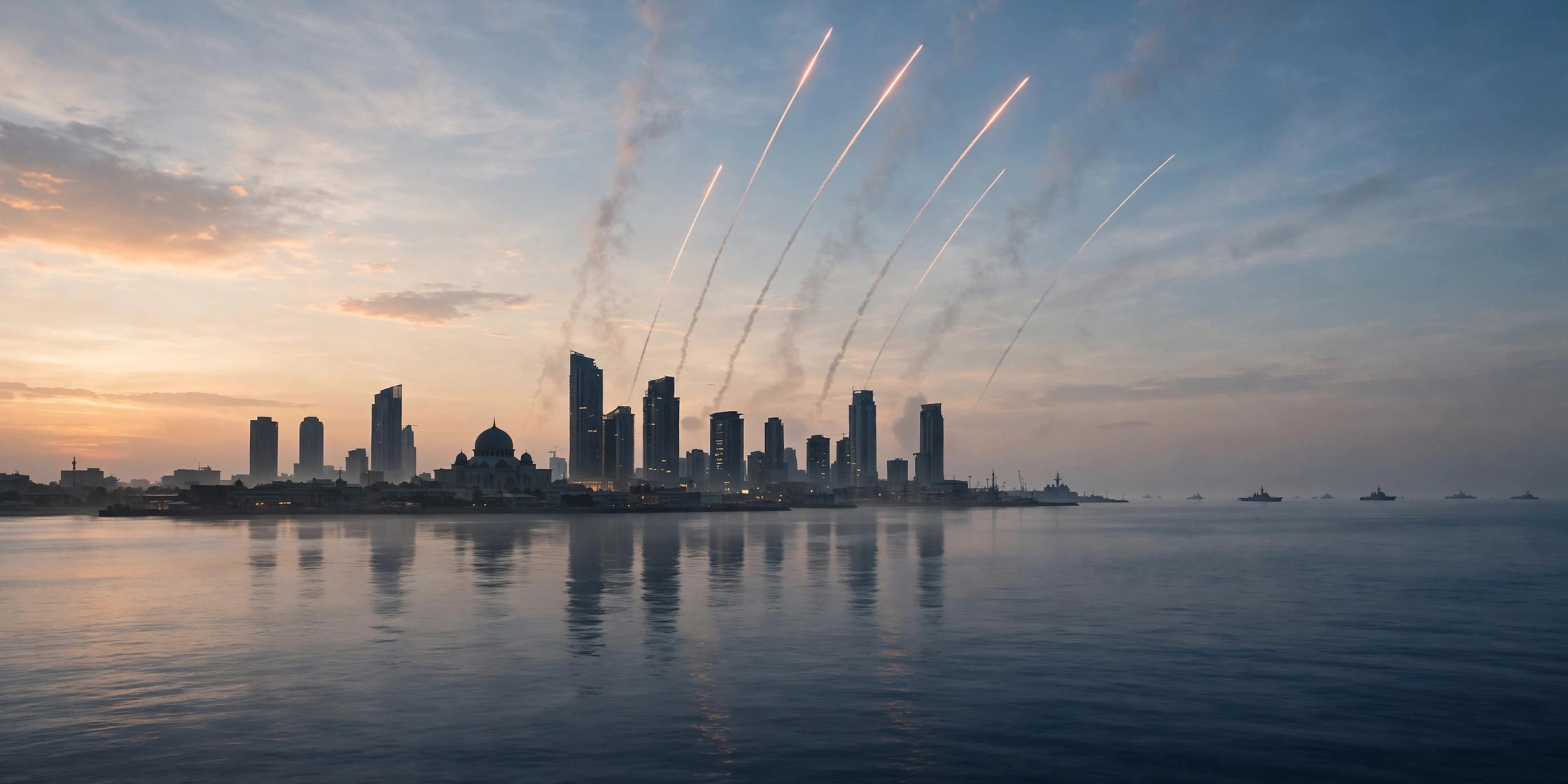
Iran attacks Bahrain again. Early on Sunday, 15 November 2026, Iran's Islamic Revolutionary Guard Corps said it launched six drones at a United States air-defence radar at the Riffa helicopter base in Bahrain — the second Iranian attack on the Gulf kingdom in three days. Bahrain's military said its air defences intercepted and destroyed several Iranian aerial attacks before they reached their targets, and no damage or casualties were reported. Neither the United States nor Bahrain had confirmed Iran's claim that the radar was hit, and Washington had not responded to the Sunday claim at the time of reporting. The attack landed as negotiations to end the war between Iran and the United States remained at a stalemate, and on the same day Saudi Arabia said it had intercepted Houthi missiles aimed at Riyadh.
Iran attacks Bahrain: what happened on Sunday morning
The first sign of trouble came before dawn. Bahrain's Interior Ministry sent out two public safety alerts on Sunday morning — the first such warnings since September — telling residents to remain calm, go to the nearest safe location, and follow official channels for updates. An AFP journalist in the capital, Manama, heard explosions at about 4:00 a.m. local time (01:00 GMT), and residents reported a second series of blasts at about 6:30 a.m. as alarm sirens sounded across the city. Bahrain TV reported that the country's air defences had shot down an Iranian drone.
Later that morning, the Bahrain Defence Force said its air defences had "intercepted and destroyed" several Iranian aerial attacks, accusing Tehran of continuing its "systematic hostile approach" towards the kingdom. The force did not say how many drones it had intercepted, or whether any had got through. Bahrain's Foreign Ministry called the strikes "a resumption of Iran's aggression against Bahrain and other countries in the region" and said it held Iran fully responsible.
Iran's account arrived within hours. The Islamic Revolutionary Guard Corps said its Aerospace Force had targeted the American radar at the Riffa base, in a statement carried by the Fars news agency, the state broadcaster Press TV and Iranian state television's Telegram channel. "The US air defense radar system at the Al-Riffa helicopter base in Bahrain was targeted by six drones belonging to the IRGC Aerospace Force," the statement said. Press TV added that the drones had carried out precise strikes on the radar facility. The Guards framed the operation as retaliation for what Iran described as hostile US actions. Iran's Foreign Ministry spokesman, Esmaeil Baghaei, defended the strikes as "purely defensive".
What nobody has confirmed is the result. No source has established whether the blasts heard over Manama were interceptions or impacts, and neither American nor Bahraini authorities had confirmed that the radar was struck. Anadolu Agency noted there were no claims or details of the drones having caused damage. The central question — whether any Iranian drone reached its target — remained unanswered on Sunday.
Six drones and the Riffa radar: what each side claims
The two accounts agree that Iranian drones flew at Bahrain on Sunday morning and that Bahraini air defences fired. They disagree on what happened next, and the gap between them is the story.
Iran says six drones were launched, that they struck the US air-defence radar at the Riffa helicopter base, and that the operation was a deliberate, limited act of retaliation. The Guards have used the same framing before: a precise strike on a military target, carried out in self-defence under Article 51 of the United Nations Charter, in answer to American attacks.
Bahrain says its air defences intercepted and destroyed several Iranian aerial attacks before they reached their targets. It has not said how many drones were involved, has released no damage figure, and has not confirmed that any radar was hit. Its Foreign Ministry invoked United Nations Security Council Resolution 2817 — adopted on 11 March 2026 by 13 votes to none, with China and Russia abstaining — alongside Article 51, in holding Iran responsible.
The United States, notably, had said nothing about Sunday's claim at the time of reporting. That silence matters, because on Friday the US military's Central Command answered within hours. The distinction is important: CENTCOM's Friday denial covered Friday's attack only, and it does not establish the outcome of Sunday's claim either way. Al Jazeera reported that the US military, having commented on Friday, had yet to comment on Sunday's claim.
Friday vs Sunday: how the two Iran attacks on Bahrain differ
Friday's attack came first. On 13 November, the Revolutionary Guard said it had targeted and destroyed a US early-warning radar in Bahrain, in retaliation for what it called an American air attack on a telecommunications tower in the southern Iranian port of Sirik, near the Strait of Hormuz. It was the first Iranian strike on a Gulf country since early September, when Iran last targeted US military assets in Bahrain, the UAE and Kuwait. US Central Command rejected the claim, saying: "The IRGC launched two one-way attack drones toward Bahrain and both were shot down by U.S. forces. There were no injuries or damage." Bahrain said it intercepted two drones that day. Worldlession covered Friday's claim in full here: Iran Claims It Destroyed US Radar in Bahrain.
Sunday's attack was bigger and louder. Six drones, according to the Guards, against two on Friday. A named target — the air-defence radar at the Riffa helicopter base, a facility the US military uses — against a more general early-warning radar claim. Two public safety alerts and sirens across Manama, against a Friday attack that passed with far less public alarm. And this time, it was Bahrain's own military that announced the interceptions, before Washington had said a word.
The pattern is what makes the two attacks one story. After a lull of about two months, Iran has now struck at Bahrain twice in three days, both times naming an American radar, both times claiming a hit, and both times facing a denial or an interception claim. The war itself is in its ninth month: France 24 dates it to 28 February 2026, when US and Israeli strikes killed Iran's supreme leader, Ayatollah Ali Khamenei. The question of whether that war is ending is examined here: Is the Iran War Over? Trump's 'Effectively Over' Claim Explained.
Why Bahrain matters: the US Fifth Fleet and the Gulf
Bahrain is a small island kingdom with an outsized military role. It hosts the headquarters of the US Navy's Fifth Fleet at Naval Support Activity Bahrain in Manama, and the Riffa Air Base, just south of the capital, is used by the American military. An attack on a US radar in Bahrain is therefore an attack on the centre of the American military presence in the Gulf — which is why both sides treat it as more than a local incident.
The timing reaches beyond Bahrain. On Sunday, the Saudi-led coalition said it had intercepted two Houthi ballistic missiles launched towards Riyadh and three drones in the kingdom's oil-rich Eastern Province. In the Strait of Hormuz, three oil tankers caught fire on Saturday after hitting naval mines, according to Iran's navy — an incident covered here: Three Tankers Hit Mines in Strait of Hormuz, Iran Says — and the Revolutionary Guard claimed the strait remained closed, threatening a stronger response to any further American attacks. Earlier in the war, the United States struck Iran's Qeshm Island: US Strikes Iran's Qeshm Island: What Happened and What Happens Next.
For the Gulf monarchies, the message of the two Bahrain attacks is hard to miss. Iran is showing that it can reach American assets on their soil, twice in three days, even while negotiations to end the war are under way. For Washington, the question is whether to answer the Sunday claim as directly as it answered Friday's — and whether the pattern of strikes changes the calculation around a deal that, for now, remains out of reach.
What happens next after the Iran Bahrain drone attack
Four things will settle what Sunday's attack actually achieved. First, whether US Central Command confirms or denies the Guards' claim, as it did on Friday — and whether it says anything about damage at Riffa. Second, whether any evidence emerges about what the blasts over Manama were: interceptions, impacts, or both. Third, whether Iran strikes a third time, and whether the target set widens beyond Bahrain. And fourth, whether the attacks move the stalled negotiations to end the war, or harden both sides further.
What is already clear is that the two-month lull is over. Bahrain's first public safety alerts since September, sirens in Manama, and a second Iranian claim in three days all point the same way: the Gulf is back in the line of fire, and the next statement from Washington — or the next launch from Iran — will say more about where this war goes than either side's claims about a single radar.
Sources: Reuters; The Wall Street Journal; France 24 and AFP; Anadolu Agency; Al Jazeera; Fars News Agency; Press TV; US Central Command; Bahrain Defence Force; Bahrain Foreign Ministry.