
Trinidad Maloney curfew rules are now before a judge. Social activist Wendell Eversley filed a lawsuit on 16 November challenging the Special Operations Act 2026, the law that allows the curfew and the lockdown in Maloney Gardens, and he is seeking declarations that the Act is unconstitutional, null and void. The case has been assigned to Justice Nirala Bansee-Sookhai, who has yet to set a first hearing date. The challenge comes a week after Maloney Gardens Housing Development, in D'Abadie, was declared the first closed area under the Act on 10 November, and it comes after a law that passed the Senate on a 15-15 deadlock broken by the Senate President. Eversley is a survivor of the 1990 attempted coup and a national awardee, and his lawyers are led by former prime minister and current MP Stuart Young, SC. His own lawyer admitted that Eversley, who lives in Bon Air West, Arouca, is not currently directly affected by the legislation. That admission is part of the story, and so is the response from the government: Prime Minister Kamla Persad-Bissessar says she is "not perturbed" by the challenge. This article explains what the Act allows, how it passed, what is happening in Maloney, and what the court is being asked to decide.
Trinidad Maloney curfew: what the court case asks
The Trinidad Maloney curfew court case asks a judge to declare the Special Operations Act 2026 unconstitutional, null and void. The lawsuit was filed on 16 November by Wendell Eversley, a social activist, a survivor of the 1990 attempted coup and a national awardee, according to the Trinidad Tribune reporting of 16–17 November. His lawyers are led by former prime minister and current MP Stuart Young, SC. The case is assigned to Justice Nirala Bansee-Sookhai, who has yet to set a first hearing date, so the challenge is at its earliest stage: filed, assigned to a judge, and waiting for a date. The Act itself was proclaimed on 6 October 2026. It divides the country into policing districts and empowers police and, if necessary, the Trinidad and Tobago Defence Force to conduct special crime-fighting operations. Once a community is declared closed, police may impose curfews, cordons and checkpoints, road closures, entry and exit permit requirements, and warrant-less searches. Eversley's challenge is aimed at the Act as a whole, not only at the curfew in Maloney, and the declarations he seeks — that the Act is unconstitutional, null and void — would, if granted, remove the legal basis for the closed-area powers. His lawyer admitted that Eversley, who lives in Bon Air West, Arouca, is not currently directly affected by the legislation. That is a fact the court will have to weigh, because a challenge to a law is usually brought by someone the law touches directly, and here the claimant lives outside the closed area. The admission does not end the case, but it is part of the record from the start.
What the Special Operations Act allows
The Special Operations Act 2026, proclaimed on 6 October 2026, gives the police wide powers once an area is declared closed, and the Maloney declaration shows how those powers work in practice. The Act divides the country into policing districts and empowers police and, if necessary, the Trinidad and Tobago Defence Force to conduct special crime-fighting operations. Once a community is declared closed, police may impose curfews, cordons and checkpoints, road closures, entry and exit permit requirements, and warrant-less searches. Those are the powers listed in the reporting, and they are the powers the court case is about. The list matters because it goes beyond an ordinary curfew: a cordon seals an area, checkpoints control movement through it, road closures stop traffic, entry and exit permits decide who can come and go, and warrant-less searches allow police to enter and search without going to a court first. Attorney General John Jeremie acknowledged when piloting the bill on 18 September that it could infringe several constitutional rights, but he maintained that a special majority was not necessary. That acknowledgement is now part of the debate the court will hear: the government's own Attorney General said the bill could infringe constitutional rights, and the question is whether that infringement is lawful without the special majority that the constitution requires for certain laws. The Act's powers are the reason the challenge was filed, and the reason the opposition has set up a free legal hotline for affected residents.
How the Act passed: the 15-15 Senate tie
The Trinidad Maloney curfew law passed the Senate on a 15-15 deadlock, and the way it passed is central to the argument around it. The Senate vote on 24 September ended in a 15-15 tie, and the deadlock was broken by Senate President Wade Mark voting in favour. That single vote carried the bill through the Senate. The bill had been piloted by Attorney General John Jeremie on 18 September, and when he introduced it he acknowledged that it could infringe several constitutional rights but maintained that a special majority was not necessary. A special majority is a higher threshold than a simple majority, and the question of whether one was needed is now the constitutional question at the heart of the court case. The Senate President's role did not end with the vote on the bill. On 17 November, Opposition Senator Dr Amery Browne brought a motion for an urgent Senate debate on the Maloney restrictions, and it was not approved by Senate President Wade Mark. The same office that broke the tie to pass the Act also declined to allow an urgent debate on its first use. The sequence — a tied vote, a casting vote in favour, a proclamation on 6 October, and a first closed area declared on 10 November — is the legislative history the court will have in front of it, and it is the history the opposition points to when it says the law was pushed through on the narrowest possible margin.
Trinidad Maloney curfew: what has happened in Maloney since 10 November
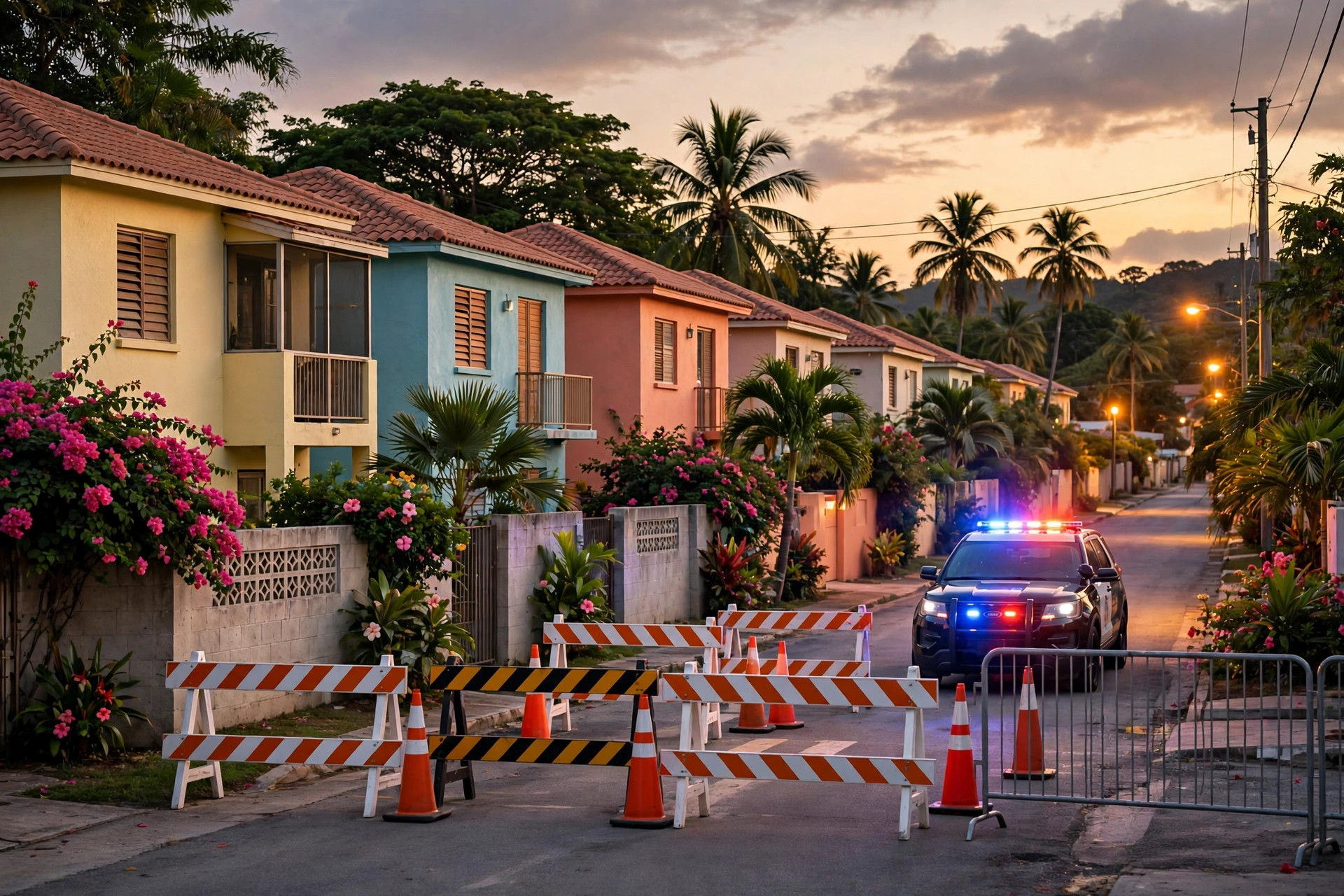
Maloney Gardens Housing Development, in D'Abadie, was declared the first closed area under the Act on 10 November, through Legal Notice 847, after a stabbing and shooting on 9 November suggested retaliatory attacks were being planned. A nightly curfew from 9pm to 5am followed, through Legal Notice 848. The two notices, a day apart, set the pattern: first the declaration of the closed area, then the curfew hours. Since 10 November, police have searched about 600 apartments, up from 392 four days earlier, which shows the scale and the pace of the operation. On 17 November, police found a cache of five illegal firearms hidden in a fig patch in Maloney Gardens, which the police present as a result of the searches. Police Commissioner Allister Guevarro says the lockdown's duration is assessed daily, which means there is no fixed end date and the decision to continue is taken day by day. The trigger for the declaration was specific: a stabbing and shooting on 9 November that suggested retaliatory attacks were being planned, and the declaration followed the next day. The searches, the firearms find and the daily assessment are the operational facts of the lockdown as it stands, and they are the facts the court case and the political debate both turn on. The opposition launched a free legal hotline, called "People's Counsel", for affected residents, which shows that the legal challenge in court is running alongside practical help for people living under the restrictions.
The people at the centre of the challenge
The people at the centre of the Trinidad Maloney curfew challenge come from both sides of the country's politics. The claimant is Wendell Eversley, a social activist, a survivor of the 1990 attempted coup and a national awardee, who filed the lawsuit on 16 November. His lawyers are led by Stuart Young, SC, a former prime minister and current Member of Parliament. The judge assigned to the case is Justice Nirala Bansee-Sookhai, who has yet to set a first hearing date. On the government's side, the Act was piloted by Attorney General John Jeremie, who acknowledged on 18 September that it could infringe several constitutional rights but maintained a special majority was not necessary. The Senate vote was broken by Senate President Wade Mark, who voted in favour on 24 September and who later, on 17 November, did not approve Opposition Senator Dr Amery Browne's motion for an urgent Senate debate on the Maloney restrictions. The Prime Minister is Kamla Persad-Bissessar, who says she is "not perturbed" by the challenge and that the opposition PNM is seeking to derail her government's crime-fighting efforts. The police operation is led by Police Commissioner Allister Guevarro, who says the lockdown's duration is assessed daily. The claimant's own position is complicated by the admission from his lawyer that Eversley, who lives in Bon Air West, Arouca, is not currently directly affected by the legislation. That admission will be one of the first things the court considers, and it sits alongside the political weight of the case: a former prime minister leading the legal team, a national awardee as claimant, and a government that says it will not be deterred.
The politics around the case
The politics around the Trinidad Maloney curfew case are as visible as the legal arguments. Prime Minister Kamla Persad-Bissessar says she is "not perturbed" by the challenge and that the opposition PNM is seeking to derail her government's crime-fighting efforts. That is the government's public position: the challenge is a political attempt to stop a crime-fighting operation, and it will not change the government's course. The opposition's response has two parts. The first is the court case itself, led by Stuart Young, SC, a former prime minister and current MP, on behalf of Eversley. The second is practical: the opposition launched a free legal hotline, "People's Counsel", for residents affected by the restrictions, and Opposition Senator Dr Amery Browne sought an urgent Senate debate on the Maloney restrictions on 17 November, a motion that Senate President Wade Mark did not approve. The military context adds a further layer: Trinidad and Tobago–US military drills run from 16 to 21 November, overlapping with the court filing and the lockdown. The drills are a separate event, but their timing means the lockdown and the legal challenge are unfolding while foreign troops are training in the country. The government's crime-fighting argument rests on the facts from Maloney — about 600 apartments searched since 10 November, five illegal firearms found in a fig patch on 17 November, and a stabbing and shooting on 9 November that suggested retaliatory attacks were being planned. The opposition's argument rests on the constitutional question — whether a law that the Attorney General acknowledged could infringe constitutional rights could pass without a special majority, on a 15-15 tie broken by the Senate President. For wider context, see the Privy Council ruling on Trinidad and Tobago's buggery law, the plan by five EU countries for a Rwanda deportation hub, and the Canada-China trade deal between Carney and Xi.
Why it matters and what happens next
The Trinidad Maloney curfew case matters because it will decide whether the government's main crime-fighting tool survives in its current form. The Special Operations Act 2026, proclaimed on 6 October, gives police the power to declare closed areas and impose curfews, cordons and checkpoints, road closures, entry and exit permit requirements, and warrant-less searches. Maloney Gardens, declared the first closed area on 10 November after a stabbing and shooting on 9 November, is the test of those powers: a nightly 9pm to 5am curfew, about 600 apartments searched, and five illegal firearms found in a fig patch on 17 November. What happens next starts with Justice Nirala Bansee-Sookhai, who has yet to set a first hearing date for Eversley's lawsuit, which seeks declarations that the Act is unconstitutional, null and void. The court will have to weigh the admission that Eversley, who lives in Bon Air West, Arouca, is not currently directly affected by the legislation, against the constitutional question at the centre of the case: whether the Act, which Attorney General John Jeremie acknowledged could infringe several constitutional rights, needed a special majority that it did not receive, passing instead on a 15-15 Senate tie broken by Senate President Wade Mark on 24 September. Police Commissioner Allister Guevarro says the lockdown's duration is assessed daily, so the curfew continues while the case waits for a date. The Prime Minister says she is "not perturbed", the opposition has set up a free legal hotline for residents, and the Trinidad and Tobago–US military drills run until 21 November. The first hearing date, when it is set, will be the next concrete step in a case that already carries the country's politics inside it.
Sources: Trinidad Tribune, CANA News/CMC, Trinidad Express, November 2026.