
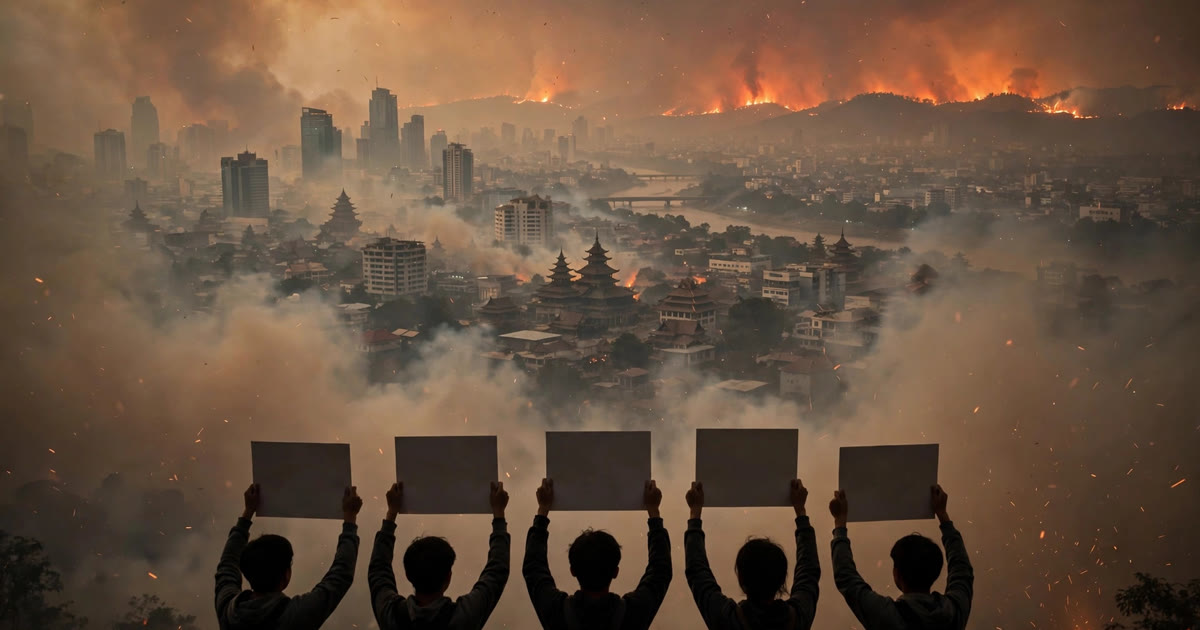
Thousands of demonstrators have staged rallies across multiple Indonesian cities this week, expressing fierce indignation over the government's failure to curb catastrophic forest fires that have shrouded the nation and neighboring countries in hazardous smog, trending per news coverage from outlets including The New York Times, The Jakarta Post, and the Straits Times.
Spearheaded by university students and civil society organizations, the street actions began on Monday, October 20, and spread across more than six urban centers, including key locations on Borneo island as well as the capital Jakarta. The protests coincided with the second anniversary of President Prabowo Subianto's administration taking office, and demonstrators have sharply condemned the head of state for failing to take resolute measures against the blazes.
Protesters are calling on President Prabowo to formally declare the forest fires a national emergency and to enforce swift action to eliminate destructive slash-and-burn land clearing, which is widely held responsible for feeding the widespread blazes. Placards displayed at a Jakarta gathering carried slogans such as "I have the right to breathe," "Extinguish the fires immediately!" and "If we burn, you burn with us!"
"The situation has reached a level that is completely, utterly abnormal," Naomi Artika, a law student at the University of Palangka Raya in Borneo's Central Kalimantan province, was quoted as saying.
A nationwide protest movement takes shape
The demonstrations have been remarkably widespread. In Jakarta, hundreds of university students gathered around the Tugu Tani monument, demanding action on rising living costs and the government's handling of forest and peatland fires. In Semarang, an estimated 2,000 students from several universities, including Diponegoro University, staged a demonstration outside the Central Java Governor's Office on Thursday afternoon, voicing demands ranging from environmental action to ending corruption, collusion, and nepotism.
Further protests erupted in Bandung and Yogyakarta in West Java, Pekanbaru on Sumatra, and Makassar on South Sulawesi. In Jakarta, the student marches were preceded by a Greenpeace action: police detained six activists who had draped banners from a monument on Jakarta's central Bundaran HI roundabout on Tuesday morning. One banner read: "Haze & Prabowo's Regime = National Disaster."
A coalition calling itself Komite Sadar (Save People's Sovereignty) laid out five demands at a Jakarta rally: declare forest and land fires a national disaster, restore public trust in economic governance, stop the constriction of free expression, eradicate systemic corruption, and make education, health, and public services affordable again. Student organizers in Jakarta urged the public to join another demonstration on October 28, Indonesia's Youth Pledge Day.
According to RT, protesters in Indonesia also set a police truck on fire amid the unrest, a claim that underscores how tensions have flared at the margins of the largely peaceful demonstrations.
The scale of the fire emergency
The anger is rooted in the sheer scale of the disaster. The Nusantara Atlas wildfire monitor said the Indonesian blazes have burned more than 1.9 million hectares of land in the first nine months of 2026. Indonesia experiences fires every dry season, but this year's blazes have been particularly severe, partly due to a severe episode of the El Niño weather phenomenon driving an unusually dry season. The fires raging across Sumatra, Kalimantan, and Papua have produced Indonesia's worst peatland fire season since 2015, choking large parts of Southeast Asia.
National Disaster Mitigation Agency spokesman Berton Panjaitan told journalists that more than 60,000 firefighters, including volunteers, were deployed in firefighting efforts nationwide. Forty-nine aircraft were available for water bombing and cloud seeding to make rain, although many have been grounded intermittently because the haze itself is too thick to fly through.
The environmental crisis has taken a heavy toll on everyday life in affected regions. In the Borneo city of Palangkaraya, local traders reported sharp drops in business alongside rising costs of living. Residents described prolonged coughing, physical fatigue, and smoke seeping directly into their homes. Thousands of Indonesians have fallen ill after weeks of breathing smoke from widespread forest and peatland fires, intensifying criticism of the government's response.
A transboundary crisis
The haze has not respected national borders. Air pollution levels have soared as far afield as Kuala Lumpur and Singapore, prompting concerns over regional air quality and public health across Southeast Asia. Singapore has widened its haze crackdown to Indonesian firms under its anti-haze law as the diplomatic row over the smoke has escalated.
In a striking cross-border moment, Malaysian parliamentarian Kalam Salan delivered a message in Javanese to Indonesian President Prabowo during a Malaysian parliament deliberation on the 2027 Budget Bill on October 21, urging the Indonesian government to immediately address the forest and land fires sending haze over Malaysia. According to the Bernama news agency, Kalam deliberately chose Javanese so his message could be fully understood by Indonesia's top leaders.
Government response and political pressure
Amid the protests, Presidential Chief of Staff General Police Listyo Sigit Prabowo said President Prabowo Subianto chaired a limited meeting at Merdeka Palace in Jakarta on Monday to discuss accelerating efforts to tackle forest and land fires. The administration also highlighted measures aimed at maintaining household purchasing power: a Rp26.34 trillion stimulus package for the second half of 2026, including assistance of 10 kilograms of rice for 33.24 million beneficiaries, another one million metric tons of rice from reserves to stabilize prices, and a pledge to keep fuel prices unchanged through the end of 2026.
Government officials have said they are strengthening law enforcement against those responsible for the fires and that President Prabowo has personally led efforts to address the crisis. But demonstrators say those measures are producing insufficient results, and the debate now centers on whether official narratives match lived experience.
The movement marks a significant heightening of public anger that has been gathering momentum since August. The fires have generated toxic haze, disrupted flights, forced school closures, and raised public health concerns, and protesters called on the government to prosecute companies responsible for environmental damage, tackle corruption, and make education and healthcare more affordable. They also demanded stronger protection for freedom of expression.
The protests echo a broader pattern of citizen action in Indonesia this year, including recent protests in Batam over water shortages and data centers, as Indonesians increasingly take to the streets to press the government on environmental and cost-of-living issues.
What happens next
The protest movement shows no sign of stopping. Student organizers have called for a larger demonstration on October 28, Indonesia's Youth Pledge Day, and civil society groups continue to pressure the government to declare the fires a national disaster. With the dry season's worst conditions still straining firefighting resources and the haze continuing to drift across Southeast Asia, the unrest has turned Indonesia's worsening wildfire emergency into a major political test for President Prabowo, whose administration faces mounting pressure to extinguish the fires, protect affected communities, and hold those responsible for illegal burning accountable.
The fires have drawn legal pressure from across the region, with Singapore issuing haze notices to 10 Indonesian companies blamed for the smoke.
Sources: Reuters (via multiple outlets), The New York Times, The Jakarta Post (via ANI), Straits Times, jawawa.id, indianeconomicobserver.com, tob.news, batamnewsasia.com, realnewshub.blog, WWC One Media, National Disaster Mitigation Agency, Nusantara Atlas, Bernama.