
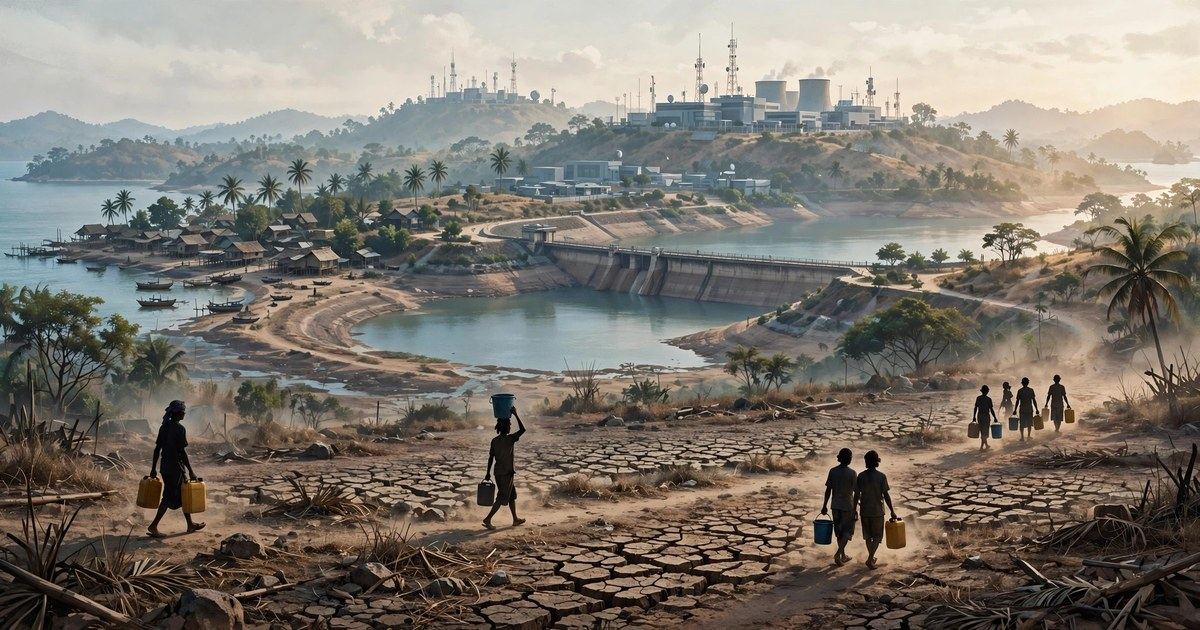
On an island in Indonesia trying to become Southeast Asia's next digital powerhouse, several hundred residents armed with nothing more than empty plastic bottles and jerry cans stormed a compound housing data centres this week. Their taps at home had run dry, they said, while the servers inside appeared to have all the water they needed. It is a dispute over water on a thirsty island — and, trending per news coverage, it has become a global symbol of the collision between the AI boom and everyday life.
Batam is a small island in Indonesia's Riau archipelago, just a short ferry ride from Singapore. In recent years it has been racing to transform itself into a digital hub, with the Nongsa Digital Park (NDP) — part of the Nongsa Special Economic Zone — hosting a fast-growing cluster of data centres. But Batam's reservoirs are shrinking, its piped water is faltering, and residents say the island's basic needs are losing out to its digital ambitions.
What happened this week
According to reports, around 300 residents of Bakau Serip village in the Nongsa district marched on the digital park, chanting "Water! Water!" as they carried the empty containers that have become the symbol of the shortage. One protester, Dewi Susanti, told reporters she had not seen "a single drop" come through her taps for three months, adding that her water supply had been reliable until the data centres arrived. Families in her village are now depending on tanker trucks that dispense water residents describe as "dirty, cloudy and smelly."
This was not a one-off flare-up. On 5 October, dozens of residents blocked access roads to Nongsa Digital Park, protesting shortages that they said had left some neighbourhoods without piped water for months — in some cases between three and six months of complete supply cuts. Police and military personnel were deployed around the area and redirected vehicles during the blockade. Local reporting describes it as the latest in a series of protests stretching back over the previous two months.
Why data centres are in the middle of it
Data centres need enormous amounts of water to keep their servers from overheating. Most facilities use fresh, treated water in cooling towers because it transfers heat efficiently. Batam's Free Trade Zone Authority, BP Batam, has estimated that the data centres already present require around 1,000 litres of water per second — while the allocation the authority could offer was only about 160 litres per second. NDP's own projections put its future water needs at up to 900 litres per second.
Those numbers are only the beginning. Analyses of the island's plans suggest that 18 data centres planned for Batam could eventually require roughly 32 million litres of water per day — about the same as the daily needs of 320,000 people. A single hyperscale facility in the region can demand as much as 50 million litres a day. In Malaysia's Johor state, just across the water, authorities have already halted new water allocations for data centres until at least mid-2027 amid similar fears of shortages.
The pattern of protests suggests a breaking point is approaching elsewhere in the region too. In Canada, a recent survey found most Canadians want the country's data centre boom to slow down — a sign that the backlash against the infrastructure behind artificial intelligence is going global.
What the authorities say
BP Batam, the agency overseeing trade and industry on the island, rejects the claim that the shortages are linked to data centre demand. It blames a prolonged dry spell and falling water levels at the Nongsa Reservoir, and denies that water meant for homes is being channelled to the industrial park. After the October blockade, an official promised to restore piped supplies within two days and ordered six tanker trucks to deliver water temporarily to affected neighbourhoods.
Batam's water utility told reporters it was working to improve supply but did not comment on whether the disruption was linked to demand from the data centres. Some reporting notes that certain data centres are supplied from the Duriangkang Reservoir, only after community needs are met — a claim residents plainly do not trust.
An island with almost no water of its own
Batam's vulnerability is structural. The island has no major river and little usable groundwater — wells were banned permanently because of poor quality. It relies entirely on six rain-fed reservoirs linked by a fragile network of pipes. Leaks, maintenance lapses and dry spells routinely leave taps running dry; in some neighbourhoods, residents get running water for only eight hours a day even in better times.
It is a precarious base for a digital boom. The nine data centres in NDP alone are estimated to need 1,200 to 1,500 megawatts of electricity by 2032 — and power is the one utility Batam still has in reserve. Water is the constraint that cannot be engineered away cheaply.
The desalination question
One proposed fix is seawater desalination through Sea Water Reverse Osmosis (SWRO) plants. But the economics are daunting: a facility with a capacity of 1,000 litres per second is estimated to cost around IDR 1 trillion (tens of millions of dollars). And the regional chamber of commerce warns that the concentrated waste brine from desalination could damage coral reefs — an environmental trade-off that merely moves the crisis offshore.
A global pattern
Batam is not the first place where the AI infrastructure race has collided with local communities. Similar protests have erupted in Malaysia's Johor state. Researchers in Indonesia warn that the situation risks becoming a form of environmental injustice, with basic human needs competing against the demands of data centres — a concern that grows sharper as climate change makes water scarcer.
The island's story captures the defining tension of the AI era: the servers that power chatbots and cloud computing must live somewhere, and somewhere has to supply the water. In Batam, that somewhere is an island of more than a million people whose taps are running dry.