
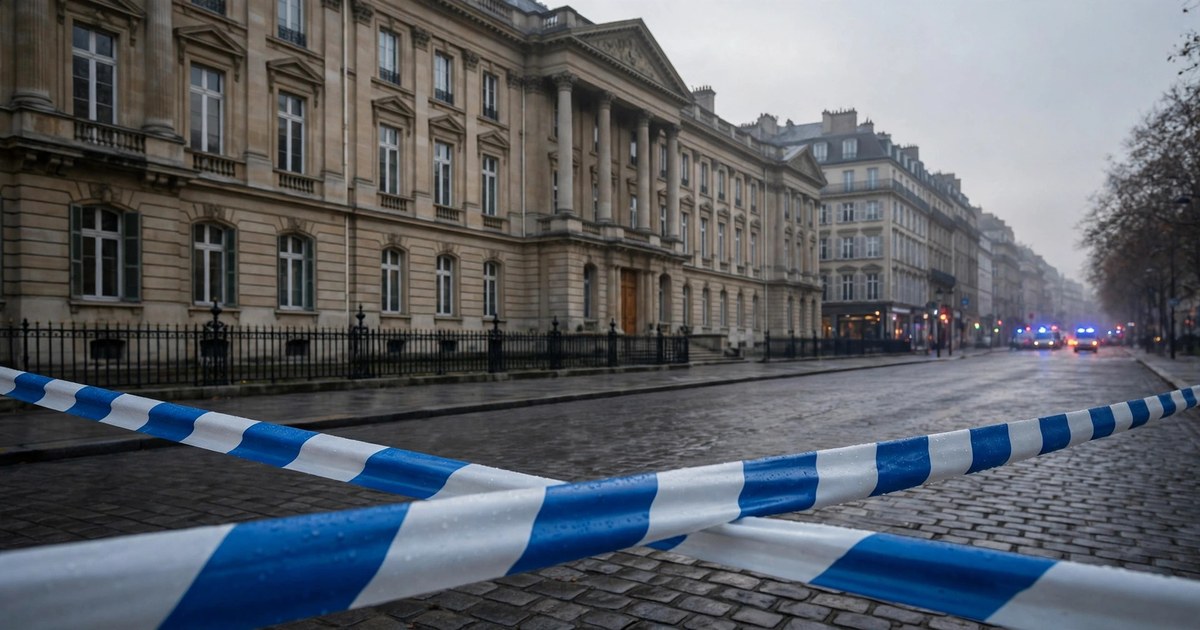
The Belgrade Israeli embassy attack happened overnight, when a man armed with two knives wounded a police officer guarding the Israeli embassy in Belgrade and was then shot dead by that officer, according to Serbia's outgoing interior minister and prosecutors. The Belgrade Israeli embassy attack left no embassy staff hurt, because the mission was closed at that time of night, Israel's Foreign Ministry said. Within hours, Serbia had raised its national terror threat level to red, the highest level, and promised a heavier police presence at key locations across the country.
What happened in Belgrade in the early hours of Wednesday, 28 October 2026, is still being investigated, and several important details remain unconfirmed. The attacker's identity had not been determined when officials first spoke about the incident, and no group had publicly claimed responsibility in the reporting available at the time of writing. What is confirmed is the sequence at the embassy itself, the officer's injury, the raising of the threat level, and the fact that this is the second attack at the same embassy in just over two years.
This article sets out what is known from Reuters, the Associated Press account of the interior minister's remarks, the Belgrade Higher Public Prosecution Office, and Israel's Foreign Ministry, and it separates those confirmed facts from claims that rest on a single official statement and from questions the investigation has not yet answered. Readers looking for the latest position should treat early official statements as the starting point, not the final word, because investigations of this kind often revise first descriptions as evidence is checked.
Belgrade Israeli embassy attack: what happened outside the embassy?
According to Reuters, which reported the incident from Belgrade on 28 October, an attacker with two knives wounded a policeman guarding the Israeli embassy overnight, before the officer shot the assailant dead. Serbia's outgoing interior minister, Ivica Dacic, said in an emailed statement that the attacker rushed at a member of the Gendarmerie, the Serbian police force unit that guards diplomatic premises, and attacked him with two knives. Dacic described the attacker as a minor of so far undetermined identity who was reasonably suspected to be from Sabac, a city in western Serbia, and said the attacker had shouted "Allahu Akbar" as he rushed at the officer.
The Belgrade-based Higher Public Prosecution Office gave a more detailed account of the moments at the scene. It said a black-clad, unidentified individual opened the door of a guard house in front of the embassy and, armed with two knives, rushed at the policeman, who was identified only by the initials D.S. The individual threw one knife in the direction of the officer, hitting him in the left cheek, the prosecution office said. The officer then took out his service weapon and fired several shots at the attacker, killing him on the spot. The prosecution office said the officer's action had been qualified as justified and in self-defence, and that the investigation was continuing.
Dacic described the officer's wound as a light head wound. The two descriptions are not contradictory: a knife strike to the cheek can fairly be described both ways, and neither account suggested the officer's injuries were life-threatening. No other person was reported wounded in the incident. The embassy itself was closed, and Israel's Foreign Ministry told the Jewish News Syndicate that local police had neutralised the attacker, that there were no casualties among the employees of the mission, and that the matter was under investigation by the relevant authorities.
The timing matters for understanding why the building was empty. The attack took place overnight, on Tuesday night into Wednesday morning, when an embassy guard post would normally be staffed but the mission's offices would be closed. That is also why the confrontation was between the attacker and the guard, rather than involving embassy staff or visitors. Reuters published its report at 07:19 UTC on Wednesday, 28 October, which places the incident in the hours before dawn in Belgrade.
Belgrade Israeli embassy attack: what police and prosecutors say happened
The Belgrade Israeli embassy attack is being treated by Serbian police as a terrorist attack, according to the Associated Press account of Dacic's remarks carried by the Jewish News Syndicate. That classification is important, but readers should understand what it does and does not establish at this stage. Treating an incident as a terrorist attack is a working classification for the investigation: it determines which units lead the inquiry, what powers are used, and how seriously related threats are taken. It is not, on its own, proof of the attacker's motive, of any organisational link, or of a wider plot.
So far, the public record contains no named suspect, no confirmed age beyond Dacic's description of the attacker as a minor, and no confirmed organisational affiliation. Local media in Serbia were quoted as saying Dacic had described the attacker as a suspected Islamic State terrorist, but that characterisation was reported second-hand through local outlets, and Reuters' own account of Dacic's emailed statement did not carry that label. This article therefore does not present an Islamic State link as an established fact for the 2026 attack. If Serbian prosecutors or police later confirm or rule out such a link, that will be a significant update, and it should be reported as a new finding rather than assumed from the start.
What prosecutors have established in public is narrower and more concrete. The attacker arrived at the guard house, opened its door, and attacked with two knives. One knife was thrown and struck the officer in the cheek. The officer fired several shots and killed the attacker at the scene. The prosecution office has qualified the shooting as justified self-defence. Those are the facts on which the next stage of the investigation will build: identifying the attacker, tracing how he reached the embassy, establishing whether he acted alone, and determining what, if anything, he left behind that explains his intent.
Serbian authorities have not yet published details about searches, arrests, or items recovered, beyond the knives described in the official accounts. The absence of that information in the first hours is normal, but it is also why the full picture will take days to emerge. Early reporting that fills gaps with speculation about networks or motives should be treated with caution until prosecutors or police confirm it.
Why Serbia raised its terror threat level to red after the Belgrade Israeli embassy attack
Dacic said he had raised Serbia's security threat level to red, the highest level, and that there would be an increased police presence at key locations. In his words, as reported by the Associated Press, he raised the level because the attack had taken place on Serbian territory and, as the minister responsible, he was raising the terrorist threat to the highest possible level, namely the red level.
A red alert in this context is a national security posture, not a claim that further attacks are expected at a specific place or time. It signals that the authorities consider the risk serious enough to justify maximum vigilance, more visible policing, and tighter protection for sensitive sites. In practice, readers in Serbia should expect to see more police at transport hubs, government buildings, diplomatic missions, and other key locations, and possibly more checks at the entrances to public buildings. The alert also gives security agencies a clear basis to coordinate across regions while the investigation is at its most active.
The decision to go straight to the highest level reflects two things: the target and the precedent. An attack on a foreign embassy is an attack on a protected diplomatic site, and states treat it as a matter of national reputation as well as public safety. Serbia also has a direct precedent at this exact location, from June 2024, which showed that an attack on the embassy guard post could be repeated. Raising the level to red is therefore both a response to this incident and a precaution against a copycat or follow-on attempt while the facts are still unclear.
Diplomatic missions elsewhere in the region have also been operating in a heightened security climate in recent weeks. The United States has warned Gulf states to prepare for a possible short, intense campaign against Iran after the American midterm elections, and US warnings about Iran strikes after the midterms have underlined how tense the wider Middle East security picture has become. That wider tension does not explain the Belgrade attack, and no link between the two has been reported, but it is part of the background against which governments are currently assessing threats to embassies and other diplomatic sites.
The 2024 crossbow attack: the precedent at the same embassy
The 2026 attack is the second such attack at the Israeli embassy in Belgrade in two years, Reuters noted, and the comparison with the earlier incident is instructive. On 29 June 2024, at around 11:00 in the morning, a man attacked a Serbian gendarme guarding the embassy with a crossbow. The embassy is in the wealthy Dedinje neighbourhood of Belgrade. According to the interior minister's account at the time, the attacker approached a small building near the embassy, asked about a museum, opened the door to the small building, and fired a crossbow at the gendarme, wounding him in the neck. The officer returned fire and killed the assailant.
The 2024 attacker was identified in reports as a 25-year-old convert to Islam who had moved to Novi Pazar, in southern Serbia. Serbian officials described him as a supporter of the Islamic State, and the group was reported to have claimed responsibility. The wounded officer needed surgery to remove an arrow from his neck and was reported to be in a stable condition in hospital. Serbia's then president, Aleksandar Vucic, called the 2024 incident a terrorist attack against Serbia, and the interior minister put the whole country on red alert with an increased police presence, just as Dacic has done now.
The parallels are striking, and they are also limited. Both attacks targeted the guard post rather than the embassy building itself. Both involved a lone attacker approaching the small guard building and striking at close range. Both ended with the guard returning fire and killing the attacker. And both prompted a national red alert. But the weapons differed, the time of day differed, and the 2024 attacker was an identified adult with a reported organisational claim, while the 2026 attacker remained unidentified in the first official accounts. Those differences matter, because they mean the 2024 case cannot simply be used as a template for understanding the motive or background of the 2026 attacker.
The 2024 case also shows what a red alert looked like in practice. It stayed in place for at least two days, police detained further individuals and carried out operations across the country, and officials said they were searching for at least one more person. Whether the 2026 alert follows a similar course will depend on what the investigation finds in its first days, including whether the attacker is found to have acted alone.
Why this happened during Serbia's political handover, and a day after Israel voted
The attack came at a moment of unusual political transition in Serbia. On Sunday, 25 October 2026, Serbia held a snap parliamentary election, and the student-backed Students' List won a commanding victory over the Serbian Progressive Party alliance led by longtime leader Aleksandar Vucic. With almost 99 percent of votes counted, the students' candidates had secured 52.7 percent of the vote, against 39.2 percent for Vucic's alliance, giving the Students' List 139 seats in the 250-seat parliament and leaving the SNS alliance with 97. Vucic conceded defeat on election night. Serbia's election result and Vucic's concession marked the end of 14 years in which Vucic had dominated Serbian politics as prime minister or president.
The outgoing administration remains in place in a caretaker role until a new government is formed, Reuters reported, which is why Dacic, described as the outgoing interior minister, was the official announcing the security response. That caretaker position does not reduce the authority of the police or prosecutors to investigate, but it does mean the political leadership responding to the attack is not the government that will be in office in the weeks ahead. How the incoming government handles security policy, including the future of the red alert, will be one of its early tests.
The attack also came a day after Israelis went to the polls, with projected results showing the opposition bloc neck and neck with Prime Minister Benjamin Netanyahu's camp, according to Reuters. Israel's election exit polls pointed to a deadlock, with neither bloc projected to reach a majority on its own. No evidence has been reported linking the Belgrade attack to the Israeli election, and the timing should not be read as a motive. It is included here because readers may reasonably ask whether the two events are connected, and the honest answer on the current public record is that no such connection has been established.
Serbia's political transition also has a longer background that helps explain the atmosphere in Belgrade. The student movement grew out of nearly two years of protests following the deaths of 16 people in the collapse of a train station canopy in Novi Sad, and it built its support on accusations of corruption and the dismantling of democracy. Tens of thousands of people celebrated in Belgrade and other cities after Vucic conceded. Against that background, an attack on a foreign embassy during the handover period is a serious security challenge for a state whose institutions are about to change hands, even though there is no reported evidence that the attacker was connected to Serbian domestic politics.
What is confirmed, what is claimed, and what is still unknown
Confirmed about the Belgrade Israeli embassy attack: a man armed with two knives attacked a Gendarmerie officer at the guard house in front of the Israeli embassy in Belgrade overnight on 27-28 October 2026; the officer was wounded in the cheek and head area; the officer fired several shots and killed the attacker on the spot; no embassy staff were hurt and the mission was closed; Serbia's terror threat level was raised to red; and police presence was increased at key locations. These facts come from Dacic's statement, the prosecution office, and Israel's Foreign Ministry, as reported by Reuters and the Associated Press.
Claimed, but resting on a single official account so far: the attacker's description as a minor from Sabac, and the account that he shouted "Allahu Akbar" as he attacked. Both details come from Dacic's emailed statement. They may well prove accurate, but they have not yet been corroborated in the public record by prosecutors, by identity documents, or by other witnesses, and they should be treated as official claims pending confirmation. The reported characterisation of the attacker as a suspected Islamic State terrorist, carried through local media, is weaker still, and this article does not treat it as established.
Still unknown: the attacker's name and exact age; whether he acted alone or with help; how he obtained the knives and travelled to the embassy; whether he left any statement, message, or online trail; whether security agencies had any prior knowledge of him; and how long the red alert will remain in place. Each of those questions is a normal part of a terrorism investigation, and each will take time to answer reliably. Readers should be wary of social media claims that purport to answer them before the authorities do.
What happens next in Belgrade and beyond
The immediate next steps after the Belgrade Israeli embassy attack are investigative and protective. Prosecutors will lead the identification of the attacker and the search for any associates or evidence of planning. Police will maintain the increased presence at key locations for as long as the red alert lasts, and diplomatic missions in Belgrade can expect continued close protection. If the investigation finds that the attacker acted alone, the alert may be lowered relatively quickly, as happened after the initial days of the 2024 case. If it finds links to others, the alert is likely to stay in place longer and further operations may follow.
Beyond Serbia, the incident will be watched by other governments with embassies in Belgrade and by Israel's Foreign Ministry, which will want reassurance about the protection of its missions. It may also prompt a review of guard-post procedures at diplomatic sites, since both the 2024 and 2026 attacks began at the small guard building in front of the embassy. The lesson of the earlier case is that a guard post is both the first line of protection for an embassy and, precisely for that reason, the first point an attacker will meet.
For now, the most useful thing readers can do is to follow official updates from Serbian prosecutors and police, and to distinguish between what those authorities have confirmed and what remains under investigation. The Belgrade Israeli embassy attack is a serious incident with a clear, confirmed core and a still-unfinished investigation around it. This article will need updating as prosecutors identify the attacker and establish whether he acted alone, and any future update should be judged against the confirmed facts set out here, not against early speculation.
Sources: Reuters reporting from Belgrade, 28 October 2026; Associated Press account of Interior Minister Ivica Dacic's remarks, as carried by the Jewish News Syndicate; Belgrade Higher Public Prosecution Office statement, as reported by Reuters; Israel's Foreign Ministry statement, as reported by the Jewish News Syndicate; Reuters reporting on the 2024 crossbow attack and on Serbia's 2026 election result. Figures and quotations in this article are attributed to those sources; where sources differed in wording, this article reports both versions rather than choosing one.