
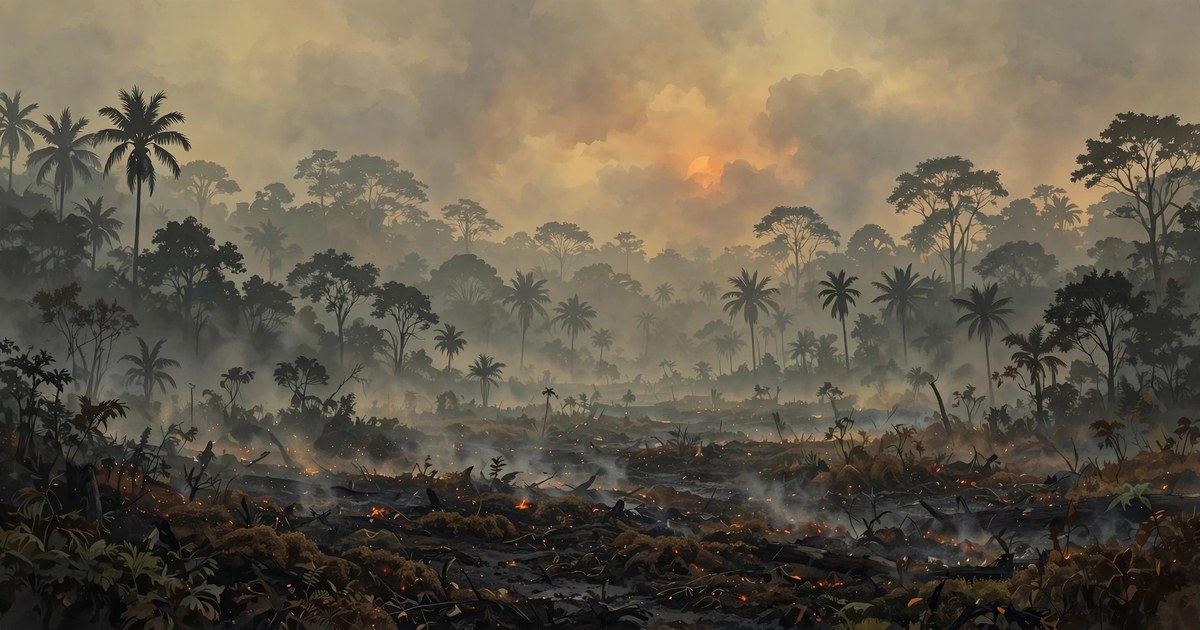
Indonesia is living through its worst wildfire season in 11 years, and the smoke has become a regional crisis. Thick haze from burning peatlands has choked cities across Sumatra and Kalimantan, pushed air pollution readings to several times the hazardous level, closed schools in neighbouring countries, and left hundreds of thousands of people with respiratory illnesses. On Thursday, October 15, 2026, a senior Indonesian official publicly blamed the disaster on decades of peatland degradation caused by past food-estate projects, and promised the government would work to restore the damaged peat ecosystem.
The story, trending per news coverage across Reuters and other outlets, is not just about fire. It is about what happens when a waterlogged landscape built to stay wet is drained, dried out, and then hit by a powerful El Niño drought. Peatlands that once acted as giant sponges and carbon stores have become fuel. And because peat fires burn underground, they are among the hardest fires on Earth to put out.
What Happened This Week
According to Reuters, Indonesia is struggling to contain its most intense wildfire season since 2015, after an El Niño-driven drought made its forests and land highly flammable. The fires have been raging for months. Hundreds of thousands of people have contracted respiratory illnesses in seven Indonesian provinces alone, and thick haze has drifted into neighbouring countries.
The air pollution figures are startling. Indonesian cities, especially in Sumatra and Kalimantan, are being choked by haze, with the air pollution index far above the “hazardous” threshold of 300. The Katingan district of Central Kalimantan recorded a reading of nearly 1,600 on Thursday, while the provincial capital Palangka Raya recorded nearly 1,300. Reported figures from Indonesia’s environment ministry put the Air Pollution Standard Index (ISPU) in parts of Central Kalimantan above 1,200, more than four times the hazardous threshold.
The transboundary haze has polluted the air in neighbouring countries, with schools suspended in East Timor and some states of Malaysia. Images from local media showed Palangka Raya shrouded in dense yellowish haze, with visibility on roads significantly reduced. Firefighters have been using water to tackle blazes near peatland areas, while flights have been delayed, parks shut and thousands of schools closed across the affected region.
The health toll has escalated fast. Reported figures cited in news coverage put respiratory illness cases associated with the fires and haze at 277,075 across seven Indonesian provinces by October 12, more than double the 113,336 cases reported on September 9. Separately, officials have said more than 12.5 million people have been exposed to haze caused by the fires. Scientific American reported that the fires have already produced 12.82 megatons of carbon emissions in 2026, nearly 100 times as much as was emitted in all of 2025.
The firefighting response has grown with the crisis. More than 69,000 firefighters have been deployed, up from approximately 44,000 in mid-September, according to officials cited in news reports. Indonesian President Prabowo Subianto has instructed authorities to deploy additional resources, and officials say new techniques involving specialised chemicals are being tested to improve firefighting effectiveness. More than 50 aircraft have been deployed for cloud-seeding and water-bombing operations.
Why Peat Fires Are So Hard to Put Out
The worst-affected areas, Central Kalimantan and South Sumatra, are suffering mainly from peatland fires. Peat is a dense layer of partly decayed plant matter that builds up over thousands of years in waterlogged wetlands. When it is wet, it barely burns. When it is drained and dried, it becomes a deep, carbon-rich fuel.
Peat fires smoulder slowly beneath the surface and can re-emerge at any time. Unlike a forest canopy fire that races through treetops and can be seen from the air, a peat fire can creep underground for weeks or months, with embers smouldering metres below the surface and flaring up if not completely doused. Fire crews from Manggala Agni, Indonesia’s national firefighting force, have been forced to stand guard overnight to watch for re-ignition. One fire crew leader in West Kalimantan told reporters that conditions in 2026 were worse than the catastrophic 2015 season, with an El Niño-driven drought drying up water sources and leaving the region without rain for over 60 days.
Peat fires also produce far thicker, more toxic smoke than ordinary forest fires. Because they burn at relatively low temperatures and smoulder for so long, they generate extremely high levels of fine particulate matter that can travel deep into the lungs and cause breathing and heart problems. That is why a peat fire season can poison the air across an entire region even when the area of visible flame looks modest from satellite images.
What Caused This Season: El Niño Meets Drained Peat
Two forces combined to create this disaster: a climate pattern and a land-use history.
The first is El Niño. The natural climate pattern tends to bring bone-dry conditions to Indonesia, and the current event has been described as a “super” El Niño. Dry conditions lower the water table, dry out the peatlands far more than usual, and make both deliberate land-clearing burns and accidental ignitions far more likely to spread. According to NASA data cited in news coverage, the current drought conditions resemble those seen in 2015, another El Niño year. The drought is likely to continue until the rainy season begins in October or November. For background on the pattern itself, see our explainer on El Niño in 2026.
The second force is decades of peatland degradation. Deputy food minister Hanif Faisol Nurofiq said on Thursday that long-standing interventions had seriously degraded the peatlands in Central Kalimantan and South Sumatra. “Massive drainage efforts were carried out, fundamentally altering the natural properties of the peat,” he said, identifying a food estate project in the 1990s as one of the causes of degradation. “Today, a large portion of these peatlands has been destroyed,” he added.
The history matters. In the 1990s, Indonesia pursued a giant food-estate scheme, often called the Mega Rice Project, which cut canals through the peat swamps of Central Kalimantan to drain them for rice cultivation. The rice largely failed, but the canals remained, draining water out of the peat year after year. Peatland protection group Pantau Gambut estimated that out of 24 million hectares of Indonesian peatland, 16 million hectares have been made more fire-prone as a result of ecosystem damage, including extensive deforestation and the depletion of water tables.
Many fires are also deliberately lit. Every year, during the dry season, fires are set to clear land for pulp, paper and palm oil production. In a wet year, many of those fires stay small. In an El Niño year, on drained peat, they escape and keep burning. The result is a fire season that is less a natural accident than a predictable outcome of how the land was changed.
The Human and Economic Toll
The comparison everyone is making is 2015. That year, fires fuelled by a previous super El Niño incinerated around 2.6 million hectares, an area roughly the size of Massachusetts, cost the country as much as $28 billion, and may have caused 100,000 premature deaths across Indonesia, Malaysia and Singapore, according to research cited in news coverage. Half a million people were hospitalised for respiratory, eye and skin ailments. A Harvard-led study estimated that smoke from the 2015 fires may have caused around 100,000 premature deaths.
By September 2026, at least 200,000 hectares had already burnt across Indonesia, according to reports citing officials, and Indonesia’s Forestry Minister Raja Juli Antoni had warned that September would be the toughest month. A peatlands researcher at YKAN, an Indonesian conservation non-profit, told CNN that the magnitude of the 2026 fire season was currently very similar to that of 2015. The current season still has weeks to run before the rains arrive.
Beyond the health figures, the haze carries a heavy economic cost: closed schools, delayed flights, shuttered parks, disrupted transport, and lost working days. In 2015, the haze closed some airports and cost the region billions of dollars in health and economic damage. The same machinery is running again in 2026, and Singapore and Malaysia are again breathing air polluted by fires they did not light. The episode has also sharpened attention on Indonesia’s wider environmental pressures, from water stress around fast-growing industrial zones, covered in our report on Batam’s water crisis, to the global climate forces driving more extreme fire weather, explained in our guide to climate change.
What Happens Next
The Indonesian government says it will work to restore the peat ecosystem. That is the right long-term answer, and it is also a slow one. Restoration means blocking old drainage canals, rewetting the peat, keeping the water table high, and preventing new drainage and burning. Peat that has been drained for decades does not recover in a single season, and rewetting only works if the canals stay blocked and the land is protected.
The near-term outlook depends on rain. If the rainy season arrives on schedule in October or November, it should finally douse most of the smouldering peat. If the drought lingers, the fires could continue to spread and the haze could worsen. Cloud-seeding can nudge local rainfall, but it cannot replace a monsoon.
There is also a regional diplomatic dimension. Southeast Asian countries have an agreement on transboundary haze pollution, but enforcement has always been difficult when fires are numerous, small, and spread across remote peatlands. Each bad season renews pressure from Singapore and Malaysia for stronger prevention, and each season tests whether Indonesia’s pledges on peat protection and restoration are matched by action on the ground.
For now, the immediate advice for people in affected areas remains the same as in every haze season: stay indoors when the air is hazardous, use proper masks when going outside, keep children and people with asthma or heart conditions away from smoke, and follow local health advisories. For the region, the lesson of 2026 is the one scientists have repeated since 2015: drained peat plus drought equals disaster, and the only durable fix is to keep peat wet.
Frequently Asked Questions
Why are Indonesia’s 2026 wildfires the worst since 2015?
An El Niño-driven drought dried out Indonesia’s peatlands, while decades of drainage from past food-estate projects left the peat fire-prone. The combination produced the most intense wildfire season since 2015, with hundreds of thousands of respiratory illness cases and haze spreading to neighbouring countries.
What is peat, and why do peat fires produce so much smoke?
Peat is a thick layer of partly decayed plant matter that accumulates over thousands of years in waterlogged wetlands. When drained and dried, it becomes deep, carbon-rich fuel. Peat fires smoulder underground at low temperatures for weeks or months, producing far more thick, toxic smoke than ordinary forest fires.
Which areas are worst affected by the fires and haze?
Central Kalimantan and South Sumatra are currently the worst affected areas, according to officials cited by Reuters. Cities in Sumatra and Kalimantan have recorded air pollution readings far above the hazardous threshold of 300, and haze has drifted into Malaysia, Singapore and East Timor, where some schools were suspended.
How many people have been affected by the haze?
Reported figures cited in news coverage put respiratory illness cases associated with the fires at 277,075 across seven Indonesian provinces by October 12, more than double the figure from September 9. Officials have also said more than 12.5 million people have been exposed to haze, and more than 69,000 firefighters have been deployed.
When will the fires end?
The fires are likely to persist until the rainy season begins, expected in October or November. Rain is the most reliable way to extinguish smouldering peat. Until then, firefighting, cloud-seeding and water-bombing operations continue, while the government says it will work on longer-term peatland restoration.
Sources: Reuters (October 15, 2026); Scientific American; CNN; Harvard T.H. Chan School of Public Health / SEAS research on the 2015 fires; Pantau Gambut peatland estimates; reported Indonesian environment ministry and official figures cited in news coverage.
The fires have also turned political at home, where protests have erupted across Indonesia over the forest fires and choking haze.