
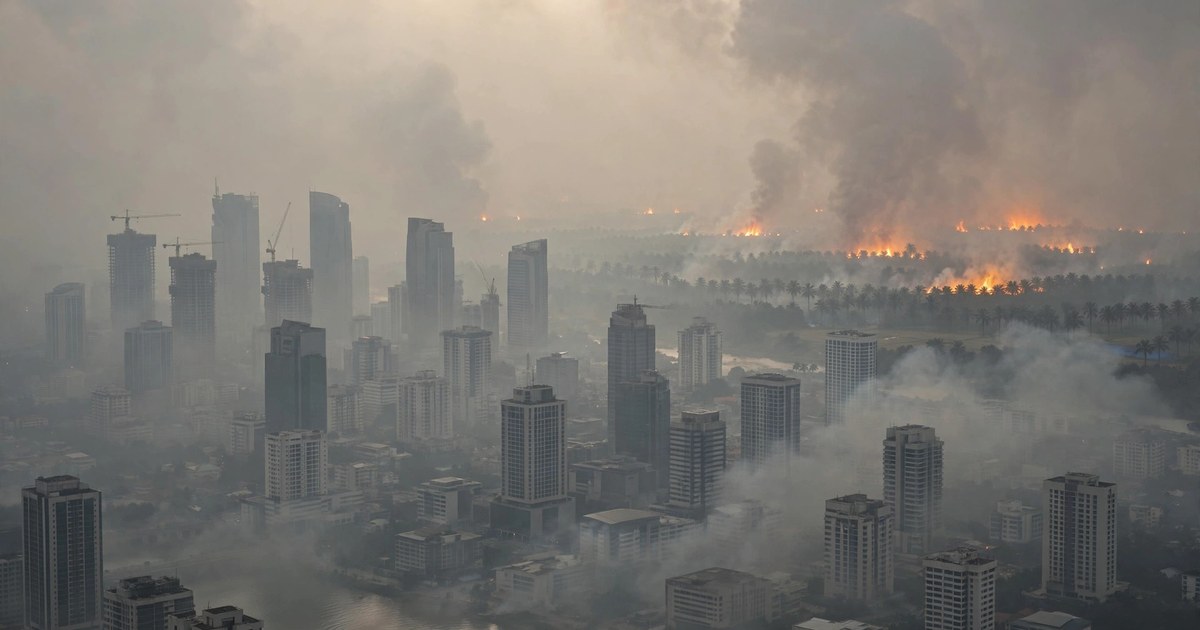
Singapore has widened its crackdown on companies linked to Southeast Asia's haze crisis, issuing preventive notices to three more Indonesian firms — even as a diplomatic row with Jakarta escalates over who bears responsibility for the region's worst transboundary haze episode in a decade. The moves, announced around October 20-21, 2026, bring to ten the number of companies targeted under Singapore's Transboundary Haze Pollution Act.
The enforcement push comes as former Indonesian trade minister Muhammad Lutfi publicly accused Singapore of using warning letters as political theatre, while Indonesian President Prabowo Subianto pushed back against countries he said were "insulting" Indonesia over the toxic haze. The dispute is straining relations between neighbours even as firefighters battle blazes across Sumatra and Kalimantan.
Singapore's expanding enforcement
On October 20, Singapore announced additional preventive notices to three companies operating in Kalimantan, identified by the Associated Press as PT Buana Megatama Jaya, PT Mananjung Hayak, and PT Baratama Putra Perkasa. The notices require the companies to take preventive measures — including dealing with fires on or around their concessions and submitting fire-prevention plans.
The additional notices brought the reported number of Indonesian companies targeted under Singapore's Transboundary Haze Pollution Act to ten. Singaporean authorities have emphasized that receiving a preventive notice is not the same as being found legally responsible for causing the haze — but that companies may face further enforcement action if they fail to comply.
The net is also widening to Singapore-listed firms. Companies on the Singapore Exchange are being investigated over suspected land clearing by burning. Kencana Agri, a palm oil producer listed in Singapore, disclosed — in response to SGX regulatory queries — that fires had occurred on approximately 62 hectares within concession areas managed by its subsidiaries in North and East Kalimantan. The company said the fires spread from surrounding land and did not originate from its operations. Some companies have acknowledged fires within their concessions while denying responsibility for starting them.
Lutfi's broadside
The sharpest criticism came from Muhammad Lutfi, who served as Indonesia's trade minister under both Susilo Bambang Yudhoyono and Joko Widodo. In posts on Instagram and TikTok quoted by detikFinance on October 20, Lutfi said Singapore's warning letters were merely a way to appease its own citizens suffering the economic and health impacts of the smog.
"The Singaporean government announced that they sent warning letters to seven companies in Indonesia due to the disaster. Let me say this: do not write warning letters just to make your constituents and voters happy," Lutfi said.
His substantive charge was more pointed: citing an October 2026 Greenpeace report, Lutfi argued that four of the seven originally warned companies — along with giants First Resources and Bumitama Agri — are directly listed on the Singapore Exchange and based in the city-state, with a combined valuation reaching S$10 billion (about US$7.5 billion). "Four of the seven companies you mentioned are suppliers for conglomerate groups with massive corporate ownership that are listed directly there, in Singapore," he said, addressing Minister Grace Fu's announcement. The implication: Singapore is going after Indonesian firms while the corporate ownership — and the profits — sit in Singapore itself.
Lutfi also rebuked a Malaysian MP, Syed Saddiq, who had called for ASEAN to treat Indonesia as a regional "outcast" over the haze and to cut financing to implicated firms. Lutfi countered that Malaysian plantation groups control up to 3.4 million hectares in Indonesia and that corporate supply chains on both sides need scrutiny, pointing to a Greenpeace report identifying 19 fire hotspots in Indonesian concessions linked to Malaysian groups.
Singapore and Jakarta respond
Senior Minister K. Shanmugam criticized Lutfi's remarks, while separately welcoming President Prabowo's efforts to tackle the fires — a distinction Singaporean officials have been careful to draw between criticizing particular comments and the broader government-to-government cooperation, which continues.
Shanmugam also pushed back on a separate Indonesian official's suggestion that Singapore should appreciate the oxygen Indonesian forests supply when the haze is absent — a remark that underscored how raw the rhetoric has become.
Prabowo, for his part, has defended Indonesia against foreign criticism while warning domestic corporations. Indonesia's National Disaster Mitigation Agency (BNPB) has mobilized a joint force of 60,177 personnel domestically, and Prabowo has approved accepting help from neighbouring countries — Malaysia has officially offered three helicopters and 52 personnel, announced by Coordinating Minister Dudung Abdurachman.
Why the haze keeps returning
The underlying mechanics are depressingly familiar. Fires — many deliberately set to clear land for palm oil and pulpwood plantations — burn across drained peatlands in Sumatra and Kalimantan, producing thick smoke that drifts across the Strait of Malacca. Peat fires are notoriously hard to extinguish and can smoulder for weeks.
What makes this episode the worst in a decade is a combination of dry conditions, the scale of burning, and the political moment: with Singapore's air quality repeatedly hitting "very unhealthy" levels and schools curtailing outdoor activities, public pressure on governments across the region is intense.
The corporate-accountability question Lutfi raised is the hardest one. Palm oil supply chains run through layered subsidiaries across Indonesia, Malaysia, and Singapore; proving which entity started a particular fire — as Singaporean officials themselves note — requires evidence that Indonesian authorities have often been reluctant to share. Singapore's Transboundary Haze Pollution Act was designed precisely to reach across that jurisdictional gap, but it has rarely been tested to a conviction.
What happens next
The immediate test is operational: whether Indonesia's firefighting surge, plus Malaysian helicopters, can bring the blazes under control before the dry season ends. The political test is longer: whether ASEAN can build a credible cross-border enforcement regime, or whether each haze season will replay the same cycle of smoke, suffering, and recrimination.
For Singapore, the ten preventive notices signal that the city-state intends to keep using the legal tools it has — while the Lutfi episode shows how quickly enforcement becomes diplomacy. The haze, as ever, does not respect borders. The politics of blaming someone for it increasingly doesn't either. Related reading: the WMO warning on the strongest El Niño on record, Storm Adam's deadly flooding in Spain, and the Gulf of Mexico marine-life study.