
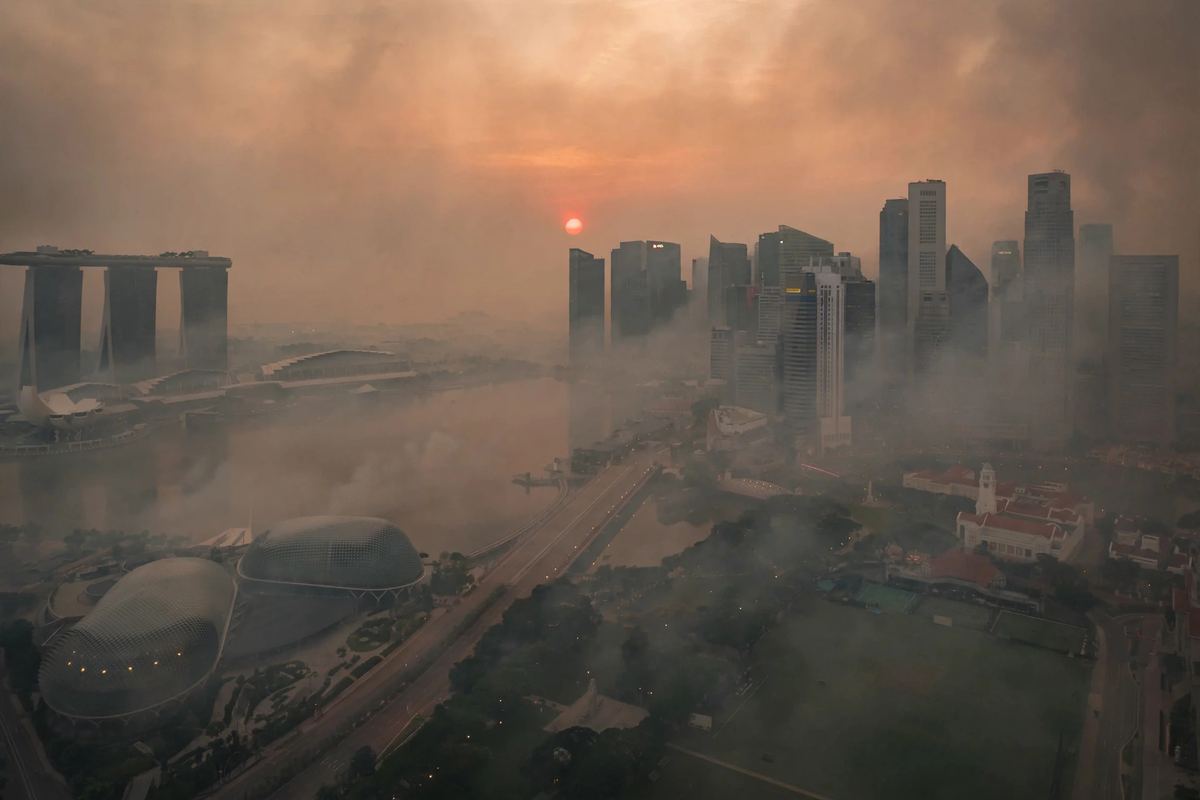
Singapore is escalating its legal response to the worst transboundary haze episode in years. The National Environment Agency (NEA) has announced it will issue preventive notices to three more Indonesian companies linked to forest fires in Kalimantan, bringing to ten the number of firms targeted under the Transboundary Haze Pollution Act (THPA) within a fortnight. The move represents one of the most aggressive uses of the landmark 2014 law since it was passed.
The announcement, made over the weekend of October 19–20, 2026, comes as smoke from Indonesian forest fires continues to drift across the Strait of Malacca, pushing Singapore's air quality into the Unhealthy range for days. It also follows a warning from Singapore's Coordinating Minister for National Security, K. Shanmugam, that companies behind the smog "should not underestimate the Singapore government's determination to act" — and a striking new economic estimate that this year's haze season could cost Singapore between S$3.2 billion and S$3.9 billion.
Background: how transboundary haze works
The haze is an almost annual phenomenon in Southeast Asia. During the dry season, fires — many deliberately set to clear land for plantations — burn in Indonesia's Sumatra and Kalimantan. When the land is peat, the problem becomes far more severe. Dried peat can smoulder underground for weeks, releasing enormous quantities of thick smoke that is carried by monsoon winds across the Strait of Malacca to Singapore, Malaysia and beyond.
Singapore has lived with this cycle for decades. The worst episode, in 2015, blanketed the city-state in smoke for weeks, pushed the Pollutant Standards Index (PSI) into the Hazardous range, forced school closures and grounded outdoor events. The economic damage was estimated at around S$1.83 billion. Frustrated by repeated episodes, Singapore's parliament passed the Transboundary Haze Pollution Act in 2014 — one of the first laws in the world to make it a criminal offence for any entity, anywhere in the world, to conduct activities that cause or contribute to haze pollution in Singapore.
The Act gives the NEA power to issue preventive notices requiring companies to take steps to stop the burning, and to prosecute those that fail to comply. For background on how this season's crisis developed, see Singapore's Haze Crisis: 15 Days of Unhealthy Air and What's Next and Indonesia's Peatland Wildfires: Worst Season Since 2015 Chokes Southeast Asia.
What happened: ten companies now in the net
The three newest companies named by the NEA are PT Buana Megatama Jaya, PT Mananjung Hayak and PT Baratama Putra Perkasa, all linked to the forest fires raging in Kalimantan, the Indonesian part of Borneo. The notices they will receive are known as preventive measures directions. In practice, the companies are required to deploy firefighting personnel, stop any open burning, and submit detailed action plans explaining how they will extinguish fires on their land and prevent new ones.
They follow seven companies targeted the prior week — all described as pulpwood suppliers in Sumatra. That means within roughly two weeks, the NEA has moved against ten firms, the fastest expansion of enforcement under the THPA since the law took effect. Companies that fail to comply with a preventive notice can face prosecution, with penalties that include heavy fines.
The NEA's action is being mirrored in the corporate world. The Singapore Exchange (SGX) has separately sought information from seven Singapore-listed agricultural companies about possible links between their operations and the fires — a sign that investors and regulators are scrutinising corporate exposure to haze-linked plantations.
The S$3.9 billion question: what the haze costs
A report by Eco-Business published during the episode estimates that the 2026 haze could cost Singapore between S$3.2 billion and S$3.9 billion — more than double the estimated S$1.83 billion cost of the 2015 crisis. The damage spans several channels:
- Tourism: fewer arrivals and shorter stays as travellers postpone trips to a city shrouded in smoke.
- Cancelled events: outdoor concerts, sporting events and the marquee events that fill Singapore's calendar lose ticketing revenue, broadcast value and visitor spending.
- Healthcare: respiratory illnesses, asthma flare-ups and emergency visits rise when PSI climbs into the Unhealthy range and beyond.
- Productivity: construction, logistics and other outdoor-heavy sectors slow down as workers limit exposure, while school closures pull parents away from work.
Whether the final bill lands near S$3.2 billion or S$3.9 billion will depend largely on how long the smoke lingers — which is itself a function of firefighting progress in Indonesia and the direction of the winds.
Why it matters: deterrence and diplomacy
K. Shanmugam's remarks captured Singapore's framing of the crisis: the smog is "entirely preventable" and driven by profit-seeking companies rather than nature alone. That framing is deliberate. The THPA was designed to change corporate incentives — to make it more expensive for companies to let fires burn on their concessions than to invest in prevention and firefighting. Expanding enforcement to ten companies signals that Singapore intends to use the law as a deterrent, not merely a symbolic gesture.
The move also has a diplomatic dimension. Indonesia's senior security minister, Dudung Abdurachman, said on Monday that the Indonesian government will not declare a national disaster over the fires for now — a position that suggests Jakarta believes the situation, however serious, remains manageable under provincial-level responses. Singapore's unilateral legal action proceeds regardless, operating under its own statute rather than waiting for Indonesian enforcement outcomes.
The human impact extends beyond Singapore. Schools in the Malaysian state of Johor, just across the causeway, were ordered closed from October 19 to 23 because of the haze — a reminder that the smoke respects no borders, and that the region's schoolchildren, elderly and outdoor workers bear much of the health burden.
Key facts
- 10 companies targeted: seven Sumatra pulpwood suppliers (notices issued the prior week) plus three Kalimantan-linked firms — PT Buana Megatama Jaya, PT Mananjung Hayak and PT Baratama Putra Perkasa.
- The law: the Transboundary Haze Pollution Act (2014) lets Singapore take action against entities anywhere in the world whose activities contribute to haze in Singapore.
- What the notices require: deploy firefighting personnel, stop burning, and submit action plans to the NEA.
- Air quality: the 24-hour PSI reached 88–114 (Moderate to Unhealthy) on October 19; the NEA forecast a range of 90–160 for October 20.
- Estimated cost: S$3.2–3.9 billion for the 2026 haze season, per Eco-Business — more than double the ~S$1.83 billion estimated cost of the 2015 episode.
- SGX scrutiny: the Singapore Exchange asked seven Singapore-listed agricultural companies for information about possible fire links.
- Johor schools: closed October 19–23 due to haze.
What happens next
The immediate question is whether the three newly named companies will comply with the preventive notices. Under the THPA, failure to comply can lead to prosecution in Singapore's courts, though actually bringing a case against an Indonesian company operating in Indonesia raises obvious questions about enforcement and jurisdiction — the law's reach has always been its boldest and least tested feature.
On the meteorological front, the NEA has warned that smoke haze could return on Tuesday night as prevailing winds shift. The 24-hour PSI forecast of 90–160 for October 20 means Singaporeans should expect air quality to hover between Moderate and Unhealthy, with vulnerable groups — children, the elderly, and those with heart or lung conditions — advised to reduce prolonged outdoor activity.
The deeper question is structural. The THPA was passed in 2014, yet twelve years later the fires still burn and the smoke still drifts. Singapore's legal pressure is a tool, but lasting prevention depends on fire management, peatland restoration and land-use enforcement in Indonesia itself. Until those pieces fall into place, Southeast Asia's haze season is likely to remain a recurring bill measured in billions — and in breaths.