
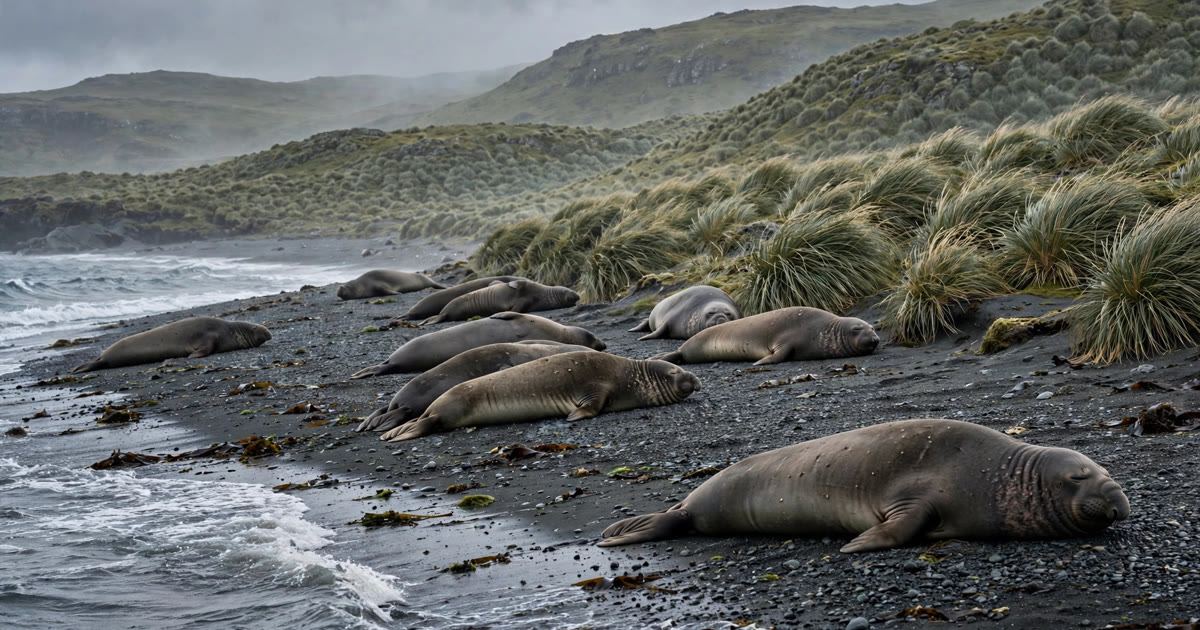
Australia has confirmed that the deadly H5N1 bird flu virus has reached Macquarie Island, one of the most important wildlife sanctuaries in the Southern Ocean. On Saturday 17 October 2026, the country's Chief Veterinary Officer, Beth Cookson, said official testing had confirmed the highly pathogenic virus in samples collected from an elephant seal and a kelp gull on the island, marking the first H5 event on Macquarie Island. The announcement was carried by Reuters and picked up by news outlets around the world. The story is trending per news coverage.
The news was expected, but it was dreaded all the same. Macquarie Island is a key breeding ground for southern elephant seals, and the animals are acutely vulnerable to this virus. According to the Australian federal government, the mammals — which can weigh up to 3,600 kilograms, nearly four tonnes — are particularly susceptible to H5 bird flu, with pup mortality rates in some cases above 90 percent. With the breeding season approaching, experts have warned that a significant elephant seal mortality event is likely. The question now is not whether the virus will spread through the colony, but how much damage it will do.
What was confirmed on Macquarie Island
The confirmation is narrow in its facts and large in its implications. Two samples tested positive: one from a southern elephant seal, one from a kelp gull. Both are species that live cheek by jowl on Macquarie's crowded beaches, and both are part of the dense, interlocking web of life that makes the island so ecologically rich — and so exposed to a virus that moves between birds and mammals.
Cookson described the finding as the island's first H5 event. That phrasing matters. It means the virus had not previously been confirmed on Macquarie, even though it has been closing in for months. In August, Australia's environment department said it would withdraw personnel from the research station on Macquarie Island because of the "psycho-social risk to expeditioners of a potential H5 avian influenza outbreak." Expert assessments at the time predicted the virus would likely cause a significant elephant seal mortality event during the upcoming breeding season. Saturday's confirmation turns that feared scenario into a live one.
Macquarie Island itself is no ordinary patch of land. It is a UNESCO World Heritage-listed territory lying in the Southern Ocean, roughly halfway between the Australian state of Tasmania and Antarctica. It is one of the very few places on Earth where the planet's geological machinery is visible at the surface — the island is formed of oceanic crust pushed up above the waves — but it is best known for its wildlife. Millions of seabirds and seals crowd its shores, including vast colonies of king penguins, royal penguins and fur seals alongside the elephant seals. A virus that kills pups in large numbers does not just threaten one species; it strikes at the heart of an ecosystem that has been protected for more than a century.
The Heard Island warning: 13,000 seal pups dead
The reason scientists are so alarmed is that they have already watched this exact disaster unfold once before, on another Australian sub-Antarctic territory. In late 2025, H5N1 was detected on Heard Island and McDonald Islands, about 4,000 kilometres south-west of mainland Australia. What followed was one of the worst wildlife mortality events ever documented in the region.
Scientists from the Australian Antarctic Program surveyed Heard Island by drone on two voyages, in October 2025 and January 2026, and finalised their findings in June 2026. Samples from nine vertebrate species were tested at CSIRO's Australian Centre for Disease Preparedness, and six species tested positive for the globally spreading strain, influenza A H5N1 clade 2.3.4.4b: southern elephant seal, king penguin, gentoo penguin, Antarctic fur seal and the South Georgia diving petrel among them. The drone surveys estimated total pup production at around 17,000 southern elephant seal pups — and island-wide pup mortality at around 13,000. Average pup mortality in the final October surveys was 76 percent, reaching as high as 97 percent in one area. By January, widespread pup mortality had been found in every surveyed breeding area, including at McDonald Island.
Genetic analysis suggested the virus reached Heard Island via wildlife travelling from the French Crozet Islands, roughly 1,800 kilometres away, around August 2025. The likely carriers were seabirds such as the southern giant petrel — birds that range across thousands of kilometres of empty ocean, and that also visit Macquarie Island. The same pathway, scientists warned, could carry the virus onward to Macquarie Island, New Zealand, mainland Australia and East Antarctica. That warning has now been borne out at Macquarie.
One critical unknown from Heard Island still hangs over Macquarie. The drone surveys counted dead pups — animals born that season, with no prior immune exposure and little ability to move away from a contaminated colony. What they could not establish was the toll on breeding adults. Senior scientist Jarrod Hodgson said the impact on the breeding adult population was the great unknown: a colony can recover from one catastrophic pup season if its breeding adults survive, but not if adults are also dying in large numbers. That question will shape how scientists read whatever happens on Macquarie in the months ahead.
A virus that has conquered the planet
H5N1 is not a new virus, but the strain now circling the globe is behaving in ways that have alarmed scientists for years. The highly pathogenic H5 family has been known since 1959, when it was first detected in domesticated chickens in Scotland. The H5N1 strain now dominant was first identified in domesticated waterfowl in southern China in 1996. It re-emerged in 2003 and spread through Asia, Africa and Europe, carried by migrating wild birds.
The current panzootic — a pandemic in animals — took hold in Europe in 2020 and has since killed millions of birds and mammals. It reached North America in late 2021, South America soon after, and the sub-Antarctic in late 2023. In South America, tens of thousands of seals died. At South Georgia, elephant seal colonies were hit hard in early 2024. In Antarctica itself, the virus was confirmed in skuas and a kelp gull, meaning H5N1 had been detected on all seven continents. In June 2026, Australia became the last continent to report bird flu, when infected petrels and a skua were found on beaches along the country's southern coastline — birds believed to have migrated from Antarctic breeding grounds.
The virus's reach into mammals is what makes this outbreak different from earlier bird flu waves. The clade 2.3.4.4b strain has infected an extraordinary range of species, from foxes and bears to dairy cattle and domestic cats, and genetic mutations observed in some samples show increased adaptation to mammals. Documented mammal-to-mammal transmission remains limited, and the risk to people is assessed as low: human infections remain rare, and most recorded cases have involved close contact with infected poultry. But every new mammalian host is another roll of the evolutionary dice, which is why wildlife agencies track the virus's spread through seal and sea lion colonies so closely.
Why Macquarie Island is so exposed
Macquarie's vulnerability is a direct consequence of its richness. Southern elephant seals breed in dense colonies on open beaches, with pups packed together in the first weeks of life, when they are most fragile. Seabirds — gulls, skuas, petrels, penguins — nest, feed and scavenge in the same small coastal strip. A virus that spreads through droppings, respiratory secretions and contaminated carcasses finds few barriers in such a setting. Scavengers that feed on dead birds can carry it onward; seals hauled out shoulder to shoulder pass it between themselves.
The island's remoteness cuts both ways. It has kept Macquarie free of many of the pressures that damage wildlife elsewhere — there are no cities, no farms, no roads through the colonies. But it also means that once the virus arrives, there is no realistic way to intervene at scale. There is no mass vaccination programme for wild seals, no way to quarantine a beach of ten thousand animals, and no hospital for wildlife on an island 1,500 kilometres from the nearest city. The tools available are monitoring, biosecurity and restraint: keeping people out of the way, limiting the movement of equipment and clothing between colonies, and documenting what happens so the next island has a better warning.
The withdrawal of research station personnel in August was a measure of how seriously Australian authorities take that risk — to the animals, and to the people who work among them. Expeditioners on Macquarie live in close quarters and work daily around the colonies; an outbreak among the seals would have been distressing to witness and difficult to manage. That decision, taken two months before the virus was confirmed, now looks like prudent preparation rather than overreaction.
What happens next
The immediate task is surveillance. Scientists will be watching the elephant seal breeding season for the first signs of elevated pup mortality, using the same drone survey methods that documented the Heard Island die-off, along with ground counts and sampling where it can be done safely. The kelp gull finding is a reminder that the virus is not confined to one species: gulls and skuas range widely and can carry infection between colonies and islands, so monitoring will cover seabirds as well as seals.
Beyond Macquarie, the confirmation sharpens the focus on Antarctica itself. Macquarie sits on the doorstep of the Antarctic region, and the seabirds that carried the virus there also travel to East Antarctica. The Antarctic ecosystem — penguin colonies numbering in the hundreds of thousands, seal populations with no evolutionary history of this virus — is the largest naive population left in the path of the panzootic. Every island that falls extends the bridge the virus can walk across.
There is also a longer question about recovery. Southern elephant seals are long-lived, slow-reproducing animals; females typically produce a single pup a year. A colony that loses most of a season's pups can recover if its adults survive, but repeated bad seasons compound. If Macquarie follows the Heard Island pattern — pup mortality above 90 percent in the worst-hit areas — the island's seal population will carry the scar for years. Researchers will be watching not just this breeding season but the ones after it, counting returning females and pups, to learn whether Macquarie's colony bends or breaks.
For now, the confirmation is a milestone of a grim kind: the virus that has now reached every continent has claimed another of the planet's great wildlife refuges. Macquarie Island survived sealing, rabbits, rats and cats over the past two centuries, and was painstakingly restored to a pest-free haven. Its next test is one no fence or eradication programme can keep out — a virus carried on the wings of the very birds the island was protected to shelter. Disease outbreaks are straining health systems worldwide this month, and Oceania has already seen one outbreak spill across borders, but the Macquarie case is a reminder that the ecological toll of a spreading virus can be just as severe. As with the fight to protect the Amazon, the lesson is that hard-won conservation gains can unravel fast. Sources: Reuters (17 October 2026), reporting by Sam McKeith; Nine News Australia (17 October 2026); Australian Antarctic Program via phys.org (18 June 2026); Bioscience Today; BritBrief.
Cross-species infections are a growing concern — in France, the Shamonda virus, previously seen only in livestock, has been detected in a human for the first time.
Flu viruses are straining health systems on land too: Japan's flu season started five weeks early, with a peak still ahead.