
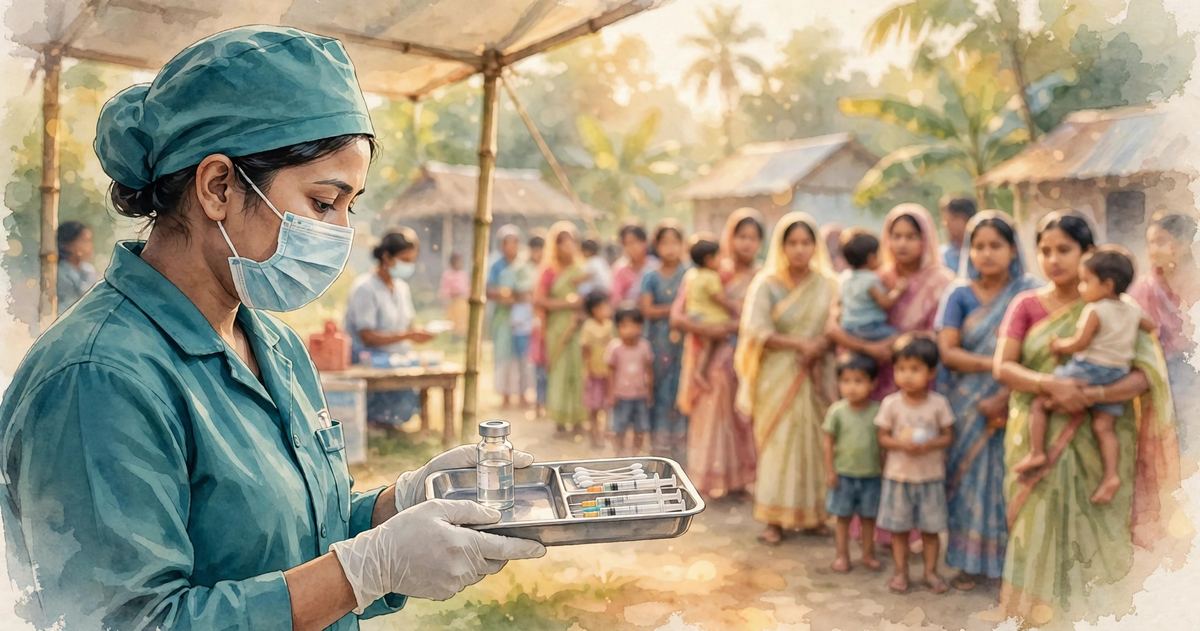
Bangladesh is battling the world's worst measles outbreak, a crisis that has killed more than 1,100 people — almost all of them young children — since it began in mid-March. The scale of the outbreak, and the reason it happened, have made it a story with implications far beyond one country: health experts say it is a warning to every nation where vaccination coverage has slipped. The story is trending per news coverage, after a new Reuters investigation published on 17 October 2026 laid out how weak data, missed children and a faltering immunisation programme allowed a preventable disease to explode.
The numbers are stark. According to the World Health Organization, Bangladesh reported about 202,000 suspected measles cases — 22,000 of them confirmed in a laboratory — between the start of the outbreak in mid-March and 9 October. That is more suspected cases than any other country in the world this year. In the same period, 1,147 people died, and 94% of those deaths were among children under five years old.
Bangladesh's own health directorate reports even higher figures, because it counts more recently and counts suspected deaths alongside confirmed ones. In its update on 16 October, the Directorate General of Health Services (DGHS) recorded five more children dying with measles-like symptoms in the previous 24 hours, taking the combined toll of confirmed and suspected measles-related deaths to 1,186. Of that total, 104 deaths were confirmed as caused by measles, while 1,082 involved children who died with measles-like symptoms. In the same 24-hour period, 1,164 new suspected cases were reported, bringing the nationwide tally of suspected cases to 211,040, with 22,972 laboratory-confirmed infections. Since 15 March, about 187,615 patients with suspected measles have been hospitalised, and 180,002 had recovered.
The two sets of figures do not contradict each other; they measure different things over different periods. The WHO figures reflect cases and deaths attributed to measles up to 9 October. The DGHS figures are a running national count that includes deaths where measles was suspected but not laboratory-confirmed — a common situation in an outbreak moving faster than testing capacity. What both counts agree on is the central fact: this is the largest measles outbreak anywhere in the world right now, and it is killing children who should have been protected by a vaccine that costs less than two dollars for two doses.
How a preventable disease came back
Measles was close to being under control in Bangladesh. The country had nearly reached the vaccination coverage needed to stop the virus spreading, and it had not run a nationwide measles campaign since 2020 partly because routine immunisation was thought to be holding the line. Then, in 2025, the routine programme faltered and coverage dropped. Exactly how far it fell is contested — one widely reported account puts routine coverage for eligible children at just 59% in 2025 — but the direction is not in dispute: enough children missed their shots to leave a large and growing pool of susceptible children, and the virus found them.
Reporting has linked the collapse to a disruption in vaccine supply. In September 2025, according to that reporting, the government halted measles-rubella vaccine procurement through UNICEF and switched to an open tender process that stalled amid bureaucratic delays, leaving clinics short of stock. The government reinstated procurement through UNICEF in April 2026, but by then the outbreak was already racing through communities. A Supreme Court lawyer has filed a complaint with Bangladesh's Anti-Corruption Commission alleging corruption and procurement failures, and the removal of vaccination coverage data from official websites has drawn criticism from health advocates. These are allegations and reported accounts, not established findings, but they describe the same basic failure: a working vaccine supply chain was interrupted, and children paid for it.
The Reuters investigation added a second, quieter failure: data that left out millions of children. When health authorities do not know how many children exist in a district, or which of them have been vaccinated, they cannot find the ones who were missed. The review of WHO documents and interviews with more than a dozen scientists, health workers and officials found that the emergency response was hampered by incomplete data, shortcomings in preparation and a failure to reach enough parents. In an outbreak where speed is everything, not knowing where the unvaccinated children are is nearly as dangerous as not having the vaccines.
The outbreak has spread to 58 of Bangladesh's 64 districts. Early reports traced its beginnings to crowded conditions where immunisation gaps already existed, and from there it moved quickly through cities, towns and villages. Children under five — most of them unvaccinated — account for the overwhelming majority of cases and deaths, according to WHO figures. That age pattern is the signature of a vaccination failure: measles hits hardest exactly where immunity is thinnest.
Why measles spreads so fast
Measles is one of the most contagious diseases known. One infected person can spread the virus to 12 to 18 susceptible people in an unvaccinated population. It travels through the air in respiratory droplets, and the virus can linger in the air for up to two hours — meaning someone can be infected simply by entering a room where an infected person has recently been, even after that person has left. There is no specific antiviral treatment for measles; care focuses on relieving symptoms and treating complications.
The illness typically begins 7 to 14 days after exposure with fever, cough, runny nose and red, watery eyes — symptoms easily mistaken for a common cold. The characteristic blotchy rash appears a few days later. For most people the illness is miserable but survivable. For a minority, it turns dangerous: complications include pneumonia, encephalitis (inflammation of the brain), loss of sight or hearing, and death. Children under five and people who are malnourished face the highest risk. Measles can also weaken the immune system for months or even years afterwards, a phenomenon known as immune amnesia, leaving survivors more vulnerable to other infections. Rarely, it causes a devastating brain condition years after infection.
That is why the threshold for stopping measles is so high. About 95% of a population needs to be immune to interrupt transmission — a level known as herd immunity. Below that threshold, the virus keeps finding susceptible people, and outbreaks grow exponentially. The measles-mumps-rubella (MMR) vaccine is highly effective: one dose provides roughly 93% to 95% protection, and two doses raise that to about 97% to 99%. Even in the rare cases where a vaccinated person becomes infected, the illness is typically much milder. Vaccines of this kind have been in use for more than 50 years, and during 2000–2023 measles vaccination saved an estimated 60 million lives worldwide, according to the US Centers for Disease Control and Prevention.
Those facts are what make the Bangladesh outbreak so frustrating to public health experts. The tools to prevent it existed, were cheap, and were already in use in the country. What failed was the system that delivers them — the procurement, the data, the outreach — and the failure was predictable once coverage began to fall. As one WHO vaccine adviser put it, preventing an outbreak through vaccination is easier, cheaper and safer than responding to an emergency.
The emergency response
The response began in earnest in April 2026, when the government launched an emergency measles-rubella vaccination campaign. The first phase targeted about 1.3 million children in 30 sub-districts across 18 high-risk districts, and the campaign then rolled out nationwide. In an unusual step, the WHO advised giving one additional vaccine dose to all children in the target age group regardless of whether they had been vaccinated before, to build a rapid wall of immunity. Every child with suspected or confirmed measles was also given vitamin A, a simple supportive treatment that lowers the risk of severe illness and death. District rapid response teams were activated, hospitals added isolation beds, and weekly situation reports began flowing.
On 26 September, health authorities launched a nationwide catch-up campaign aiming to reach 3.4 million children aged 6 to 59 months over about a month, with support from UNICEF and the United States. The campaign lowered the usual minimum vaccination age to reach infants faster. UNICEF, the WHO and Gavi, the global vaccine alliance, have backed the response, and organisations such as Save the Children have run community awareness drives, including door-to-door visits and work with mothers' groups and schools, to encourage families to register their children and bring them for vaccination.
But experts warn that the epidemic will not be contained quickly. Children generally need three to four weeks after vaccination to develop sufficient immunity, so infections, hospitalisations and deaths from exposures that have already happened can continue for weeks after a campaign begins. The virus is already widespread, and reaching the last unvaccinated children — the ones missed by routine services and by earlier campaigns — is the hardest part of any outbreak response. Reporting in mid-October suggested the wave could continue for at least another month.
Why this is a warning to the whole world
Bangladesh is the extreme case, but it is not an isolated one. Measles is resurging in many parts of the world as vaccination coverage slips below the 95% threshold. New Zealand is dealing with an outbreak described as unprecedented, which has already spilled into Australia, and outbreaks have been reported across dozens of countries this year. The causes vary — pandemic disruption, political instability, misinformation, complacency, supply failures — but the mechanism is always the same: when coverage falls, measles returns, and it returns first and hardest among children.
That is the lesson health officials want the world to take from Bangladesh. A vaccination programme is not a one-time achievement; it is a system that has to be maintained every year, for every new cohort of children. Interrupt the supply chain for a few months, lose track of a few million children in the data, or let a campaign lapse, and the immunity gap opens silently. By the time the outbreak is visible in hospitals, thousands of children are already infected. The same pattern — a health system under strain, and a preventable disease exploiting the gap — has played out in other outbreaks this year, including Ebola in Congo.
For parents and communities, the practical message is simpler. Vaccines work by training the immune system to recognise a pathogen before it is encountered in real life, and the measles vaccine is among the most effective and best-tested vaccines in existence. Children who have missed scheduled doses can still catch up, and health authorities urge families to book a catch-up appointment as soon as possible rather than waiting for the next campaign to reach them. In an outbreak, a few weeks of delay can matter.
What to watch next
Three things will determine how this crisis unfolds. First, the daily DGHS updates: whether new suspected cases and deaths are still rising, plateauing, or beginning to fall will show whether the September catch-up campaign is bending the curve. Second, the reach of that campaign itself — whether it actually finds the children missed by routine services, including those outside official registries. And third, accountability: whether the investigation into the procurement failure produces answers, and whether Bangladesh rebuilds its routine immunisation system so that the next cohort of children does not face the same risk.
Bangladesh's outbreak is a tragedy measured in children's lives. It is also a test of a simple proposition: that a disease we know how to prevent should not be killing more than a thousand children in a single year. Whether the world treats it as a warning, or as a preview, depends on what happens to vaccination coverage everywhere else. Sources: Reuters (17 October 2026), citing WHO figures; The Business Standard, citing DGHS data, 16 October 2026; WHO measles guidance; UCSF and US CDC measles explainers; UNICEF / US Embassy Dhaka campaign reporting (per news coverage, October 2026).