
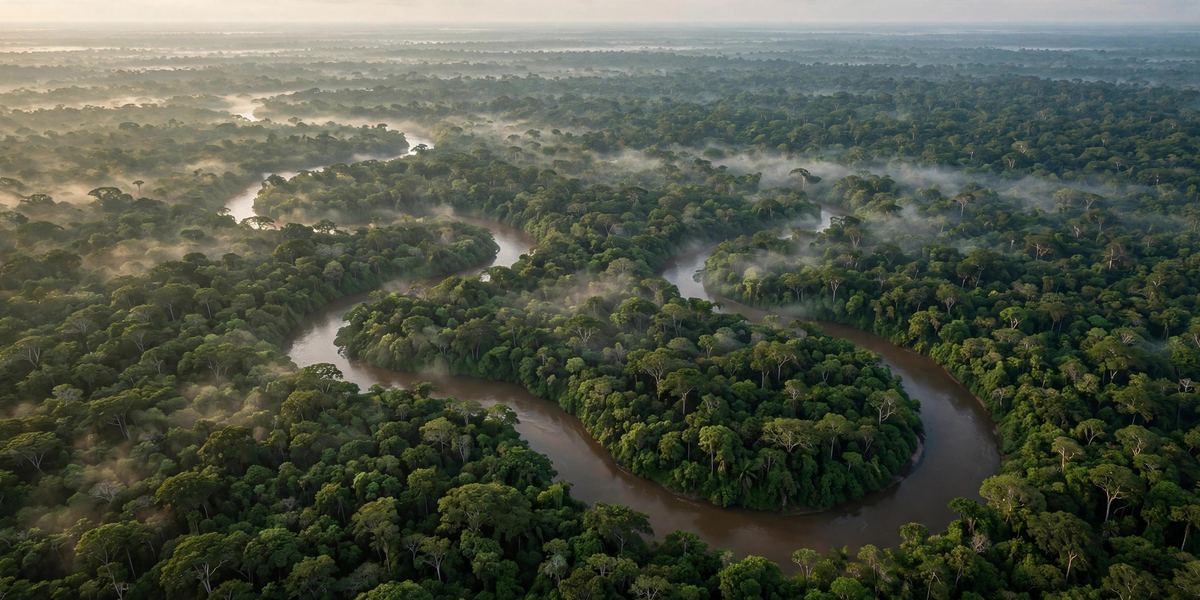
Brazil's Amazon rainforest has just recorded its lowest annual deforestation level since official satellite monitoring began in 1988, a result that is trending per news coverage around the world. According to data released on Friday, 16 October 2026 by Brazil's National Institute for Space Research (Inpe), the Amazon lost 3,335 square kilometres of forest in the twelve months from August 2025 to July 2026, a drop of about 42 percent compared with the previous year. The announcement lands barely a week before a presidential election runoff in which the future of the rainforest is one of the central dividing lines.
The figure matters far beyond Brazil. The Amazon is the world's largest tropical rainforest, home to an extraordinary share of the planet's species, and a vast store of carbon. About 60 percent of it lies within Brazil, so what happens to the forest there shapes the global fight against climate change. A record-low deforestation year is therefore a genuinely significant milestone, even though scientists and campaigners are quick to add that one good year does not mean the forest is safe.
The numbers behind the record low
Inpe's PRODES satellite monitoring programme measured 3,335 square kilometres of Amazon forest loss between August 2025 and July 2026. That is the smallest annual total in a series that stretches back to 1988, beating the previous record low of 4,571 square kilometres set in 2011–12. For comparison, in the mid-1990s, annual Amazon deforestation reached nearly 30,000 square kilometres a year, roughly nine times the current level.
The neighbouring Cerrado savanna also improved. Clearing there fell by about 24 percent to around 5,517 square kilometres, the lowest level in a monitoring series that goes back to 2001. The Cerrado is a vast tropical savanna south and east of the Amazon, and although it receives less international attention, it is one of the most biodiverse savannas on Earth and a major carbon store in its own right.
The Brazilian government also says Amazon deforestation has fallen by roughly 71 percent since 2023. That longer-term comparison uses a different baseline from the year-on-year figure, and the two numbers should not be confused: the 42 percent drop describes one year against the last, while the 71 percent describes the change since the current administration took office.
How the deforestation figures are measured
The annual numbers come from PRODES, Inpe's long-running programme that maps clear-cutting from satellite images. PRODES measures each year from August to July because there is less cloud cover over the Amazon in the middle of the year, giving satellites a clearer view of the forest floor. The programme distinguishes outright clearing from other forms of damage, which is important: deforestation, fire activity and forest degradation are different measures, and a low clear-cutting total does not capture every kind of harm.
Alongside PRODES, Brazil runs DETER, a near-real-time alert system that flags fresh clearing as it happens so enforcement teams can respond within weeks rather than months. The government has approved R$147.6 million from the Amazon Fund for a project called SIM-Biomas, which will merge PRODES and DETER, automate image analysis with machine learning, extend near-real-time alerts to all of Brazil's biomes, and produce fire maps at 30-metre resolution. The idea is to close the gap between spotting destruction from space and stopping it on the ground.
What changed under President Lula
President Luiz Inácio Lula da Silva took office in January 2023 pledging to end deforestation by 2030, after forest loss had climbed to its highest level in 15 years. One of his first moves was to revive the Action Plan for the Prevention and Control of Deforestation in the Legal Amazon, known by its Portuguese acronym PPCDAm. The plan was first launched in 2004 during Lula's earlier presidency and had been shelved under his predecessor.
PPCDAm rests on four pillars: strengthening monitoring and enforcement; promoting a sustainable economy in the Amazon region; managing protected areas and deciding how undesignated public forests should be used; and using regulations and financial incentives to discourage clearing. In practice, the government restored satellite-based sanctions for illegal clearing, rebuilt environmental enforcement budgets, and increased field operations. Between 2023 and 2026, Brazil's environmental enforcement agency Ibama carried out 76,095 inspections and issued 25,101 infraction notices, according to figures released with the new data.
Lula brought back the officials who designed the original plan two decades earlier, including environmental campaigner Marina Silva, who led the environment ministry until she resigned in April to run for Congress. Her former deputy, João Paulo Capobianco, now holds the post. Capobianco described the new figures as "an absolutely stratospheric drop... it's like a dream", and said they prove that political will can halt illegal logging and cut greenhouse-gas emissions.
Marcio Astrini, executive secretary of the climate advocacy group Observatório do Clima, called the figures "a historic achievement" and said they show the world that "with political will, it is possible to curb deforestation and greenhouse gas emissions." On Friday, Lula reiterated his goal of zero illegal deforestation by 2030 in a post on X. The government credits the sustained policy shift — restored monitoring budgets, a reactivated PPCDAm and more field enforcement — for the steep declines since 2022, though attributing the entire reduction to any single policy would oversimplify the result.
The Bolsonaro years in context
The record low is best understood against what came before it. Under former president Jair Bolsonaro, who governed from 2019 to 2022, Amazon deforestation surged by about 60 percent, with more than 17,400 square miles of forest cleared over his four-year term, according to official data. His administration promoted mining in indigenous lands, cut resources for forest protection, and halted the practice of sanctioning illegal clearing detected by satellites — a tool specialists consider one of the most effective deterrents.
Lula reversed those policies and saw deforestation rates fall to a six-year low during his first year back in office. The new data extends that trend to its lowest point in nearly four decades of monitoring. Supporters of the government present it as proof that enforcement works; critics note that deforestation had already begun falling from its peak and argue that commodity prices, weather and other forces also shape clearing rates.
Why the timing matters: the 25 October runoff
The announcement comes just over a week before Brazil's presidential runoff on 25 October, in which Lula faces Senator Flávio Bolsonaro, the eldest son of the former president, in a race that polls suggest is neck-and-neck. The rainforest's future is a central issue in the contest, and the two candidates offer sharply different visions for the Amazon.
Flávio Bolsonaro performed better than expected in the first round and has pledged in his manifesto to strengthen environmental oversight in the Amazon, prioritising the areas under the greatest pressure from deforestation and wildfires. He says law enforcement would focus on organised crime rather than on extractive workers and small farmers, and has promised to fight organised crime in the Amazon. His critics argue that his father's record speaks louder than the manifesto; his supporters say the pledge shows a break from it.
For Lula, the record-low figures are a powerful campaign argument: evidence that his government delivered on its signature environmental promise. For his opponents, the timing of the release — days before the vote — invites scepticism, and some analysts caution that official statistics can be framed to favour an incumbent during an election cycle. The underlying satellite data comes from Inpe, a respected scientific institution, but the political framing around it is inevitably contested. Readers wanting the full election picture can find it in our guide to Brazil's 2026 election runoff.
Why the Amazon matters for the global climate
Tropical rainforests like the Amazon are home to millions of species. In a healthy state, they absorb vast quantities of planet-warming carbon dioxide, helping to keep the Earth cool. When forest is cleared — usually by burning or felling to make way for cattle pasture, soy fields or mining — that stored carbon is released, and the land loses its ability to absorb more. Deforestation is therefore both a biodiversity crisis and a climate crisis, and it is one of the largest sources of greenhouse-gas emissions in Brazil. Our explainer on what climate change is, what causes it and what can be done about it sets out how forest loss fits into the wider picture.
The Amazon also generates much of its own rainfall, recycling moisture through the trees in a process sometimes called a "flying river" that carries water deep into South America's interior. Scientists warn that if deforestation passes a tipping point, large parts of the rainforest could shift toward drier savanna-like conditions, releasing enormous amounts of carbon and disrupting rainfall across the continent. That is why each year's deforestation total is watched so closely, and why a record low is treated as globally significant news.
What the record low does not mean
A record-low clear-cutting figure is not the same as a forest free from harm. Recent fires in parts of the Amazon have disrupted daily life, and officials are investigating their causes. Fire can damage forest that satellites classify as standing, and degraded forest — thinned by logging, drought or repeated burning — stores less carbon and shelters fewer species even when it is not fully cleared.
The geography of loss is also uneven. Deforestation remains concentrated: the states of Pará, Mato Grosso and Amazonas together accounted for roughly 75 percent of Amazon loss in the latest period. In the Cerrado, clearing is led by the Matopiba frontier states such as Maranhão and Tocantins, where much of the loss is legally authorised under Brazil's Forest Code, which allows landowners to clear a proportion of native vegetation. That means tackling the Cerrado will require different tools from tackling illegal clearing in the Amazon — including land-use rules, credit conditions and incentives for farming on already-cleared land.
Experts also warn that better monitoring only reduces clearing if enforcement turns remote detections into sustained field action. A satellite alert is only useful if inspectors reach the site, fines are collected and illegal operations are shut down. The durability of the current gains will depend on whether the next government — whoever wins on 25 October — keeps funding enforcement, protects Inpe's independence and closes the loopholes that allow legal clearing to eat away at the Cerrado.
What happens next
Three dates will shape the forest's near future. The first is 25 October, when Brazilians choose between two competing visions for the Amazon. The second is the start of the next PRODES monitoring year, whose early DETER alerts will show whether the downward trend is holding. The third is the international climate calendar: Brazil's deforestation record will be a centrepiece of its climate diplomacy, and the credibility of its pledges will be judged against whether the numbers keep falling after the election.
For now, the headline stands on its own: after decades in which the Amazon's destruction seemed almost unstoppable, Brazil has recorded the smallest annual forest loss since monitoring began. It is a reminder that deforestation is a policy choice as much as a natural inevitability — and that the choices made in Brasília over the coming months will echo far beyond Brazil's borders. Individuals can also make a difference: our guide on how to reduce your carbon footprint covers the everyday steps that add up.
Sources: BBC News; Reuters; RTE; DW; Inpe (PRODES satellite monitoring programme); Observatório do Clima.