
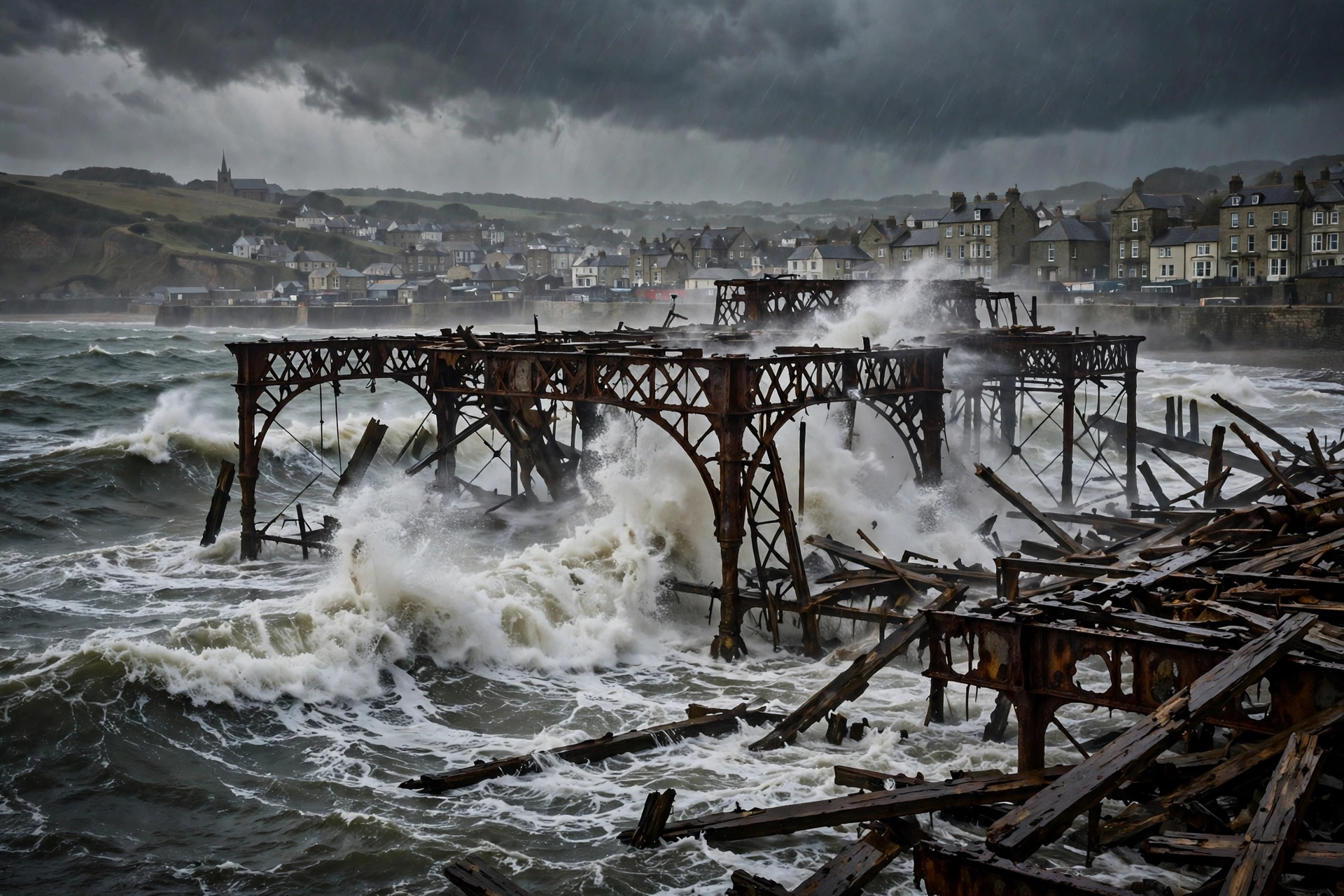
The Storm Austen Boelo UK story unfolded over a single stormy week in late October 2026, when two named storms hit the United Kingdom in quick succession and exposed how vulnerable coastal infrastructure, power networks and transport can be to autumn weather. The Met Office named Storm Austen on 20 October 2026 and Storm Boelo on 22 October 2026, a naming sequence that itself signalled a busy period for forecasters. Austen struck first, battering the south coast on Friday 23 October, with gusts of about 80 miles per hour reported in exposed coastal areas. Tens of thousands of homes lost power, roads and rail services were disrupted, and in Brighton a much-loved landmark suffered a dramatic loss. Part of the historic West Pier fell into the sea on 23 October, an event captured on video by local resident Simon Haffenden and shared widely online. Boelo then brought a second wave of disruption, with amber wind warnings for northern parts of the UK, rain warnings for the south-east, ferry cancellations and airport disruption. Together, the two storms raised a wider question that the Prime Minister had already flagged: whether the UK faces a winter of greater flooding, and how prepared homes, businesses and infrastructure really are.
Background to Storm Austen Boelo UK
To understand the Storm Austen Boelo UK episode, it helps to know how storms are named and why autumn storms can be so damaging. The Met Office, together with its Irish and Dutch counterparts, names storms when they are expected to cause medium or high impacts, so that warnings are easier to communicate and the public can prepare. Austen and Boelo were named only two days apart, which meant forecasters, emergency services and utility companies were dealing with overlapping warnings, rest periods and repair work. Autumn storms in the UK often combine strong winds, heavy rain and high tides, and when those factors coincide, the risks multiply. Wind can bring down trees and power lines, rain can saturate ground and overwhelm drains, and high tides and large waves can attack sea defences and piers. Brighton's West Pier is a powerful symbol of that vulnerability. Opened in 1866 as a Victorian pleasure pier, it closed in 1975 and has been derelict for decades. It was badly damaged by arson attacks in 2003 and had already suffered earlier partial collapses, leaving a skeletal iron structure standing in the sea off Brighton beach. It was not a working pier, but it remained an iconic silhouette, photographed by millions of visitors and locals, and its gradual decay had long been a subject of local debate about heritage, safety and cost.
What happened during Storm Austen Boelo UK
During the Storm Austen Boelo UK week, Austen made its impact felt first on the south coast on Friday 23 October. Gusts of about 80 miles per hour were reported, and the storm brought down trees, damaged roofs and disrupted travel. Power networks were hit hard. National Grid reported that it had restored power to more than 124,000 properties since the start of the storm, a figure that shows both the scale of the outage and the scale of the repair effort. At one stage, about 31,000 homes in the South West were without power, while about 18,000 homes lost power in another affected area, including about 13,000 in Cornwall. Those numbers changed as the storm moved and as engineers worked through the night, but they underline a familiar pattern: coastal and rural networks, with long overhead lines exposed to wind and falling trees, are often the first to fail and the hardest to repair quickly. In Brighton, the most visible damage was to the West Pier. Part of the derelict structure fell into the sea on 23 October, captured on video by Simon Haffenden. The footage showed a section collapsing into the waves, a stark reminder that a structure already weakened by fire, rust and previous collapses could not withstand another major storm. Access around the pier was closed off, and safety warnings were issued, because debris, unstable ironwork and rough seas made the area dangerous. There is no new restoration plan for the pier, and local discussion has focused on safety and on what, if anything, should happen to the remaining structure. Boelo then followed, bringing amber wind warnings for northern UK areas, a yellow rain warning for Brighton, Sussex, London and the south-east on Saturday, with 25 to 30 millimetres of rain expected in places, and further travel disruption.
Why Storm Austen Boelo UK matters
The Storm Austen Boelo UK episode matters because it connects heritage, infrastructure and climate risk in a single, visible story. The West Pier collapse is sad for Brighton, but it is also a warning about other coastal structures. Piers, sea walls, harbours and promenades across the UK were built in a different climate era, and they now face stronger storms, higher sea levels and more frequent wave attack. Maintaining them is expensive, and deciding whether to restore, protect, demolish or let nature take its course involves heritage bodies, councils, engineers, insurers and local communities, none of whom can make the decision alone. Power outages matter too, because they affect vulnerable people most: older residents, people who rely on medical equipment, families with young children, and small businesses that lose stock and trade. The fact that National Grid restored power to more than 124,000 properties shows the system can recover, but the experience of being without power, sometimes for hours, is disruptive and frightening. Travel disruption during Boelo also showed how interconnected the UK and Ireland are. Ferry operators including CalMac, StenaLine, Irish Ferries and P and O cancelled sailings, Dublin Airport saw cancellations, and the Royal National Lifeboat Institution issued warnings about dangerous sea conditions. When ferries and flights stop, island communities, freight and holidaymakers are all affected, and the economic cost spreads far beyond the coast. The Prime Minister's warning about a possible winter of greater flooding adds a policy dimension, because it suggests government is preparing the public for a season in which flooding, not just wind, may be the main risk.
Key facts about Storm Austen Boelo UK
The key facts of the Storm Austen Boelo UK week are worth stating clearly. The Met Office named Storm Austen on 20 October 2026 and Storm Boelo on 22 October 2026. Austen battered the south coast on Friday 23 October, with gusts of about 80 miles per hour reported. National Grid restored power to more than 124,000 properties since the storm began, while at one stage 31,000 homes in the South West were without power and about 18,000 homes lost power including about 13,000 in Cornwall. Part of Brighton's West Pier, opened in 1866, closed in 1975, damaged by arson in 2003 and already partly collapsed, fell into the sea on 23 October, filmed by local resident Simon Haffenden. There is no new restoration plan, access has been closed off and safety warnings remain in place. Boelo brought amber wind warnings for northern UK, a yellow rain warning for Brighton, Sussex, London and the south-east on Saturday, with 25 to 30 millimetres of rain forecast, and travel disruption including ferry cancellations by CalMac, StenaLine, Irish Ferries and P and O, cancellations at Dublin Airport, and a warning from the RNLI. The Prime Minister warned of a possible winter of greater flooding. Readers should note that power figures are snapshots during a moving event, and different reports may cite different totals depending on the time and region covered. The overall picture, however, is consistent: two storms, widespread power loss, a landmark collapse, and significant transport disruption across the UK and Ireland.
What happens next after Storm Austen Boelo UK
After the Storm Austen Boelo UK week, several things will happen in parallel. Engineers will continue to inspect power networks, clear fallen trees and repair damaged lines, and councils will assess roads, sea defences and public spaces for storm damage. In Brighton, officials will need to decide how to manage the remaining West Pier structure safely, whether that means further closures, monitoring, removal of dangerous sections, or a longer-term heritage discussion. Any decision will need to balance public safety, cost, environmental impact and the strong emotional attachment many people feel to the pier's silhouette. For households, the next step is practical preparation for winter. That means checking flood risk for your postcode, signing up for flood warnings where available, keeping torches, charged phones and warm clothing ready during severe weather warnings, and knowing how to report a power cut. For businesses, especially in coastal tourism, fishing and transport, the storms are a reminder to review insurance, contingency plans and supply chains before winter. At a national level, the conversation about flooding will continue. If the winter does bring greater flooding, as warned, investment in flood defences, drainage, nature-based solutions such as wetlands and tree planting, and better planning for new homes will be debated again. Storms Austen and Boelo will not be the last named storms of the season, and the lessons from this week, about warnings, power resilience, coastal heritage and travel planning, will be tested again soon. Related coverage includes record king tides flooding Florida, Storm Austen's deadly floods in southern France and Cyclone Arnab in the Bay of Bengal.