
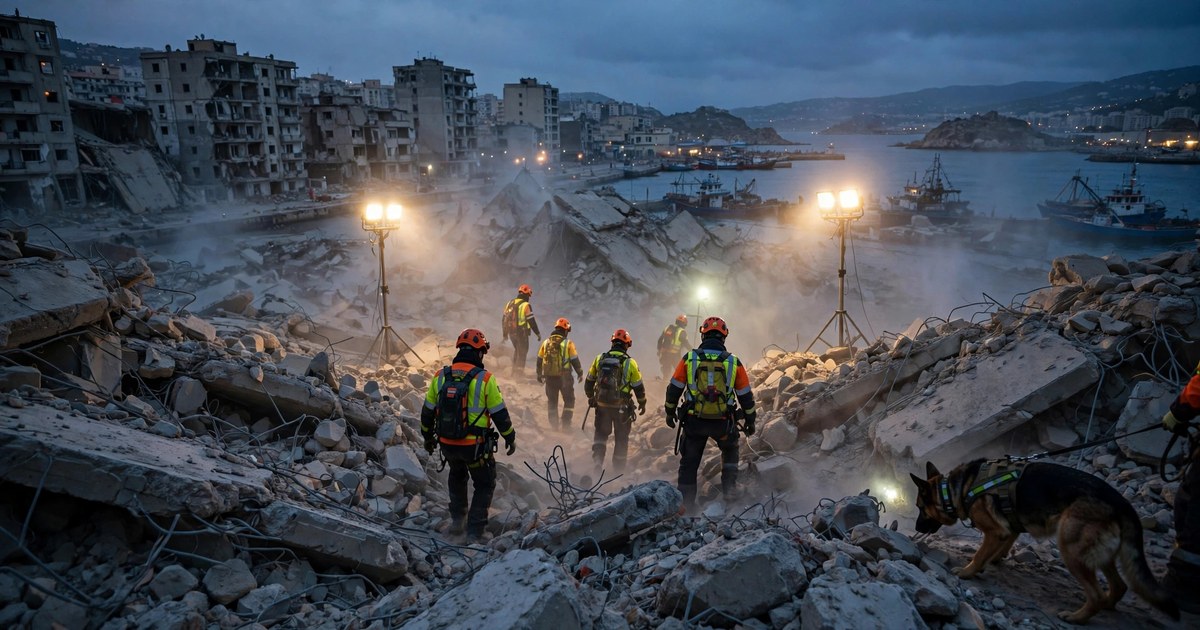
Trending per news coverage: the Venezuela earthquake has killed at least 1,450 people after twin earthquakes of magnitude 7.2 and 7.5 struck the country's northern coast on Wednesday, 28 October 2026. The two quakes hit 39 seconds apart, flattening buildings across the coastal state of La Guaira, injuring more than 3,000 people and leaving tens of thousands reported missing, as rescue teams from around the world race through the rubble. Four days on, the official death toll is still rising, the 72-hour window for finding survivors alive has passed, and Venezuela's acting president has vowed the search will go on.
What Happened in the Venezuela Earthquake?
The first quake, magnitude 7.2, struck at 6:04 p.m. local time on Wednesday, 28 October, near the coastal city of Morón, at a depth of 22 kilometres, according to the U.S. Geological Survey (USGS). Just 39 seconds later, a second and more powerful quake, magnitude 7.5, erupted 45 kilometres away at a depth of only 10 kilometres. Seismologists classified the event as a rare earthquake doublet, and the USGS described it as Venezuela's strongest earthquake since the 7.7-magnitude quake of 1900.
Shaking was felt across northern Venezuela, including in the capital, Caracas, about two million of whose residents are among the up to 6.8 million people the International Organization for Migration estimates may have been affected. The coastal state of La Guaira suffered the worst destruction: more than 770 buildings had partially or totally collapsed by Sunday, twice as many as were reported destroyed or damaged on Friday, and more than 70,000 families have been affected. Hundreds of aftershocks have continued to rattle damaged neighbourhoods, including a magnitude 4.8 tremor on Saturday and quakes measuring 4.2 and 4.5 on Sunday morning.
Venezuela Earthquake Death Toll: 1,450 Dead and Thousands Reported Missing
The official death toll has climbed steeply as rescuers reach new areas. Authorities reported 235 dead on Thursday and 589 on Friday, before the figure climbed past 900 later on Friday and reached 1,430 late on Saturday and 1,450 on Sunday afternoon, according to the Associated Press. More than 3,000 people have been injured, and officials have warned the toll is likely to rise further.
The number of missing is far harder to pin down. More than 50,000 people have been reported missing on a citizen-run database set up by families to find loved ones, though the figure is unverified and includes people cut off by failed phone networks as well as those trapped under rubble. Families had listed 68,900 people as missing on Saturday, while the government has spoken of hundreds missing or trapped. The confusion underlines how badly communications have been damaged in the worst-hit areas.
Foreign nationals are among the dead. Spanish media, citing the Foreign Ministry, reported that four Spanish citizens were killed and 106 remained unaccounted for, while Portugal confirmed the death of one of its citizens and Brazil said two Brazilians had died. Among the victims was a young mother who died saving her toddler daughter when their apartment building collapsed, and the Venezuelan Football Federation confirmed that two football players were among those killed.
Why Two Quakes Struck Seconds Apart: What Is an Earthquake Doublet?
An earthquake doublet is a pair of large earthquakes that strike almost simultaneously on neighbouring faults. In the Venezuela earthquake, the second quake fired before the shaking from the first had ended, so buildings were hit by two waves of violent movement in under a minute. The shallow depths — 22 kilometres for the first quake and only 10 for the second — made the shaking at the surface far stronger than a deeper quake of the same magnitude would have caused.
The October disaster is the second such doublet to hit Venezuela this year. On 24 June 2026, twin quakes of the same magnitudes, 7.2 and 7.5, struck the same region, killing more than 6,300 people and displacing tens of thousands; about 24,000 people were still living in temporary shelters four months later, according to ReliefWeb. The two events are separate disasters, but together they have left Venezuela's northern coast facing one of the worst seismic crises in its history.
Rescue Efforts in La Guaira as the 72-Hour Window Passes
Rescue teams in the Venezuela earthquake pulled 33 people alive from collapsed buildings on Saturday, including a man and his son freed by a U.S. team from Virginia, an 11-year-old boy found by a Colombian team after a scanner detected him about 10 feet below the surface, and another 11-year-old rescued by Mexican crews in Caraballeda. Earlier, U.S. rescuers pulled a nine-month-old infant alive from the rubble along with her mother; both suffered only minor injuries.
But the odds of finding survivors fall sharply after about 72 hours under rubble, a mark that passed on Saturday evening, according to Swiss rescue-team leader Sebastian Eugster, speaking to Reuters. More than 2,600 rescue workers from around the world had arrived by Sunday, with trained search dogs and machinery, and acting President Delcy Rodríguez said on Sunday night that the search would continue even though the threshold had passed.
More than 14,000 members of the military and police are now patrolling La Guaira state, where access is blocked and special permits are required to enter. The government has faced criticism that its response was inadequate and was overshadowed by civilian-led efforts to rescue people buried under collapsed buildings. Hospitals in the region are under severe strain: one hospital anesthesiologist in La Guaira described "tons of patients" arriving as local people brought in supplies.
International Aid and Rescue Teams in Venezuela
Search-and-rescue teams responding to the Venezuela earthquake have arrived from the United States, Mexico, Colombia, France, Brazil and El Salvador, among others. Urban search and rescue teams from Virginia, California and Florida were dispatched on Friday, and the U.S. Southern Command has deployed personnel and equipment to support the international effort. Rodríguez has declared a nationwide state of emergency and announced a presidential commission to assess damage to homes and confirm whether it is safe for people sleeping on the streets to return.
Why So Many Buildings Collapsed in La Guaira
The devastation in the Venezuela earthquake was concentrated in La Guaira because the quakes were shallow, struck in quick succession, and hit a densely built coastline of apartment blocks, hotels and public housing. Entire buildings pancaked — floors collapsing straight down onto one another — leaving little space for survivors. The pattern repeated across the state: multi-storey concrete buildings that were never designed to withstand two major shocks in under a minute. The scale of the destruction will take years to repair.
Venezuela Earthquake: What Happens Next
With the survival window closed after the Venezuela earthquake, the focus is shifting from rescue to shelter, recovery and accounting for the missing. Roughly 3,000 people are living in shelters, according to Venezuelan authorities, and the housing commission must now decide which damaged buildings are safe to re-enter. Aftershocks remain a danger, and the death toll is expected to keep rising as teams clear the rubble. For families still waiting for news, the citizen-run missing-persons databases remain the main hope of tracing loved ones — and a reminder of how much of the toll is still unknown.
Related reading on Worldlession: Vanuatu Earthquake 2026: 6.9 Magnitude Quake Sparks Tsunami Warning, Bhutan Glacial Lake Outburst Flood October 2026: 10,000 Evacuated, Spain Train Crash Investigation 2026: Signalling Failure, 69 Dead, What We Know and Congo Ebola Outbreak Passes 10,000 Cases in 2026.