
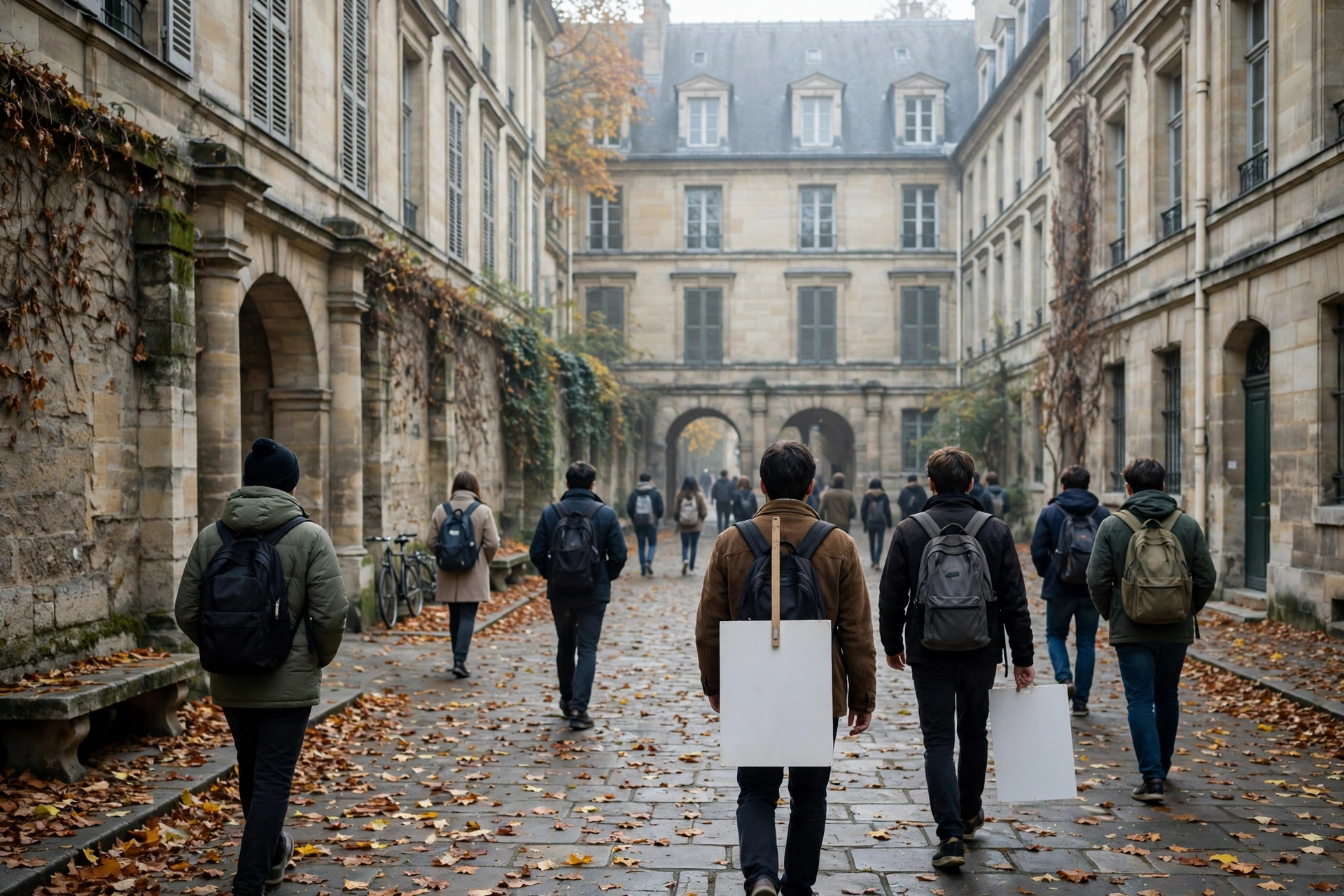
France will replace Parcoursup, its national online university admissions platform, by 2028, the government announced on Monday, in the most significant concession yet to weeks of student protests over education funding and the cost of living. Higher Education Minister Philippe Baptiste said the platform would undergo substantial change for the 2027 admissions round, before being replaced the following year by a new and simpler system.
The announcement followed a meeting between Prime Minister Sebastien Lecornu and representatives of high school and university students, and came after France's worst unrest in years on 17 October, when demonstrations over school funding and living costs descended into rioting and looting across the country. Groups of protesters set fires, looted shops, clashed with police and stormed public buildings, including Marseille's City Hall, while the town hall in Limoges was set ablaze and its roof and clock tower collapsed. About 2,400 people were arrested in connection with the demonstrations, in which hundreds of thousands marched peacefully.
What Replacing Parcoursup by 2028 Means for Students
Parcoursup handles applications to universities and other higher-education courses for more than one million people each year. Students have long criticised it as opaque and unfair, arguing that its unclear selection criteria put applicants from disadvantaged backgrounds at a disadvantage and caused heavy psychological stress. It became a central demand of the protest movement, alongside calls for more teachers, smaller classes and more university places.
The government said a committee would be set up to design the replacement, with recommendations expected by the end of November. Several changes are under consideration, the education ministry said, including a revision of the rules for taking continuous assessment into account and access to a new, AI-powered guidance tool that would draw on the results of previous campaigns to help each high school student make choices consistent with their academic path and aspirations. From June 2027, applicants will also receive an explanation for each rejection, a transparency measure students have long requested.
For the 2027 round, the existing platform will be revised rather than scrapped outright. Ministers stressed that the reform is a deep transformation rather than a simple rebranding. Student groups, however, remain sceptical. L'Union Etudiante, a union representing university students, described the measures as crumbs and vowed to continue demonstrations, while two high school groups welcomed some concessions but called for protests to continue.
The 5 Changes in France's Education Concessions Package
First, Parcoursup itself: substantial change in 2027, replacement in 2028, with published selection criteria and explanations for rejections. Second, places: 15,000 additional higher-education places between 2027 and 2028, far fewer than the 250,000 extra places some student groups have demanded, but a concrete expansion nonetheless.
Third, grants: university scholarships will be linked to inflation from the start of the 2027 academic year. Compared with 2026 levels, scholarship recipients will receive an additional 37 million euros in funding from 2027, rising to 121 million euros in 2028 and 220 million euros in 2029. Fourth, class sizes: first-year high school classes will be capped at 28 pupils in the poorest half of schools, extending to all high schools the following year, alongside 500 new teaching positions in some accounts of the package.
Fifth, buildings: up to 4 billion euros in low-interest loans for school renovations, alongside 1 billion euros for university campus repairs by 2029. The regions, which are responsible for high school buildings, have said they do not want to borrow more, which may complicate delivery of that part of the package.
Why the Protests Went Beyond Parcoursup
The movement began with secondary school pupils protesting teacher shortages and poor conditions, with a teachers' union survey finding more than half of schools faced staffing shortages this academic year. University students then joined, calling for Parcoursup to be abolished and for more funding for universities. The movement has since widened to include workers demanding relief from rising living costs, making the government's task tougher than simply resolving a dispute over admissions.
A second nationwide round of demonstrations on the Saturday after 17 October drew lower levels of violence. Official police figures estimated attendance at more than 400,000, while organisers claimed nearly 800,000 participants. The gap between those figures is itself part of the political contest over the movement's scale and legitimacy.
What Happens Next in the France Student Protests
The immediate test is whether the concessions calm the streets or whether demonstrations continue, as student groups have promised. The committee designing the Parcoursup replacement reports by the end of November, and the 2027 admissions round will be the first practical test of the promised transparency. Longer term, the government must show that extra places, indexed grants and smaller classes are actually delivered, and that the building loans reach schools that need them.
For students applying in the next two cycles, the practical advice is to watch the published criteria and the new rejection explanations from June 2027, and to use the guidance tools the ministry promises. For the government, the risk is that a concession seen as too small hardens rather than softens the movement. The coming weeks will show whether replacing Parcoursup is remembered as a turning point or as a first step that was not enough.
How Parcoursup Became a Symbol in France
Parcoursup was introduced in the late 2010s to replace an earlier admissions system, with the aim of matching applicants to courses more transparently and of reducing the lottery-like allocation that had frustrated students. In practice, many students experienced it as a black box: they submitted ranked wishes, received responses that seemed hard to predict, and struggled to understand why they had been accepted to one course and rejected from another. For pupils in schools with fewer resources, that opacity felt like a further disadvantage, because families with more knowledge of the system could game it more effectively. Over successive admission rounds, grievances accumulated, and Parcoursup became shorthand for a wider sense that the education system was rationing opportunity rather than expanding it. That history explains why a technical platform became a political demand: abolishing or replacing Parcoursup was a concrete, understandable ask in a movement that also raised broader questions about funding, staffing and living costs. The government's promise of published criteria and explanations for rejections from June 2027 directly addresses the opacity complaint, even if students dispute whether the scale of the accompanying funding is enough.
Related reading: France protests in October, Serbia student election, France-Germany budget clash.