
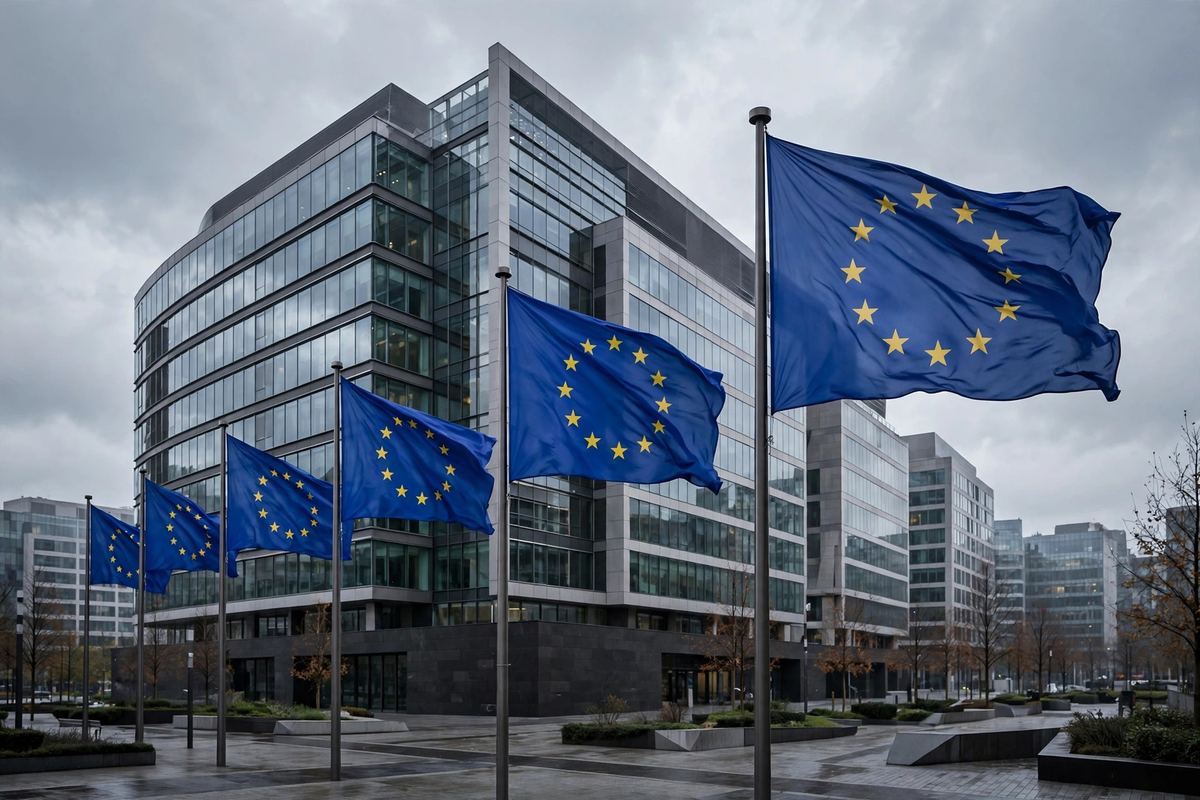
What the EU budget is — and why it matters
Every seven years, the European Union negotiates a long-term budget known as the Multiannual Financial Framework, or MFF. The MFF sets the ceiling for how much the EU can spend in total, and how much it can spend on each broad policy area, for a full seven-year cycle. It is not a single annual budget document but a framework: each year's detailed spending is decided inside the ceilings the MFF sets. Because the MFF locks in priorities for nearly a decade, every round of negotiation becomes a major political event.
The EU budget is funded mainly through contributions from member states, calculated largely from each country's gross national income, along with smaller own resources such as customs duties. The current framework covers 2021–2027 and totals roughly €1.2 trillion. Negotiations for the next cycle, 2028–2034, are now underway — and the stakes are high. The money pays for agriculture subsidies, regional development, research, climate programmes, border management, and increasingly, defence and security.
Budget negotiations are among the most sensitive in Brussels because they touch sovereignty. Every euro in the common pot is a euro a national government cannot spend at home, and every spending priority is a political choice about what the Union is for. That tension between national control and shared ambition is at the heart of the current dispute.
How EU budgets get negotiated
The process begins with the European Commission, which publishes a detailed proposal for the next MFF. The proposal then goes to the Council, where the governments of the member states negotiate. Crucially, the MFF requires unanimity: every single member state must agree before the framework can be adopted. That gives each country, large or small, a veto — and it is why budget talks can drag on for months or even years, often culminating in marathon summit sessions.
The European Parliament also plays a formal role and must consent to the final package, which gives it leverage over spending details. Once adopted, annual budgets are negotiated within the MFF ceilings. The unanimity rule is a defining feature of how the EU exercises collective power: it makes agreement hard, but it also makes the outcome broadly legitimate, since no member state is outvoted on how its money is pooled. For a broader look at how collective decision-making works in democracies, see what is democracy and how it works.
The €2 trillion proposal and the fault line
The European Commission has proposed a budget of approximately €2 trillion for the 2028–2034 cycle — roughly 60 percent larger than the current €1.2 trillion framework. The Commission's case is that the Union faces a new set of demands, from strengthening European defence and border security to financing industrial competitiveness and the green and digital transitions, and that the old budget simply cannot cover them.
That headline figure immediately exposed a deep divide. On one side stands Germany, together with five other net contributor countries — Austria, Denmark, Finland, the Netherlands, and Sweden. These governments argue the proposal is far too large and want roughly €400 billion cut from it. Their position reflects a long-standing philosophy among net contributors: that the EU budget should be restrained, that national budgets already carry heavy burdens, and that the Union should spend more efficiently rather than simply spending more.
On the other side stands France, which opposes the cuts. President Emmanuel Macron has said Europe needs an ambitious budget to fund defence and competitiveness, arguing that a diminished budget would leave the Union unable to meet the strategic challenges of the decade. For France, the question is not whether Europe can afford a bigger budget, but whether it can afford not to have one.
What a "net contributor" means
A net contributor is a member state that pays more into the EU budget than it receives back in EU spending. Germany is the largest net contributor in absolute terms, followed by France — both pay in far more than they get out. Others, including the Netherlands, Sweden, Austria, Denmark, and Finland, are also consistent net contributors relative to their economic size.
Net contributors tend to be the most budget-hawkish in negotiations, because they see the MFF as a direct cost to their national treasuries. Net recipients — countries where EU funding for agriculture, infrastructure, and regional development exceeds their contributions — generally favour larger budgets. This structural divide maps closely onto the current clash: the six countries pushing for €400 billion in cuts are all net contributors, while France, though itself a large contributor, is backing the ambitious option on strategic grounds.
The dynamic is a permanent feature of EU politics. In every MFF round, a group of frugal net contributors pushes for restraint while others press for spending, and the final number is a compromise hammered out under the unanimity rule. Inflation has also quietly sharpened the debate: because the MFF is negotiated in current prices, inflation erodes what a fixed ceiling can actually buy over seven years, making both the hawks' restraint and the doves' ambitions harder to satisfy.
Why defence spending is driving the debate
Defence is the sharpest new pressure on the EU budget. The EU was not built as a military organisation, and for most of its history defence barely featured in the MFF. But a changed security environment has pushed European governments to spend more on their militaries, on joint procurement, and on the industrial base that produces weapons and equipment. The Commission's proposal reflects the argument that security is now a genuinely European task that requires European money, not just national defence budgets acting in parallel.
France has been the loudest voice for that view. Macron's position is that European strategic autonomy — the ability of Europe to defend itself and to compete industrially with other major powers — requires the Union to invest at scale. Germany, while also increasing its own national defence spending substantially in recent years, has been more sceptical about expanding the EU budget itself, preferring that much of the defence effort stay within national budgets and bilateral or NATO frameworks.
This disagreement about the vehicle for defence spending — the EU budget versus national budgets — is the deeper fault line beneath the headline numbers. It is not only about how much Europe spends, but about where decisions get made and who controls the money.
A second Franco-German strain: the MGCS tank project
The budget dispute is not the only source of tension between Paris and Berlin. On 9 October 2026, France's armed forces chief, Fabien Mandon, told parliament that Berlin had decided to quit the joint MGCS (Main Ground Combat System) tank project, the programme under which the two countries were developing a next-generation battle tank together. Germany's defence ministry denied this, saying both countries had adjusted their cooperation and remain committed to the project.
The episode matters because it comes against the backdrop of the two countries scrapping their joint next-generation fighter jet project in June 2026 — a much larger and more symbolic defence collaboration that was abandoned after years of disagreements over work-sharing and leadership. Two flagship Franco-German defence programmes stumbling within months of each other has fuelled doubts about whether the two countries can still deliver joint military-industrial projects, even as both agree in principle that Europe needs stronger defence capabilities.
The MGCS disagreement remains contested: the French armed forces chief's statement and the German ministry's denial stand in tension, and the precise state of the cooperation is unclear. What is not in dispute is that the Franco-German relationship, historically the engine of European integration, is under unusual strain at the very moment the Union needs it to be functional.
What happens next in the negotiations
Under the unanimity rule, nothing can pass without both France and Germany on board — and without the other 25 member states too. The €2 trillion Commission proposal is the starting point, not the outcome: the Council will negotiate it down, line by line and priority by priority, and the frugal six's demand for roughly €400 billion in cuts sets the opening bid of one camp.
The likely path is a long negotiation, with national leaders setting the broad political direction at European Council summits while ministers and diplomats work through the technical detail. Past MFF rounds suggest the pattern: an initial period of posturing, a gradual convergence as the costs of failure become clear, and a final compromise struck under intense time pressure near the deadline. The current framework expires at the end of 2027, so the new one needs to be agreed well before then — the EU's institutions cannot function without a budget.
Two factors will shape the outcome. First, the defence question: if member states can agree on which defence tasks genuinely belong at EU level, the budget for them becomes easier to justify. Second, the Franco-German relationship itself: historically, when Paris and Berlin agree, a European deal usually follows; when they are divided, negotiations stall. Whether the two can bridge their budget positions — and rebuild trust on joint defence projects — will determine whether the next MFF is a step-change for the Union or another hard-fought compromise.
The bottom line
The EU's next seven-year budget is, on the surface, an argument about numbers: €2 trillion proposed, €400 billion in cuts demanded. Beneath it lies a deeper question about what the European Union is becoming — a restrained club that pools modest resources for shared tasks, or an ambitious political actor that funds its own defence and industrial strategy at scale. France has chosen the ambitious reading; Germany and its fellow net contributors the restrained one. With unanimity required and the clock ticking toward 2028, the negotiations ahead will test not just the Union's finances but its capacity to act as one.