
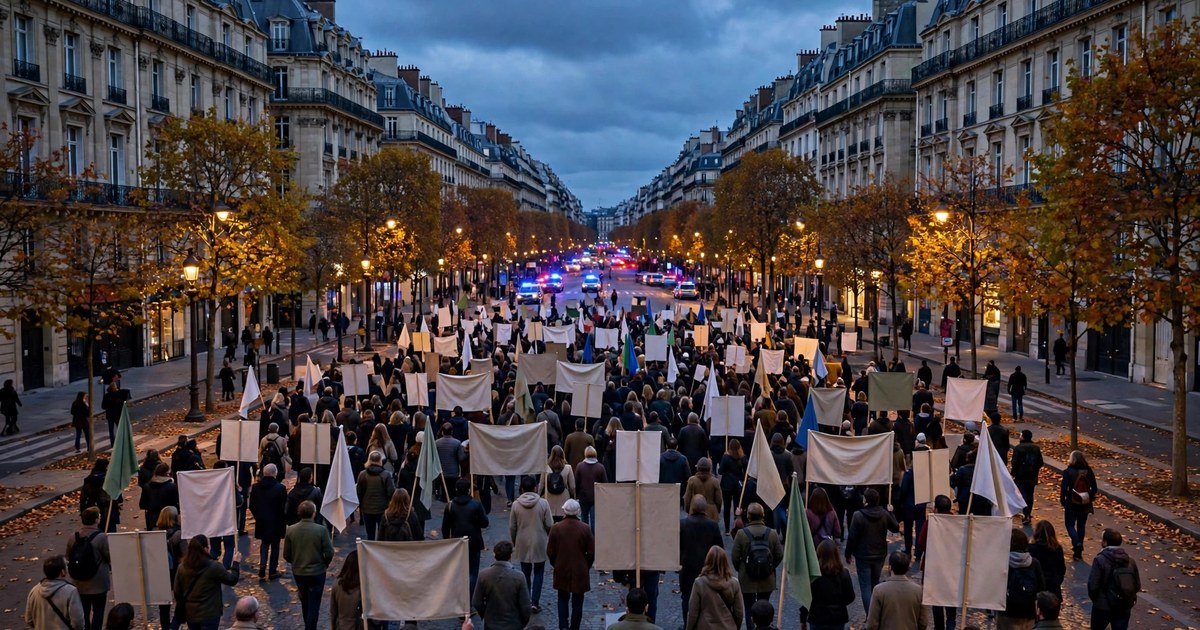
France protests October 2026 reached a new flashpoint on Saturday, October 24, as hundreds of thousands of people marched across the country over the rising cost of living and school funding — and nearly 1,000 people were arrested as largely peaceful demonstrations ended in clashes in Paris and other cities. The story is trending per news coverage across international outlets, with the BBC, the Associated Press and Euronews all leading on the scale of the turnout and the scale of the police response.
France's Interior Ministry said 410,000 people took part nationwide, including 110,000 in Paris. The CGT union, which helped organise some of the marches, put the figures far higher — nearly 800,000 across France and 250,000 in the capital. The gap between official and organiser estimates is normal for large French demonstrations, but on either count this was one of the biggest protest days of the year.
Authorities had deployed 70,000 security forces across the country, determined to avoid a repeat of the previous weekend's rioting and looting. Interior Minister Laurent Nuñez said nearly 1,000 people had been arrested by Saturday evening — and warned the figure would rise further. "As I speak to you, we are at nearly 1,000 arrests," Nuñez said at a briefing. "I believe this figure will increase significantly."
France protests October 2026: what happened on Saturday
The main Paris march began peacefully, running from Porte d'Italie towards Porte de Vincennes in the south-east of the capital, an area authorities had chosen to keep the demonstration away from the city centre. For most of the day the atmosphere was that of a traditional French protest: union banners, students, families and pensioners marching together over pay, pensions and public services.
Trouble broke out near the end of the march. Masked protesters hurled fireworks, rocks and other projectiles at police, smashed the windows of a car dealership and erected makeshift barricades. Police answered with clouds of tear gas, deafening sound grenades and jets of water cannon, and officers with megaphones urged the crowds to disperse. France 24 reported that the demonstration was eventually dispersed along the Cours de Vincennes, with a gendarmerie helicopter deployed to support ground units and locate remaining groups. Police said more than 500 rioters had been present towards the end of the demonstration.
Clashes were not confined to the capital. In Marseille, protesters set fire to barricades. In Bordeaux, demonstrators tore boards from a shopfront. Two people were seriously injured, according to Nuñez: one man in Toulouse, who reportedly had fingers blown off, and another person in Clermont-Ferrand. The Paris prosecutor's office said 64 people were arrested in the capital, with 40 remaining in police custody, including six minors.
The police operation included an elite unit normally tasked with tackling organised crime and counter-terrorism, a sign of how seriously the authorities took the threat of a second consecutive weekend of disorder. Riot police squads also fired tear gas in Lyon, Lille, Toulouse, Montpellier and Nantes.
Why are people protesting in France?
The immediate trigger for the current wave of unrest was education. The movement began last month in protest against staff shortages at a high school south-east of Paris, and students say teacher absences have disrupted classes for months. According to education ministry data cited in reporting on the protests, around 15.4 million teaching hours were affected by teacher absences in state middle and high schools in the 2024-25 academic year.
Student organisations are demanding more teacher appointments in schools and universities, increased scholarships and lower student housing rents. But the protests have grown far beyond the classroom. Workers and trade unions have joined in, citing rising fuel prices, inflation and stagnant pay, and the CGT has backed demands for price controls, higher wages and increased pensions.
That is why Saturday's marches carried such a mix of banners: students demanding better schools, workers demanding better pay, and pensioners demanding pension increases that keep pace with inflation. The common thread is the cost of living — food, fuel, rent and everyday bills rising faster than incomes. Readers following the longer arc of French unrest can also revisit our earlier explainer on the nationwide protests of October 17, when students, unions and Yellow Vest supporters first joined forces this autumn.
France protests October 2026: how this weekend compares with last weekend
Saturday's outcome was, in the government's words, more "positive" than a week earlier — but only by comparison with scenes officials described as some of the worst unrest in modern French history. Last weekend, rioting saw public buildings vandalised, hundreds of shops looted and 2,700 people arrested, with police at times outnumbered and businesses left exposed.
This time the authorities moved earlier and in greater numbers: more police on the streets, faster intervention, more pre-demonstration checks and tighter protection for businesses. President Emmanuel Macron had also decreed earlier in the week that authorities would permit only demonstrations organised by recognised trade unions. In recent days, courts have jailed hundreds of people for vandalism, arson and looting following expedited hearings.
Nuñez noted the contrast in arrest patterns: by the same time on the previous Saturday, 385 people had been arrested — a figure Saturday's near-1,000 had already far exceeded by evening, even as the overall disorder was contained more quickly. There has nevertheless been widespread anger at the crackdown itself, with trade unions and civil-liberties campaigners arguing that the restrictions amount to an assault on the right to protest.
Left-wing leader and presidential candidate Jean-Luc Mélenchon criticised the police response in Paris, and the debate over protest rights is now running in parallel with the economic grievances that brought people onto the streets in the first place.
Protests spread across Europe: Italy, Spain, Portugal, Albania and Belgium
France was the epicentre, but it was not alone. Europe is in the grip of a fresh wave of protests over the cost of living, pensions, housing, education, corruption and opposition to war, with demonstrations in France, Albania, Italy, Spain and Portugal — and a protest in Brussels as well. This is part of a wider continental pattern we have tracked as protests escalated across Europe earlier this month, and as cost-of-living protests spread through France, Belgium and Italy.
Italy saw some of the sharpest clashes. In Milan, Prime Minister Giorgia Meloni deployed 500 soldiers into the city, along with drone surveillance, railway station checks and rapid-response units. Protesters clashed with police in Rome, Turin and Florence, throwing bottles, stones and fireworks, and tearing down street signs. Italian police said they carried out nine arrests and briefly detained 371 people during protests in eight cities on Saturday, including 110 minors. The US Embassy in Italy put the country on high alert, urging Americans to avoid Piazza Duomo in Milan and major commercial streets.
In Spain, more than 25,000 people took to the streets in Madrid demanding pension reform — including linking pension increases to actual inflation, raising the minimum pension to match the minimum wage, closing the gender pension gap and protecting the public pension system from privatisation. In Barcelona, masked demonstrators smashed a glass kiosk and started fires in the streets.
Portugal's marches centred on affordable housing, with protesters in Lisbon holding up keys to demand action on rents; official figures show Portuguese house prices more than doubled between 2015 and 2024, rising much faster than the European Union average. In Tirana, Albania, students protested with fireworks, while in Brussels demonstrators gathered at Albertine Square against the federal government's economic policies, rising living costs and proposed budget cuts to social welfare programmes, before police intervened to end the protest.
What happens next: October 31 and the road to the presidential election
The unrest is not expected to end this weekend. Organisations associated with the Yellow Vest movement have called for another demonstration on October 31, and trade unions have vowed to keep opposing restrictions they see as curbs on free expression.
The political stakes are high. France goes to the polls in six months to choose a successor to Macron after 10 years in office, and the protests have become a test of his government's authority in its final phase. A movement that began over a single school's staffing shortages has become a national argument about living standards, public services and the right to protest itself.
For now, the key questions are whether the authorities' heavier security posture can keep future demonstrations peaceful, whether unions and the government can find any common ground on pay and pensions, and whether the October 31 mobilisation matches — or exceeds — the hundreds of thousands who marched on Saturday. What is clear from this weekend is that the grievances driving people onto the streets have not gone away, and neither, it seems, has their willingness to march.
Sources: BBC News, Associated Press, Euronews/ANI, France 24, France's Interior Ministry and Paris prosecutor's office statements as reported on October 25, 2026.